CAS 4362-40-7
:4-(Chlorométhyl)-2,2-diméthyl-1,3-dioxolane
Description :
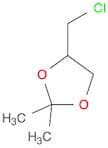
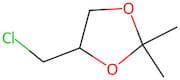
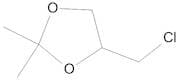
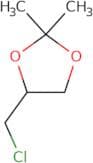
4-(Chlorométhyl)-2,2-diméthyl-1,3-dioxolane est un composé organique caractérisé par sa structure en anneau dioxolane, qui présente deux atomes d'oxygène dans un anneau à cinq membres. La présence d'un groupe chlorométhyle (-CH2Cl) en position 4 et de deux groupes méthyle en position 2 contribue à ses propriétés chimiques uniques. Ce composé est généralement un liquide incolore à jaune pâle avec une odeur distinctive. Il est soluble dans des solvants organiques et peut présenter une réactivité modérée en raison du groupe chlorométhyle, qui peut participer à des réactions de substitution nucléophile. La partie dioxolane est connue pour sa stabilité et est souvent utilisée comme groupe protecteur dans la synthèse organique. De plus, le composé peut avoir des applications dans la synthèse de produits pharmaceutiques ou d'agrochimiques, grâce à ses groupes fonctionnels qui peuvent faciliter d'autres transformations chimiques. Des précautions de sécurité doivent être prises lors de la manipulation de cette substance, car elle peut présenter des risques pour la santé si elle est inhalée ou ingérée.
Formule :C6H11ClO2
InChI :InChI=1/C6H11ClO2/c1-6(2)8-4-5(3-7)9-6/h5H,3-4H2,1-2H3/t5-/m1/s1
Code InChI :InChIKey=BNPOTXLWPZOESZ-UHFFFAOYSA-N
SMILES :C(Cl)C1OC(C)(C)OC1
Synonymes :- (4R)-4-(chloromethyl)-2,2-dimethyl-1,3-dioxolane
- (4S)-4-(chloromethyl)-2,2-dimethyl-1,3-dioxolane
- 1,3-Dioxolane, 4-(chloromethyl)-2,2-dimethyl-
- 1-Chloro-2,3-O-isopropylidenepropane
- Ai3-17556
- Brn 0104463
- 5-19-01-00085 (Beilstein Handbook Reference)
- 4-(Chloromethyl)-2,2-dimethyl-1,3-dioxolane
- (±)-4-(Chloromethyl)-2,2-dimethyl-1,3-dioxolane
- 4-Chloromethyl-2,2-dimethyl-1,3-dioxolane
- 4-(chloromethyl)-2,2-dimethyl-3-dioxolane
- 4-(CHLOROMETHYL)-2,2-DIMETHYL-1,3- DIOXOLANE 99%
- 4-(Chloromethyl)-2,2-dimethyl-1,3-dioxolane,99%
- 4-chloromethyl-2,2-dimethyl-3-dioxolane
- Voir plus de synonymes
Trier par
Degré de pureté (%)
0
100
|
0
|
50
|
90
|
95
|
100
5 produits concernés.
1,3-Dioxolane,4-(chloromethyl)-2,2-dimethyl-
CAS :Formule :C6H11ClO2Degré de pureté :98%Couleur et forme :LiquidMasse moléculaire :150.60334-(Chloromethyl)-2,2-dimethyl-1,3-dioxolane
CAS :4-(Chloromethyl)-2,2-dimethyl-1,3-dioxolaneDegré de pureté :96%Masse moléculaire :150.60g/mol4-Chloromethyl-2,2-dimethyl-1,3-dioxolane
CAS :Produit contrôléApplications 4-Chloromethyl-2,2-dimethyl-1,3-dioxolane is used in biosynthetic preparations.
Not a dangerous good if item is equal to or less than 1g/ml and there is less than 100g/ml in the package
References Spelberg, J.H., Tetrahedron, Asy., 10, 2863 (1999);Formule :C6H11ClO2Couleur et forme :NeatMasse moléculaire :150.60334-(Chloromethyl)-2,2-dimethyl-1,3-dioxolane
CAS :Formule :C6H11ClO2Degré de pureté :98%Couleur et forme :LiquidMasse moléculaire :150.64-Chloromethyl-2,2-dimethyl-1,3-dioxolane
CAS :4-Chloromethyl-2,2-dimethyl-1,3-dioxolane is a chemical compound that is used as a marker to identify the presence of fatty acids in plant tissues. It can be synthesized by reacting chloroacetaldehyde with methanol and sodium hydroxide. This compound has a cyclic structure and is chiral. It is also used for mass spectrometric analysis of fatty acid composition in plants. The synthesis of 4-chloromethyl-2,2-dimethyl-1,3-dioxolane involves four steps: (i) chlorination of acetaldehyde with sodium hypochlorite; (ii) hydrolysis of the resulting chloroacetaldehyde with methanol and sodium hydroxide; (iii) oxidation of the resulting chloroformate with hydrogen peroxide; and (iv) hydrolysis of the resulting 4-chloromethyloxymethanol with water.Formule :C6H11ClO2Degré de pureté :Min. 95%Masse moléculaire :150.6 g/mol