CAS 4385-91-5
:O-Méthylhomosérine
Description :
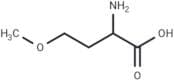
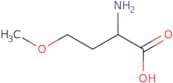
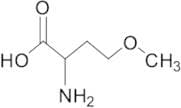
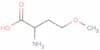
O-Méthylhomosérine, avec le numéro CAS 4385-91-5, est un dérivé d'acide aminé caractérisé par la présence d'un groupe méthyle attaché au groupe hydroxyle de l'homoserine. Ce composé est généralement classé comme un acide aminé non protéinogène, ce qui signifie qu'il n'est pas incorporé dans les protéines lors de la traduction. O-Méthylhomosérine est soluble dans l'eau en raison de ses groupes fonctionnels polaires, qui facilitent les liaisons hydrogène. Il joue un rôle dans diverses voies biochimiques, en particulier dans la synthèse de certains acides aminés et métabolites. Le composé est souvent étudié dans le contexte de la biochimie végétale et du métabolisme microbien, où il peut servir d'intermédiaire dans la biosynthèse de composés essentiels. Sa formule structurelle comprend un groupe hydroxyle, un groupe acide carboxylique et un groupe amino, contribuant à sa réactivité et à ses interactions dans les systèmes biologiques. Comme de nombreux dérivés d'acides aminés, O-Méthylhomosérine peut participer à diverses réactions chimiques, y compris l'esterification et l'amidation, ce qui le rend intéressant en chimie organique synthétique et en biochimie.
Formule :C5H11NO3
InChI :InChI=1S/C5H11NO3/c1-9-3-2-4(6)5(7)8/h4H,2-3,6H2,1H3,(H,7,8)
Code InChI :InChIKey=KFHRMMHGGBCRIV-UHFFFAOYSA-N
SMILES :C(C(O)=O)(CCOC)N
Synonymes :- 2-Amino-4-methoxybutanoic acid
- A 7572
- Butanoate, 2-Amino-4-Methoxy-, Calcium Salt (1:1)
- Butyric acid, 2-amino-4-methoxy-
- Butyric acid, 2-amino-4-methoxy- (8CI)
- Butyric acid, 2-amino-4-methoxy-, DL-
- DL-2-Amino-4-methoxybutanoic acid
- Homoserine, O-methyl-
- Methoxine
- Methoxinine
- Nsc 9325
- O-Methylhomoserine
- Voir plus de synonymes
Trier par
Degré de pureté (%)
0
100
|
0
|
50
|
90
|
95
|
100
3 produits concernés.
Methoxine
CAS :Methoxine is an oxygen analog of methionine.Formule :C5H11NO3Couleur et forme :SolidMasse moléculaire :133.14572-Amino-4-methoxybutanoic acid
CAS :2-Amino-4-methoxybutanoic acid (2AMBA) is a diagnostic agent that belongs to the class of hydroxyl group containing antimicrobial agents. It has been shown to have conformational properties, which are the spatial arrangement of atoms in a molecule. 2AMBA is a small molecule with neutral pH and has been used as a substrate for peptide synthesis by the yeast Pichia pastoris. 2AMBA has also been shown to have antimicrobial activity against infectious diseases such as Escherichia coli and Pseudomonas aeruginosa, among others. This compound is synthesized by reacting malonic acid with an amine or amide. The reaction forms a cyclic peptide that contains a disulfide bond and fatty acid, which are important for its structure and function.
Formule :C5H11NO3Degré de pureté :Min. 95%Couleur et forme :PowderMasse moléculaire :133.15 g/mol2-amino-4-methoxybutanoic Acid
CAS :Produit contrôléFormule :C5H11NO3Couleur et forme :NeatMasse moléculaire :133.146