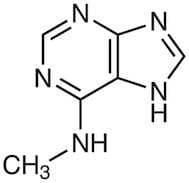
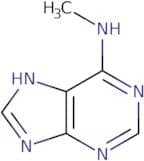
CAS 443-72-1
:N6-Méthyladénine
- 1H-Purin-6-amine, N-methyl-
- 6-(N-Methylamino)purine
- 6-Map
- 6-Methyladenine
- 6-Methylaminopurine
- 6-Mono(methylamino)purine
- 6-N-Methyladenine
- 9H-Purin-6-amine, N-methyl-
- Adenine, N-methyl-
- Methyl(Purin-6-Yl)Amine
- N-Methyl-6-aminopurine
- N-Methyl-9H-purin-6-amine
- N-methyl-5H-purin-6-amine
- N-methyl-7H-purin-6-amine
- N6-Methylademine
- N6-Methyladenine
- N<sup>6</sup>-Methyladenine
- N<sup>6</sup>-Methylaminopurine
- N<sup>6</sup>-Monomethyladenine
- Voir plus de synonymes
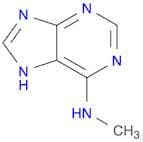
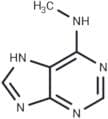
N-Methyl-7H-purin-6-amine
CAS :Formule :C6H7N5Degré de pureté :>98.0%(T)(HPLC)Couleur et forme :White to Orange to Green powder to crystalMasse moléculaire :149.161H-Purin-6-amine, N-methyl-
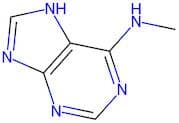
CAS :Formule :C6H7N5Degré de pureté :95%Couleur et forme :SolidMasse moléculaire :149.1533N6-Methyladenine
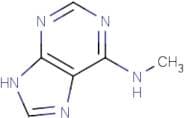
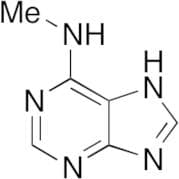
CAS :N6-Methyladenine (6-(Methylamino)Purine) is a modified purine commonly found in genomes of prokaryotes, protists, and plants.Formule :C6H7N5Degré de pureté :99.78%Couleur et forme :SolidMasse moléculaire :149.156-(Methylamino)purine
CAS :Produit contrôléApplications 6-(Methylamino)purine, 6-methylade is a reagent for substitution of adenine nucleotide analogs containing bicyclohexane ring system locked in northern conformation enhanced potency as py receptor antagonists. Adenine methylation as an epigenic mark has been observed in single-celled organisms and also rarely in mamalian cells.
References Nandanan et al.: J. Med. Chem., 43, 829 (2000); Kim, H. S. et al.: J. Med. chem., 46, 4974 (2003); Chem. and Eng. News p.6 Apr. 4 (2016)Formule :C6H7N5Couleur et forme :NeatMasse moléculaire :149.15N-Methyl-7H-purin-6-amine
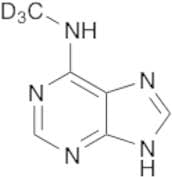
CAS :Formule :C6H7N5Degré de pureté :95%Couleur et forme :Liquid, No data available.Masse moléculaire :149.1576-(Methylamino)purine-d3
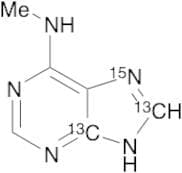
CAS :Produit contrôléFormule :C6D3H4N5Couleur et forme :NeatMasse moléculaire :152.1726-(Methylamino)purine-13C2,15N
CAS :Produit contrôléFormule :C2C4H715NN4Couleur et forme :NeatMasse moléculaire :152.132N6-Methyladenine
CAS :N6-Methyladenine is a modification of adenine in DNA. It is formed by the methylation of the N6 position of adenine, which is a group P2 purine base. The structural analysis of this compound has been studied using x-ray diffraction data, and it has been found that it may inhibit cancer cells by modifying their DNA. This compound can also be used as an antimicrobial agent to treat infections caused by eukaryotes such as bacteria and fungi. N6-Methyladenine may be useful in transcriptional regulation and cellular transformation.
Formule :C6H7N5Degré de pureté :Min. 95%Couleur et forme :PowderMasse moléculaire :149.15 g/mol