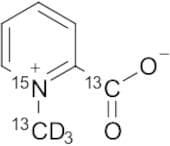
CAS 445-30-7
:Homarine
Description :
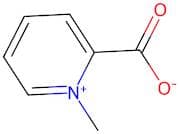
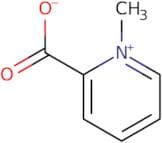
Homarine, avec le numéro CAS 445-30-7, est un composé naturellement présent classé comme un sel d'ammonium quaternaire. Il se trouve principalement dans les organismes marins, en particulier dans certaines espèces d'algues et d'invertébrés. Homarine se caractérise par sa structure chimique, qui comprend un cycle pyridine et un groupe méthyle, contribuant à sa solubilité dans l'eau et les solvants polaires. Ce composé présente une activité biologique, y compris des propriétés antioxydantes potentielles, et a été étudié pour son rôle dans l'osmorégulation des organismes marins. Homarine suscite également l'intérêt dans divers domaines, y compris la biochimie et la pharmacologie, en raison de ses applications potentielles dans la compréhension de la biologie marine et le développement de nouveaux agents thérapeutiques. Sa stabilité et sa réactivité peuvent varier en fonction des conditions environnementales, ce qui en fait un sujet d'intérêt tant pour la recherche écologique que chimique. Dans l'ensemble, Homarine sert d'exemple important des divers composés chimiques trouvés dans les écosystèmes marins.
Formule :C7H7NO2
InChI :InChI=1S/C7H7NO2/c1-8-5-3-2-4-6(8)7(9)10/h2-5H,1H3
Code InChI :InChIKey=BRTLKRNVNFIOPJ-UHFFFAOYSA-N
SMILES :C([O-])(=O)C=1[N+](C)=CC=CC1
Synonymes :- 2-Carboxy-1-methylpyridinium hydroxide, inner salt
- 2-Pyridinecarboxylic acid, N-methylbetaine
- 2-Pyridinecarboxylic acid, methoinner salt
- Homarine
- Pyridinium, 2-carboxy-1-methyl-, hydroxide, inner salt
- Pyridinium, 2-carboxy-1-methyl-, inner salt
Trier par
Degré de pureté (%)
0
100
|
0
|
50
|
90
|
95
|
100
5 produits concernés.
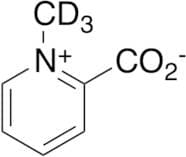
Homarine-d3
CAS :Produit contrôléStability Hygroscopic
Applications Labelled Homarine (H458500). Quaternary ammonium base occurring in tissues of marine animals.
References Stein, W., et al.: J. Biol. Chem., 211, 915 (1954), Bystedt, J., et al.: J. Sci. Food Agric., 10, 301 (1959),Formule :C7H4D3NO2Couleur et forme :NeatMasse moléculaire :140.15Homarine
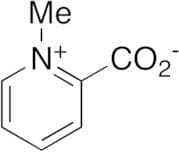
CAS :Produit contrôléStability Hygroscopic
Applications Quaternary ammonium base occurring in tissues of marine animals.
References Stein, W., et al.: J. Biol. Chem., 211, 915 (1954), Bystedt, J., et al.: J. Sci. Food Agric., 10, 301 (1959),Formule :C7H7NO2Couleur et forme :NeatMasse moléculaire :137.14Homarine
CAS :Homarine is a natural product that is found in the seeds of the Bixa orellana plant. It has been shown to have dose-dependent effects on nitrogen metabolism, enzyme activities and detoxification enzymes. Homarine is also a potential biomarker for several diseases, including fatty acid oxidation disorders, and may be used as an indicator of energy metabolism and chemical structures. This compound has been shown to bind to hydrochloric acid and hydrogen bonds with the amine group of protein molecules, which may lead to changes in their structure or function. Homarine appears to have very low toxicity, which is likely due to its inability to cross the blood-brain barrier and inhibit protein synthesis in neurons.Formule :C7H7NO2Degré de pureté :Min. 95%Couleur et forme :Yellow PowderMasse moléculaire :137.14 g/molHomarine-15N,13C2,d3
CAS :Produit contrôléFormule :C2C5D3H415NO2Couleur et forme :NeatMasse moléculaire :143.133