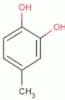
CAS 452-86-8
:4-Méthylcatéchol
Description :
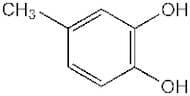
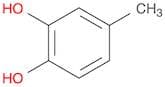
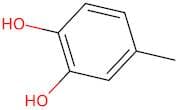
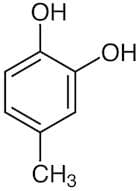
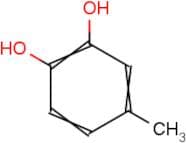
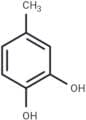
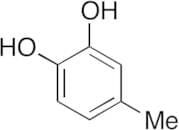
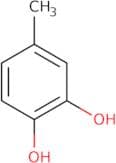
4-Méthylcatéchol, également connu sous le nom de 4-méthyl-1,2-benzenediol, est un composé organique caractérisé par sa structure de catéchol avec un groupe méthyle en position para. Il a la formule moléculaire C8H10O2 et présente deux groupes hydroxyle (-OH) attachés à un anneau benzénique, ce qui contribue à sa réactivité et à sa solubilité dans des solvants polaires. Ce composé est typiquement un liquide ou un solide incolore à jaune pâle, selon sa pureté et sa température. 4-Méthylcatéchol présente des propriétés antioxydantes et est utilisé dans diverses applications, y compris comme précurseur dans la synthèse de produits pharmaceutiques et d'agrochimiques. Il peut également servir de stabilisant dans certaines formulations en raison de sa capacité à piéger les radicaux libres. Le composé est sensible à l'oxydation et doit être manipulé avec précaution pour éviter la dégradation. De plus, il est important de prendre en compte les données de sécurité, car il peut présenter des risques pour la santé s'il est inhalé ou ingéré, nécessitant des mesures de sécurité appropriées lors de la manipulation et du stockage.
Formule :C7H8O2
InChI :InChI=1S/C7H8O2/c1-5-2-3-6(8)7(9)4-5/h2-4,8-9H,1H3
Code InChI :InChIKey=ZBCATMYQYDCTIZ-UHFFFAOYSA-N
SMILES :OC1=C(O)C=CC(C)=C1
Synonymes :- 1,2-Dihydroxy-4-methylbenzene
- 1-Methyl-3,4-dihydroxybenzene
- 2-Hydroxy-4-methylphenol
- 3,4-Dihydroxytoluene
- 4-Methyl-1,2-benzediol
- 4-Methyl-1,2-benzenediol
- 4-Methyl-1,2-dihydroxybenzene
- 4-Methylbenzcatechin
- 4-Methylbrenzcatechin
- 4-Methylcatechol
- 4-Methylpyrocatechol
- 4-Metilpirocatecol
- 5-Methylcatechol
- Catechol, 4-Methyl-
- Homocatechol
- Homopyrocatechol
- Nsc 17489
- Pyrocatechol, 4-methyl-
- Toluene-3,4-diol
- p-Methylcatechol
- p-Methylpyrocatechol
- 4-Methyl-1,2-benzenediol (4-methylpyrocatechol)
- 4-methyl-pyrocatecho
- 4-methyl-benzene-1,2-diol
- 4-methyl-2-benzenediol
- Voir plus de synonymes
Trier par
Degré de pureté (%)
0
100
|
0
|
50
|
90
|
95
|
100
10 produits concernés.
4-Methylcatechol, 96%
CAS :This Thermo Scientific Chemicals brand product was originally part of the Alfa Aesar product portfolio. Some documentation and label information may refer to the legacy brand. The original Alfa Aesar product / item code or SKU reference has not changed as a part of the brand transition to Thermo SciFormule :C7H8O2Degré de pureté :96%Couleur et forme :White to cream to brown or pale pink to pale gray, Crystals or powder or crystalline powder or flakes or lumps and/or chunksMasse moléculaire :124.144-Methylbenzene-1,2-diol
CAS :Formule :C7H8O2Degré de pureté :97%Couleur et forme :SolidMasse moléculaire :124.13724-Methylcatechol
CAS :Formule :C7H8O2Degré de pureté :>98.0%(GC)Couleur et forme :White to Light yellow to Light orange powder to lumpMasse moléculaire :124.144-Methylcatechol
CAS :4-MethylcatecholFormule :C7H8O2Degré de pureté :95%Couleur et forme : white solidMasse moléculaire :124.14g/mol4-Methylcatechol
CAS :4-Methylcatechol, a homoprotocatechuic acid metabolite, induces BDNF and inhibits Catechol 2,3-dioxygenase. Lack of BDNF may lead to neuropathic pain.Formule :C7H8O2Degré de pureté :98.67%Couleur et forme :SolidMasse moléculaire :124.144-Methylcatechol
CAS :Applications 4-Methylcatechol is a potent inducer of nerve growth factor (NGF) synthesis in vitro and in vivo.
References Kaechi, K., et al.: J. Pharmacol. Exp. Ther., 272, 1300 (1995); Hanaoka, Y., et al.: J. Neurol. Sci., 122, 28 (1994)Formule :C7H8O2Couleur et forme :NeatMasse moléculaire :124.144-Methylbenzene-1,2-diol
CAS :Formule :C7H8O2Degré de pureté :97%Couleur et forme :SolidMasse moléculaire :124.1394-Methylcatechol
CAS :4-Methylcatechol is a plant compound that has been shown to have neurotrophic and anticarcinogenic properties. It is a natural product that can be found in the bark of the cinchona tree, and it has been used as an additive in skin care products for its antioxidant properties. 4-Methylcatechol has been shown to have anti-inflammatory effects and inhibit the growth of cancer cells in vitro. It also shows potential for the treatment of diabetic neuropathy, due to its ability to inhibit acetylcholine esterase activity. 4-Methylcatechol is a neurotrophic factor that affects cell nuclei and protein synthesis. This compound acts by binding with DNA, preventing DNA polymerase from adding new bases during replication. This effect inhibits RNA synthesis, which leads to cell death after prolonged exposure. In addition, 4-methylcatechol may be carcinogenic when administered orally or topically on skin cells in vivo or when applied exFormule :C7H8O2Degré de pureté :Min. 95%Masse moléculaire :124.14 g/mol