CAS 454-29-5
:(±)-Homocystéine
Description :
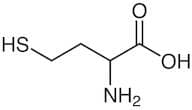
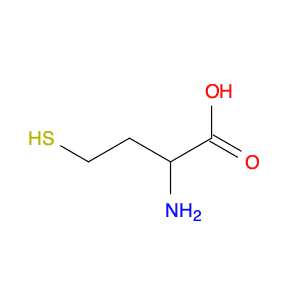
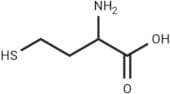
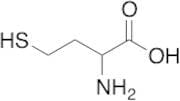
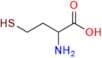
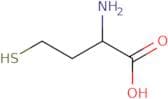
(±)-Homocystéine est un acide aminé contenant du soufre qui joue un rôle crucial dans le métabolisme de la méthionine, un acide aminé essentiel. C'est un acide aminé non protéinogène, ce qui signifie qu'il n'est pas incorporé dans les protéines mais est impliqué dans divers processus biochimiques. L'homocystéine existe sous plusieurs formes, y compris l'homocystéine libre et ses dérivés, tels que la thiolactone d'homocystéine. Le composé est caractérisé par sa nature chirale, ayant deux énantiomères, qui peuvent influencer son activité biologique. Des niveaux élevés d'homocystéine dans le sang sont associés à un risque accru de maladies cardiovasculaires, car cela peut entraîner une dysfonction endothéliale et favoriser l'athérosclérose. L'homocystéine est également impliquée dans le cycle de méthylation, où elle peut être reméthylée pour former de la méthionine ou convertie en cystéine par transsulfuration. Son métabolisme dépend de diverses vitamines, en particulier B6, B12 et acide folique. Surveiller les niveaux d'homocystéine peut être important dans les contextes cliniques, en particulier pour évaluer le risque cardiovasculaire et l'état nutritionnel.
Formule :C4H9NO2S
InChI :InChI=1S/C4H9NO2S/c5-3(1-2-8)4(6)7/h3,8H,1-2,5H2,(H,6,7)
Code InChI :InChIKey=FFFHZYDWPBMWHY-UHFFFAOYSA-N
SMILES :C(CCS)(C(O)=O)N
Synonymes :- 2-Amino-4-mercaptobutanoic acid
- 2-Amino-4-mercaptobutyric acid
- 2-Amino-4-sulfanylbutanoic acid
- <span class="text-smallcaps">DL</span>-Homocysteine
- Butyric acid, 2-amino-4-mercapto-, <span class="text-smallcaps">DL</span>-
- D-homocysteine
- DL-Homocysteine 2-Amino-4-mercaptobuyric acid
- Homocysteine
- NSC 206252
- Butyric acid, 2-amino-4-mercapto-, DL-
- DL-Homocysteine
Trier par
Degré de pureté (%)
0
100
|
0
|
50
|
90
|
95
|
100
11 produits concernés.
DL-Homocysteine
CAS :Formule :C4H9NO2SDegré de pureté :>90.0%(T)Couleur et forme :White to Almost white powder to crystalMasse moléculaire :135.18DL-Homocysteine
CAS :Formule :C4H9NO2SDegré de pureté :98%Couleur et forme :SolidMasse moléculaire :135.1848DL-Homocysteine
CAS :Formule :C4H9NO2SDegré de pureté :(Titration) ≥ 95.0%Couleur et forme :White to off-white or pale pink powderMasse moléculaire :135.18DL-Homocysteine
CAS :DL-Homocysteine (2-Amino-4-mercaptobutyric acid) is a potential marker for tumor cell growth.Formule :C4H9NO2SDegré de pureté :99.57% - ≥98%Couleur et forme :SolidMasse moléculaire :135.18DL-Homocysteine, 90%
CAS :Applications DL-Homocysteine is an allosteric antagonist at the dopamine d2 receptors. Mainly, L-Homocysteine (H591950) exists naturally and is recycled into methionine or converted into cysteine.
References Agnati, L. et al.: J. Proteome Res. 5, 3011 (2006); Stipanuk, M. et al.: Ann. Rev. Nutrition., 24, 539 (2004);Formule :C4H9NO2SDegré de pureté :90%Couleur et forme :Off WhiteMasse moléculaire :135.192-Amino-4-mercaptobutanoic acid
CAS :Formule :C4H9NO2SDegré de pureté :98%Couleur et forme :White powderMasse moléculaire :135.18DL-Homocysteine
CAS :DL-Homocysteine is a sulfur-containing amino acid that is essential for the synthesis of methionine, and is an intermediate in the metabolism of L-methionine. DL-homocysteine has been shown to cause cardiac infarction in rats by inhibiting mitochondrial functions. This amino acid also inhibits the activity of enzymes that regulate homocysteine levels, such as cystathione beta-synthase and cystathione gamma-lyase. DL-homocysteine can be used as a fluorescent probe for detecting proteins involved in apoptosis. It also has proapoptotic effects on cells, causing them to undergo apoptosis.Formule :C4H9NO2SDegré de pureté :Min. 95%Couleur et forme :PowderMasse moléculaire :135.19 g/mol