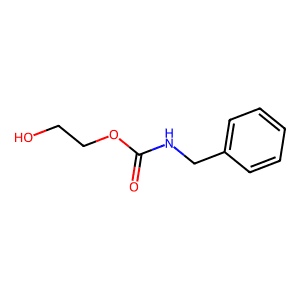
CAS 4663-83-6
:Carbamate de 2-hydroxyéthyle N-(phénylméthyle)
Description :
Carbamate de 2-hydroxyéthyle N-(phénylméthyle), avec le numéro CAS 4663-83-6, est un composé organique caractérisé par son groupe fonctionnel carbamate, dérivé de la réaction entre la phénylméthylamine et le carbonate d'éthylène. Ce composé apparaît généralement sous forme de liquide ou de solide incolore à jaune pâle, selon sa pureté et sa forme. Il est soluble dans des solvants polaires tels que l'eau et les alcools, ce qui indique la présence de ses groupes hydroxyle et carbamate. La présence du groupe hydroxyéthyle contribue à son hydrophilie, tandis que la partie phénylméthyle ajoute des caractéristiques hydrophobes. Ce composé peut présenter une activité biologique, ce qui le rend intéressant pour des applications pharmaceutiques et agricoles. Sa stabilité et sa réactivité peuvent être influencées par des facteurs environnementaux tels que le pH et la température. Les données de sécurité doivent être consultées pour la manipulation et la toxicité potentielle, comme pour toute substance chimique. Dans l'ensemble, Carbamate de 2-hydroxyéthyle N-(phénylméthyle) est un composé polyvalent avec des applications potentielles dans divers domaines.
Formule :C10H13NO3
InChI :InChI=1S/C10H13NO3/c12-6-7-14-10(13)11-8-9-4-2-1-3-5-9/h1-5,12H,6-8H2,(H,11,13)
Code InChI :InChIKey=YFLRYAVDPKONNX-UHFFFAOYSA-N
SMILES :C(NC(OCCO)=O)C1=CC=CC=C1
Synonymes :- 2-Hydroxyethyl N-(phenylmethyl)carbamate
- 2-Hydroxyethyl N-benzylcarbamate
- 2-Hydroxyethyl benzylcarbamate
- 242 Hc
- Ac 601
- Benzylcarbamic acid 2-hydroxyethyl ester
- Benzylurethane du glycol
- Benzylurethane du glycol [French]
- Brn 2838813
- Buramat
- Buramate [USAN:INN]
- Buramato
- Buramato [INN-Spanish]
- Buramatum
- Buramatum [INN-Latin]
- Carbamic acid, (phenylmethyl)-, 2-hydroxyethyl ester
- Carbamic acid, N-(phenylmethyl)-, 2-hydroxyethyl ester
- Carbamic acid, benzyl-, 2-hydroxyethyl ester
- Ethylene glycol, benzylcarbamate
- Ethylene glycol, mono(benzylcarbamate)
- Glycol benzylcarbamate
- Hyamate
- NSC 30781
- Nsc 30223
- Unii-Q9Hda6U6V4
- Buramate
- Voir plus de synonymes
Trier par
Degré de pureté (%)
0
100
|
0
|
50
|
90
|
95
|
100
5 produits concernés.
Buramate
CAS :Buramate is an antipsychotic and anticonvulsant.Formule :C10H13NO3Degré de pureté :99.26%Couleur et forme :SolidMasse moléculaire :195.22Ref: TM-T8588
1mg58,00€5mg116,00€10mg172,00€25mg281,00€50mg396,00€100mg537,00€200mg712,00€1mL*10mM (DMSO)96,00€Buramate-d7
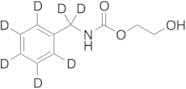
CAS :Produit contrôléApplications Buramate-d7, is the labeled analogue of Buramate (B689700), used for the synthesis of more complex compounds, having antibacterial activity, and also for the synthesis of new antimalarial compounds.
References Marrero-Ponce, Y., et al.: Bioorg. Med. Chem., 13 (8), 2881 (2005); Marrero-Ponce, Y., et al.: J. Chem. Info. Model., 45 (4), 1082 (2005);Formule :C10H6D7NO3Couleur et forme :NeatMasse moléculaire :195.2152-Hydroxyethyl N-benzylcarbamate
CAS :2-Hydroxyethyl N-benzylcarbamate is a biodegradable, analog of the amino acid L-phenylalanine. It has been shown to be an effective inhibitor of muscle cell contraction. 2-Hydroxyethyl N-benzylcarbamate binds to the active site of the enzyme acetylcholinesterase and blocks its activity. This blockage leads to a build up of acetylcholine in the synapse between nerve cells, resulting in muscle paralysis and death. The symptoms of poisoning from this compound are typical for organophosphates, including respiratory failure, hypotension, bradycardia, and seizures. Treatment with 2-Hydroxyethyl N-benzylcarbamate is symptomatic and supportive care should be provided until symptoms resolve.Formule :C10H13NO3Degré de pureté :Min. 95%Masse moléculaire :195.21 g/mol