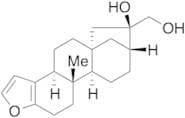
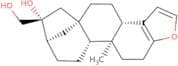
CAS 469-83-0
:Cafestol
Description :
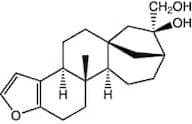
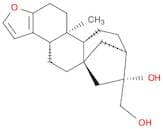
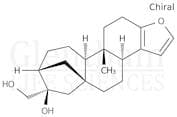
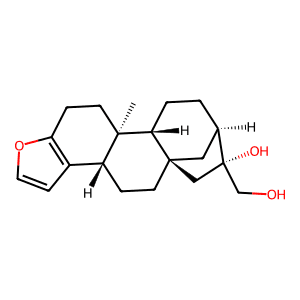
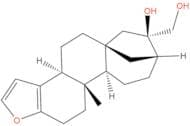
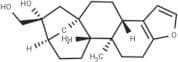
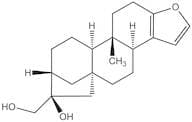
Cafestol est un composé naturel que l'on trouve principalement dans le café, en particulier dans les infusions de café non filtrées. C'est un diterpène, spécifiquement un type de labdane, et il est connu pour sa structure semblable à celle des lipides. Cafestol est reconnu pour ses effets potentiels sur la santé, y compris sa capacité à augmenter les niveaux de cholestérol dans le sang, ce qui a été un sujet de recherche concernant la consommation de café et la santé cardiovasculaire. Le composé est également noté pour ses propriétés antioxydantes, contribuant aux bienfaits globaux pour la santé associés au café. Cafestol est soluble dans des solvants organiques mais a une solubilité limitée dans l'eau, ce qui est typique de nombreux composés lipophiles. Sa présence dans le café varie considérablement en fonction de la méthode de préparation ; par exemple, des méthodes comme la presse française ou le café turc retiennent plus de Cafestol par rapport au café filtré. Comprendre les caractéristiques de Cafestol est essentiel pour évaluer son impact sur la santé et la nutrition, ainsi que son rôle dans la chimie complexe du café.
Formule :C20H28O3
InChI :InChI=1/C20H28O3/c1-18-7-5-16-14(6-9-23-16)15(18)4-8-19-10-13(2-3-17(18)19)20(22,11-19)12-21/h6,9,13,15,17,21-22H,2-5,7-8,10-12H2,1H3/t13?,15-,17+,18-,19+,20+/m1/s1
Code InChI :InChIKey=DNJVYWXIDISQRD-HWUKTEKMSA-N
SMILES :C[C@]12[C@]3([C@]4(C[C@]([C@](CO)(O)C4)(CC3)[H])CC[C@@]1(C5=C(CC2)OC=C5)[H])[H]
Synonymes :- (3bS,5aS,7R,8R,10aR,10bS)-3b,4,5,6,7,8,9,10,10a,10b,11,12-Dodecahydro-7-hydroxy-10b-methyl-5a,8-methano-5aH-cyclohepta[5,6]naphtho[2,1-b]furan-7-methanol
- (3bS,5aS,7R,8R,10aR,10bS)-7-(hydroxymethyl)-10b-methyl-3b,4,5,6,7,8,9,10,10a,10b,11,12-dodecahydro-5a,8-methanocyclohepta[5,6]naphtho[2,1-b]furan-7-ol
- (3bS,5aS,7R,8S,10aR,10bS)-7-(hydroxymethyl)-10b-methyl-3b,4,5,6,7,8,9,10,10a,10b,11,12-dodecahydro-5a,8-methanocyclohepta[5,6]naphtho[2,1-b]furan-7-ol
- 5a,8-Methano-5aH-cyclohepta(5,6)naphtho(2,1-b)furan-7-methanol, 3b,4,5,6,7,8,9,10,10a,10b,11,12-dodecahydro-7-hydroxy-10b-methyl-, (3bS,5aS,7R,8R,10aR,10bS)-
- 5a,8-Methano-5aH-cyclohepta(5,6)naphtho(2,1-b)furan-7-methanol, 3b,4,5,6,7,8,9,10,10a,10b,11,12-dodecahydro-7-hydroxy-10b-methyl-, (3bS-(3balpha,5abeta,7beta,8beta,10aalpha,10bbeta))-
- 5a,8-Methano-5aH-cyclohepta[5,6]naphtho[2,1-b]furan-7-methanol, 3b,4,5,6,7,8,9,10,10a,10b,11,12-dodecahydro-7-hydroxy-10b-methyl-, [3bS-(3bα,5aβ,7β,8β,10aα,10bβ)]-
- Cafesterol
- Ccris 1518
- Cafestol
- 3bα,4,5,6,7,8,9,10,10aα,10b,11,12-Dodecahydro-7β-hydroxy-10bβ-methyl-5aβ,8β-methano-5aH-cyclohepta[5,6]naphtho[2,1-b]furan-7α-methanol
- Cafestol (>85%)
- Voir plus de synonymes
Trier par
Degré de pureté (%)
0
100
|
0
|
50
|
90
|
95
|
100
10 produits trouvés.
Cafestol
CAS :Natural extract from coffee beans which induces glutathione S-transferaseFormule :C20H28O3Couleur et forme :White to off white, PowderMasse moléculaire :316.44Cafestol
CAS :Formule :C20H28O3Degré de pureté :≥ 98.0%Couleur et forme :White to off-white powderMasse moléculaire :316.44Cafestol
CAS :Cafestol has anticarcinogenic, peripheral antinociceptive and anti-inflammatory activities, it inhibits Cyclic-Strain-induced interleukin-8, intercellular adhesion molecule-1, and monocyte chemoattractant protein-1 production in vascular endothelial cells. Cafestol is a novel extracellular signal-regulated kinase inhibitor with AP-1-targeted inhibition of prostaglandin E2 production in lipopolysaccharide-activated macrophages. Cafestol acts as an agonist ligand for both FXR and PXR, and this may contribute to its impact on cholesterol homeostasis. Cafestol has protective effects against the CCl(4)-induced hepatotoxicity, which possibly involve mechanisms related to its ability to block the CYP2E1-mediated CCl(4) bioactivation and free radical scavenging effects. Cafestol has antidiabetic activity, it increases glucose-stimulated insulin secretion in vitro and increases glucose uptake in human skeletal muscle cells. Cafestol also has a weak inhibitory effect on osteoclastogenesis and promotes osteoblast differentiation.Formule :C20H28O3Degré de pureté :95%~99%Masse moléculaire :316.441CAFESTOL
CAS :Cafestol, an ERK inhibitor, suppresses PGE2 and COX-2 by blocking NF-kB in LPS-stimulated RAW264.7 cells.Formule :C20H28O3Degré de pureté :97.06% - 99.08%Couleur et forme :SolidMasse moléculaire :316.43Cafestol
CAS :Oxygen-heterocyclic compoundFormule :C20H28O3Degré de pureté :≥ 98.0 % (HPLC)Couleur et forme :PowderMasse moléculaire :316.44Cafestol (>85%)
CAS :Produit contrôléApplications Cafestol is a diterpene molecule that displays anti-carcinogenic properties in studies.
References Higgins, L.G. et al.: Tox. App. Pharma., 226, 328 (2008); Schilter, B. et al.: Carcinogenesis, 17, 2377 (1996);Formule :C20H28O3Degré de pureté :>85%Couleur et forme :NeatMasse moléculaire :316.43Cafestol
CAS :Cafestol is a diterpene compound, which is primarily sourced from coffee beans. It is found in the oily fraction of coffee, particularly in unfiltered types like French press and Turkish coffee. Its mode of action involves influencing lipid metabolism in the liver. Specifically, cafestol acts as an agonist for certain nuclear receptors, including FXR and PXR, which play a role in bile acid regulation and lipid homeostasis.Cafestol is known to have a notable impact on cholesterol levels. It causes an increase in serum cholesterol by reducing the excretion of bile acids, consequently enhancing cholesterol reabsorption. Due to its pronounced effects on cholesterol metabolism, cafestol is a compound of interest in cardiovascular research, especially in the context of dietary factors influencing heart health. Scientists are exploring its broader implications on lipid-related diseases and how modifying coffee preparation methods can mitigate its impact on health.Formule :C20H28O3Degré de pureté :Min. 95%Couleur et forme :PowderMasse moléculaire :316.43 g/mol