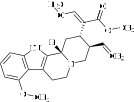
CAS 4697-66-9
:Paynantheine
Description :
Paynantheine est un alcaloïde naturellement présent, principalement dérivé de l'espèce végétale *Paynanta*, qui appartient à la famille des Apocynaceae. Il se caractérise par sa structure moléculaire complexe, qui comprend plusieurs cycles et groupes fonctionnels contribuant à son activité biologique. Le composé est connu pour ses propriétés pharmacologiques potentielles, y compris des effets sur le système nerveux central et des applications possibles en chimie médicinale. Paynantheine présente une solubilité dans des solvants organiques, ce qui est typique de nombreux alcaloïdes, et peut montrer différents degrés de stabilité selon les conditions environnementales. Son comportement chimique peut être influencé par des facteurs tels que le pH et la température, qui sont des considérations importantes tant dans les laboratoires que dans les environnements industriels. Comme pour de nombreux alcaloïdes, les interactions de Paynantheine avec les systèmes biologiques suscitent un intérêt considérable, incitant à la recherche sur ses mécanismes d'action et ses utilisations thérapeutiques potentielles. Cependant, des études détaillées sur sa toxicité et son profil de sécurité sont essentielles pour comprendre son applicabilité en médecine.
Formule :C23H28N2O4
InChI :InChI=1S/C23H28N2O4/c1-5-14-12-25-10-9-15-21-18(7-6-8-20(21)28-3)24-22(15)19(25)11-16(14)17(13-27-2)23(26)29-4/h5-8,13-14,16,19,24H,1,9-12H2,2-4H3/b17-13+/t14-,16-,19-/m0/s1
Code InChI :InChIKey=JGZKIGWXPPFMRG-CYSPOEIOSA-N
SMILES :O(C)C1=C2C3=C([C@]4(N(CC3)C[C@H](C=C)[C@@H](\C(\C(OC)=O)=C/OC)C4)[H])NC2=CC=C1
Synonymes :- 17,18-Secoyohimban-16-carboxylic acid, 16,17,18,19-tetradehydro-9,17-dimethoxy-, methyl ester, (E)-
- Indolo[2,3-a]quinolizine-2-acetic acid, 3-ethenyl-1,2,3,4,6,7,12,12b-octahydro-8-methoxy-α-(methoxymethylene)-, methyl ester, (αE,2S,3R,12bS)-
- Indolo[2,3-a]quinolizine, corynan-16-carboxylic acid deriv.
- Corynan-16-carboxylic acid, 16,17,18,19-tetradehydro-9,17-dimethoxy-, methyl ester, (16E)-
- Paynantheine
- Indolo(2,3-a)quinolizine-2-acetic acid, 3-ethenyl-1,2,3,4,6,7,12,12b-octahydro-8-methoxy-alpha-(methoxymethylene)-, methyl ester (alphaE,2S,3R,12bS)-
Trier par
Degré de pureté (%)
0
100
|
0
|
50
|
90
|
95
|
100
3 produits concernés.
Paynantheine
CAS :Paynantheine is an alkaloid with antinociceptive properties, found in Mitragyna speciosa. It also acts as an agonist at 5-HT1AR and 5-HT2BR receptors, inducing lower lip contraction and providing antinociception in rats.Formule :C23H28N2O4Couleur et forme :SolidMasse moléculaire :396.48Paynantheine
CAS :Paynantheine is a naturally occurring alkaloid, which is found in the leaves of the Mitragyna speciosa plant, commonly known as kratom. This plant is native to Southeast Asia and has a long history of traditional medicinal use. Paynantheine acts as a partial agonist on mu-opioid receptors in the central nervous system, albeit with less efficacy compared to other alkaloids like mitragynine and 7-hydroxymitragynine. This molecular interaction may contribute to its potential analgesic properties, although its precise pharmacological role is less understood and remains a subject of ongoing research.
Formule :C23H28N2O4Degré de pureté :Min 90%Couleur et forme :PowderMasse moléculaire :396.5 g/mol