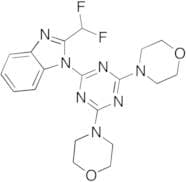
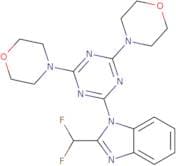
CAS 475110-96-4
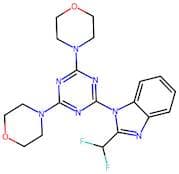
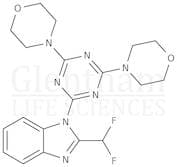
:2-(Difluorométhyl)-1-(4,6-di-4-morpholinyl-1,3,5-triazin-2-yl)-1H-benzimidazole
- 1H-Benzimidazole, 2-(difluoromethyl)-1-(4,6-di-4-morpholinyl-1,3,5-triazin-2-yl)-
- 2-(2-Difluoromethylbenzimidazol-1-yl)-4,6-bis(morpholino)-1,3,5-triazine
- 2-(2-Difluoromethylbenzimidazol-1-yl)-4,6-dimorpholino-1,3,5-triazine
- 2-(Difluoromethyl)-1-(4,6-di-4-morpholinyl-1,3,5-triazin-2-yl)-1H-benzimidazole
- Tcmdc-137004
- Zstk 474
- Zstk474
- 4,4′-(6-(2-(Difluoromethyl)-1H-benzo[d]imidazol-1-yl)-1,3,5-triazine-2,4-diyl)dimorpholine
ZSTK474
CAS :Formule :C19H21F2N7O2Degré de pureté :98%Couleur et forme :SolidMasse moléculaire :417.41254,4'-(6-(2-(Difluoromethyl)-1H-Benzo[D]Imidazol-1-Yl)-1,3,5-Triazine-2,4-Diyl)Dimorpholine
CAS :4,4'-(6-(2-(Difluoromethyl)-1H-Benzo[D]Imidazol-1-Yl)-1,3,5-Triazine-2,4-Diyl)DimorpholineDegré de pureté :98%Masse moléculaire :417.41g/molZSTK474
CAS :PI3K Inhibitor ZSTK474 is an orally available, s-triazine derivative, ATP-competitive phosphatidylinositol 3-kinase (PI3K) inhibitor with potentialFormule :C19H21F2N7O2Degré de pureté :98.29% - 99.95%Couleur et forme :White PowderMasse moléculaire :417.41ZSTK 474
CAS :Produit contrôléApplications ZSTK474 is an ATP-competitive inhibitor of class I phosphatidylinositol 3 kinase (PI3K) isoforms. Potent PI3K inhibitor.
References Yaguchi, S., et al.: J. Natl. Cancer Inst., 98, 545 (2006); Kong, D., et al.: Cancer Sci., 98, 1638 (2007); Kong, D., et al.: Eur. J. Cancer, 45, 857 (2009); Marone, R., et al.: Mol. Cancer Res., 7, 601 (2009); Yang, S., et al.: PLoS One, 6, e26343 (2011); Haruta, K., et al.: Inflamm, Res., 61, 551 (2012);Formule :C19H21F2N7O2Couleur et forme :NeatMasse moléculaire :417.41ZSTK474
CAS :ZSTK474 is a novel compound that has been shown to have autophagy-inducing properties. Studies have found that ZSTK474 inhibits the growth of human cancer cells in vitro and in vivo, and also has inhibitory effects on epithelial mesenchymal transition (EMT) and metastasis. ZSTK474 targets the mitochondrial membrane potential and ATP production, which reduces cellular energy metabolism. These inhibitory effects lead to increased autophagy in cells, which may be due to the inhibition of protein synthesis and cell cycle progression. ZSTK474 has also been shown to induce apoptosis in cancer cells by inducing DNA damage.
Formule :C19H21O2N7F2Degré de pureté :Min. 95%Masse moléculaire :417.17248
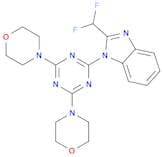

![4,4'-(6-(2-(Difluoromethyl)-1H-Benzo[D]Imidazol-1-Yl)-1,3,5-Triazine-2,4-Diyl)Dimorpholine](/_next/image/?url=https%3A%2Fstatic.cymitquimica.com%2Fproducts%2F54%2Fthumb%2FPC108908.jpg&w=3840&q=75)