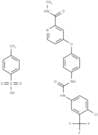
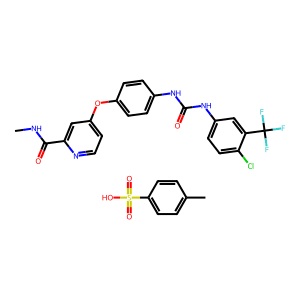
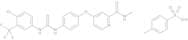
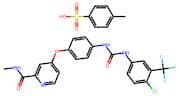
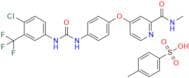
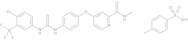
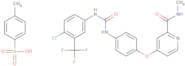
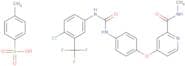
CAS 475207-59-1
:Nexavar
- 2-Pyridinecarboxamide, 4-[4-[[[[4-chloro-3-(trifluoromethyl)phenyl]amino]carbonyl]amino]phenoxy]-N-methyl-, 4-methylbenzenesulfonate (1:1)
- 2-Pyridinecarboxamide, 4-[4-[[[[4-chloro-3-(trifluoromethyl)phenyl]amino]carbonyl]amino]phenoxy]-N-methyl-, mono(4-methylbenzenesulfonate)
- 4-Methyl-3-((4-(3-pyridinyl)-2-pyrimidinyl)amino)-N-(5-(4-methyl-1H-imidazol-1-yl)-3-(trifluoromethyl)phenyl)benzamide monomethanesulfonate
- BAY 43-9006 mono-p-tosylate
- Bay 54-9085
- N-[4-Chloro-3-(trifluoromethyl)phenyl]-N'-[4-[2-(N-methylcarbamoyl)-4-pyridyloxy]phenyl]urea Tolsylate
- Nexavar
- Sorafenib TsOH salt
- Sorafenib p-toluenesulfonate
- Sorafenib-D3
- Sorafenib tosylate
Sorafenib Tosylate
CAS :Formule :C21H16ClF3N4O3·C7H8O3SDegré de pureté :>98.0%(T)(HPLC)Couleur et forme :White to Light yellow powder to crystalMasse moléculaire :637.03Sorafenib Tosylate
CAS :Compounds containing an unfused pyridine ring in the structure, nesoiFormule :C21H16ClF3N4O3·C7H8O3SCouleur et forme :White Brown PowderMasse moléculaire :636.105724-[4-({[4-chloro-3-(trifluoromethyl)phenyl]carbamoyl}amino)phenoxy]-N-methylpyridine-2-carboxamide; 4-methylbenzene-1-sulfonic acid
CAS :Formule :C28H24ClF3N4O6SDegré de pureté :98%Couleur et forme :SolidMasse moléculaire :637.0266Sorafenib tosylate
CAS :Sorafenib tosylate (Bay 43-9006) is a potent multikinase inhibitor (IC50s: 6/20/22 nM for Raf-1/VEGFR-3/B-Raf).Formule :C21H16ClF3N4O3·C7H8O3SDegré de pureté :99.24% - 99.94%Couleur et forme :White To Off-White Crystalline PowderMasse moléculaire :637.03Sorafenib Tosylate
CAS :Formule :C21H16ClF3N4O3·C7H8O3SCouleur et forme :Off-White SolidMasse moléculaire :464.83 172.20Sorafenib tosylate
CAS :Formule :C21H16ClF3N4O3·C7H8O3SDegré de pureté :≥ 98.0% (dried basis)Couleur et forme :White, off-white or pale yellow-brown powderMasse moléculaire :637.03Sorafenib Tosylate
CAS :Produit contrôléFormule :C21H16ClF3N4O3·C7H8O3SCouleur et forme :NeatMasse moléculaire :637.03Sorafenib tosylate
CAS :Sorafenib tosylateFormule :C21H16ClF3N4O3·C7H8O3SDegré de pureté :99%+Couleur et forme : off-white solidMasse moléculaire :637.03g/molSorafenib Tosylate
CAS :Produit contrôléFormule :C21H16ClF3N4O3·C7H8O3SCouleur et forme :NeatMasse moléculaire :637.03Sorafenib tosylate - Bio-X ™
CAS :Sorafenib is a drug that belongs to the class of multikinase inhibitors. It inhibits a number of kinases, including the Mcl-1 protein, which is involved in apoptosis along with blocking picolinic acid (PA), an endogenous metabolite involved in apoptosis signal transduction. Sorafenib also binds to epidermal growth factor receptor (EGFR) on the surface of cancer cells, inhibiting the production of proteins that are required for angiogenesis, thus blocking the formation of new blood vessels. Sorafenib may also inhibit P-glycoprotein (Pgp) activity. Overall, these cytotoxic effects give Sorafenib anti-tumor properties, inhibiting angiogenesis and cellular transformation, which are the two main processes of tumor growth and metastasis. Sorafenib tosylate has been shown to be effective against a range of solid tumors such as breast, prostate and lung cancers and is also used for the treatment of metastatic colorectal cancer and renal cell carcinoma. A combination therapy group found that sorafenib was more effective when used with interferon alfa-2b for the treatment of advanced renal cell carcinoma. Sorafenib tosylate also has the potential for drug interactions with other drugs that are metabolized by cytochrome P450 enzymes.
Sorafenib tosylate is part of our Bio-X ™ Range. These products are aimed at life science researchers who need high quality ready to use products for assay development, screening or other R&D work. With a solubility datasheet and convenient vials, all of our Bio-X ™ products are in stock across our global warehouses for rapid delivery and ease of use.Formule :C21H16ClF3N4O3•C7H8O3SDegré de pureté :Min. 95%Couleur et forme :PowderMasse moléculaire :637.03 g/molSorafenib tosylate
CAS :Sorafenib is a drug that belongs to the class of multikinase inhibitors. It inhibits a number of kinases, including the Mcl-1 protein, which is involved in apoptosis along with blocking picolinic acid (PA), an endogenous metabolite involved in apoptosis signal transduction. Sorafenib also binds to epidermal growth factor receptor (EGFR) on the surface of cancer cells, inhibiting the production of proteins that are required for angiogenesis, thus blocking the formation of new blood vessels. Sorafenib may also inhibit P-glycoprotein (Pgp) activity. Overall, these cytotoxic effects give Sorafenib anti-tumor properties, inhibiting angiogenesis and cellular transformation, which are the two main processes of tumor growth and metastasis. Sorafenib tosylate has been shown to be effective against a range of solid tumors such as breast, prostate and lung cancers and is also used for the treatment of metastatic colorectal cancer and renal cell carcinoma. A combination therapy group found that sorafenib was more effective when used with interferon alfa-2b for the treatment of advanced renal cell carcinoma. Sorafenib also has the potential for drug interactions with other drugs that are metabolized by cytochrome P450 enzymes.
Formule :C21H16ClF3N4O3•C7H8O3SDegré de pureté :Min. 95%Couleur et forme :Off-White PowderMasse moléculaire :637.03 g/molSorafenib, p-Toluenesulfonate Salt
CAS :Formule :C35H30F3N7O4SDegré de pureté :98%Couleur et forme :SolidMasse moléculaire :701.73
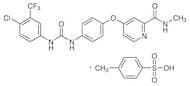



![4-[4-({[4-chloro-3-(trifluoromethyl)phenyl]carbamoyl}amino)phenoxy]-N-methylpyridine-2-carboxamide…](/_next/image/?url=https%3A%2Fstatic.cymitquimica.com%2Fproducts%2FIN%2Fthumb%2FDA0035M4.jpg&w=3840&q=75)