CAS 4758-99-0
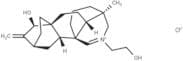
:(15alpha)-15-hydroxy-21-(2-hydroxyéthyl)-4-méthylatida-16,20-diène-21-ium chlorure
Guanfu base H
CAS :Guanfu base H, a diterpenoid from Aconitum coreanum, inhibits malaria strains TM4/8.2 and K1CB1 with IC50s of 4 μM, 3.6 μM.Formule :C22H34ClNO2Degré de pureté :98%Couleur et forme :SolidMasse moléculaire :379.96Atisinium chloride
CAS :Atisinium chloride is an organometallic compound, which is synthesized through advanced coordination chemistry techniques. The source of this compound lies in the strategic combination of organic ligands with metal centers, facilitating unique interactions that are pivotal to its functionality. The mode of action primarily involves the ability to participate in complex catalytic cycles, engaging in electron transfer processes that are essential for mediating chemical transformations.
This compound finds applications in specialized fields such as catalysis, where it is utilized to promote and drive reactions that may be inefficient under normal conditions. Its effectiveness in altering reaction pathways and increasing selectivity makes it valuable in synthetic chemistry and industrial processes. Additionally, atisinium chloride's unique properties might be leveraged in materials science for the development of novel materials with tailored functionalities. The intricate balance of its reactive properties and stability under varying conditions makes it a subject of ongoing research for further applications.Formule :C22H34ClNO2Degré de pureté :Min. 95%Masse moléculaire :379.96 g/mol