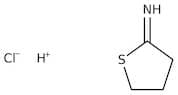
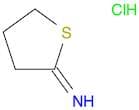
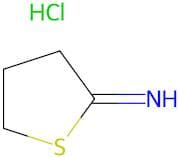
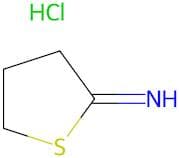
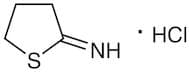
CAS 4781-83-3
:chlorhydrate de 2-iminothiolane
- (2Z)-dihydrothiophen-2(3H)-imine
- 2(3H)-Thiophenimine, dihydro-, hydrochloride
- 2(3H)-Thiophenimine, dihydro-, hydrochloride (1:1)
- Methyl-4-mercaptobutyrimidate hydrochloride 2-Iminothiolane hydrochloride
- Traut's reagent
- dihydrothiophen-2(3H)-imine
- 2-Iminothiolane hydrochloride
- 2-Iminothiolane, Hydrochloride
- METHYL 4-MERCAPTOBUTYRIMIDATE HYDROCHLORIDE
- 2-IMINOTHIOLANE HCL
- 2-THIOLANIMINE HYDROCHLORIDE
- 2-Furancarboxyaldehyde, Reagent
- DIHYDRO-2(3H)-THIOPHENIMINE HYDROCHLORIDE
- 2-IMINOTHIOLANE
- Voir plus de synonymes
2-Iminothiolane hydrochloride
CAS :Protein modification and cross-linking reagent, cleavable by thiolsFormule :C4H8ClNSCouleur et forme :Powder, WhiteMasse moléculaire :137.632-Iminothiolane
CAS :Formule :C4H8ClNSDegré de pureté :95%Couleur et forme :SolidMasse moléculaire :137.63102-Iminothiolane hydrochloride
CAS :2-Iminothiolane hydrochlorideFormule :C4H7NS·ClHDegré de pureté :95%Couleur et forme : white solidMasse moléculaire :137.63g/mol2-Iminothiolane Hydrochloride
CAS :Formule :C4H7NS·HClDegré de pureté :>95.0%(HPLC)(qNMR)Couleur et forme :White to Light yellow powder to crystalMasse moléculaire :137.632-Iminothiolane, Hydrochloride
CAS :Produit contrôléApplications A valuable tool in studies of cellular organelles and oligomeric enzymes, using the techniques of protein-protein cross-linking. It may also be used to introduce reactive sulfhydryl groups into proteins for subsequent reaction with alkylating agents or heavy metal compounds.
References Perham, R.N. & Thomas, J.O.: J. Mol. Biol., 62, 415 (1971), Jue, R., et al: Biochemistry, 17, 5399 (1978)Formule :C4H7NS·ClHCouleur et forme :NeatMasse moléculaire :137.632-Iminothiolane hydrochloride
CAS :Formule :C4H8ClNSDegré de pureté :95%Couleur et forme :SolidMasse moléculaire :137.632-Iminothiolane HCl
CAS :2-Iminothiolane HCl (Trauts reagent) is a useful RNA-protein crosslinking reagent and an effective thiolation reagent for the introduction of sulphydryl groupsFormule :C4H8ClNSDegré de pureté :98.08% - 98.52%Couleur et forme :SolidMasse moléculaire :137.632-Iminothiolane hydrochloride
CAS :2-Iminothiolane hydrochloride is an amine that reacts with free thiol groups in proteins. It can be used to generate models of protein structures, as well as to study the effects of disulfide bonds on protein stability and function. 2-Iminothiolane hydrochloride has been shown to inhibit HIV infection by blocking the uptake of all-trans retinoic acid into cells. This drug also has minimal toxicity and can be used for cancer therapy. The drug was shown to have minimal toxicity in vitro, but it has not yet been tested in vivo.
Formule :C4H8ClNSDegré de pureté :Min. 95%Couleur et forme :White Off-White PowderMasse moléculaire :137.63 g/mol