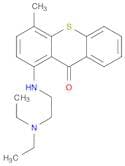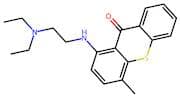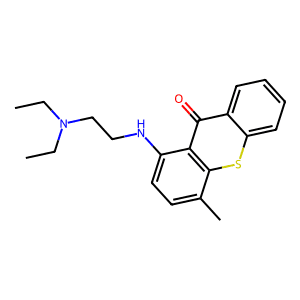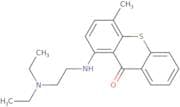
CAS 479-50-5
:Lucanthone
- 1-(2-Diethylaminoethylamino)-4-methylthiaxanthen-9-one
- 1-[[2-(Diethylamino)ethyl]amino]-4-methyl-9H-thioxanthen-9-one
- Lucanthon
- Lucanthone
- Lucatona
- NSC 20530
- Thioxanthen-9-one, 1-[[2-(diethylamino)ethyl]amino]-4-methyl-
- 9H-Thioxanthen-9-one, 1-[[2-(diethylamino)ethyl]amino]-4-methyl-
1-((2-(Diethylamino)ethyl)amino)-4-methyl-9H-thioxanthen-9-one , Lucanthone
CAS :Formule :C20H24N2OSDegré de pureté :95%Couleur et forme :SolidMasse moléculaire :340.48241-((2-(Diethylamino)Ethyl)Amino)-4-Methyl-9H-Thioxanthen-9-One
CAS :1-((2-(Diethylamino)Ethyl)Amino)-4-Methyl-9H-Thioxanthen-9-OneDegré de pureté :99+%Masse moléculaire :340.48g/molLucanthone
CAS :Lucanthone (Lucanthonum) is an inhibitor of Apurinic endonuclease-1 (APE-1).Formule :C20H24N2OSDegré de pureté :99.92%Couleur et forme :Yellow Crystals From Alcohol SolidMasse moléculaire :340.48Ref: TM-T4569
1mg52,00€2mg75,00€5mg119,00€10mg178,00€25mg379,00€50mg560,00€100mg793,00€1mL*10mM (DMSO)133,00€Lucanthone
CAS :Lucanthone is an intramolecular hydrogen-transfer compound that is synthesized from the amino acid cysteine. It has been used in biological studies for its ability to inhibit the growth of cancer cells, and may be useful in radiation therapy. Lucanthone has been shown to have a cytotoxic effect on cancer cells by inhibiting cell proliferation and inducing apoptosis. This compound also inhibits autophagy, which is the process of degrading proteins and organelles. Lucanthone has also been shown to decrease cellular viability in wild-type strains of bacteria such as E. coli, but not mutant strains that lack lucanthone reductase activity. This suggests that lucanthone is an inhibitor of physiological function in mammalian tissues, but not bacterial cell functions.
Formule :C20H24N2OSDegré de pureté :Min. 95%Masse moléculaire :340.48 g/mol