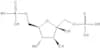
CAS 488-69-7
:Fructose 1,6-bisphosphate
Description :
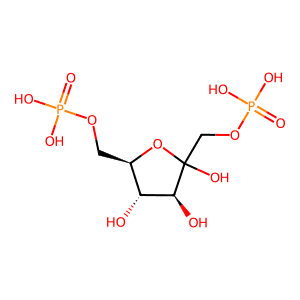
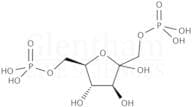
Fructose 1,6-bisphosphate (FBP) est un intermédiaire crucial dans la voie glycolytique, jouant un rôle significatif dans le métabolisme cellulaire. C'est un sucre phosphorylé, spécifiquement un hexose, dérivé du fructose. Le composé présente deux groupes phosphate attachés aux premier et sixième atomes de carbone, qui sont essentiels à sa fonction dans la production d'énergie. FBP est un composé incolore et soluble dans l'eau, et sa structure lui permet de participer à diverses réactions enzymatiques, en particulier celles catalysées par l'aldolase et la fructose-1,6-bisphosphatase. Il agit comme un régulateur allostérique, influençant l'activité des enzymes clés dans les voies métaboliques, jouant ainsi un rôle dans la régulation de la gluconéogenèse et de la glycolyse. La présence des groupes phosphate contribue à ses caractéristiques à haute énergie, en faisant une molécule vitale dans les processus de transfert d'énergie au sein des cellules. De plus, FBP est impliqué dans la régulation du flux métabolique et est un acteur clé dans l'équilibre entre la production et la consommation d'énergie chez les organismes vivants.
Formule :C6H14O12P2
InChI :InChI=1S/C6H14O12P2/c7-3(1-17-19(11,12)13)5(9)6(10)4(8)2-18-20(14,15)16/h3,5-7,9-10H,1-2H2,(H2,11,12,13)(H2,14,15,16)/t3-,5-,6-/m1/s1
Code InChI :InChIKey=XPYBSIWDXQFNMH-UYFOZJQFSA-N
SMILES :[C@H]([C@@H](C(COP(=O)(O)O)=O)O)([C@@H](COP(=O)(O)O)O)O
Synonymes :- 1,6-Bis(dihydrogenophosphate) de D-fructose
- 1,6-bis(dihidrogenofosfato) de D-fructosa
- 1,6-di-O-phosphono-D-fructofuranose
- 1,6-di-O-phosphono-D-fructose
- 1,6-di-O-phosphono-beta-D-fructofuranose
- 1,6-di-O-phosphonohex-2-ulofuranose
- 2,5-anhydro-1,6-di-O-phosphono-D-glucitol
- <span class="text-smallcaps">D</span>-Fructose 1,6-biphosphate
- <span class="text-smallcaps">D</span>-Fructose 1,6-bisphosphate
- <span class="text-smallcaps">D</span>-Fructose 1,6-diphosphate
- <span class="text-smallcaps">D</span>-Fructose, 1,6-bis(dihydrogen phosphate)
- D-Fructose 1,6-biphosphate
- D-Fructose 2,6-Diphosphate Di-Sodium Salt
- D-Fructose-1,6-bis(dihydrogenphosphat)
- D-fructose 1,6-bis(dihydrogen phosphate)
- D-fructose 1,6-bisphosphate
- Diphosphofructose
- Esafosfan
- Esafosfina
- F1,6diP
- FDP
- Fosfructose
- Fructose 1,6-bis(dihydrogen phosphate)
- Fructose 1,6-diphosphate
- Fructose Diphosphate
- Fructose, 1,6-bis(dihydrogen phosphate), <span class="text-smallcaps">D</span>-
- Fructose, 1,6-bis(dihydrogen phosphate), D-
- Fructose-1,6-Bisphosphate
- Harden-Young ester
- beta-D-fructofuranose-1,6-diphosphate
- Voir plus de synonymes
Trier par
Degré de pureté (%)
0
100
|
0
|
50
|
90
|
95
|
100
10 produits concernés.
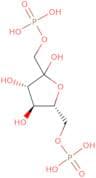
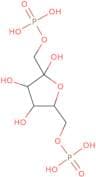
{[(3S,4S,5R)-2,3,4-trihydroxy-5-[(phosphonooxy)methyl]oxolan-2-yl]methoxy}phosphonic acid
CAS :Formule :C6H14O12P2Degré de pureté :98.0%Couleur et forme :SolidMasse moléculaire :340.1157D-Fructose-1,6-diphosphate
CAS :D-Fructose-1,6-diphosphateFormule :C6H14O12P2Degré de pureté :95%Couleur et forme : cream solidMasse moléculaire :340.12g/molFosfructose
CAS :D-fructose-1,6-diphosphate (D-fructose-1,6-diphosphate), also known as Fosfructose, is a cytoprotective natural sugar phosphate.Formule :C6H14O12P2Degré de pureté :99.84%Couleur et forme :SolidMasse moléculaire :340.12D-Fructose-13C6 1,6-Bisphosphate Sodium Salt Hydrate
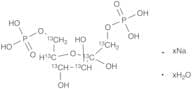
CAS :Produit contrôléApplications Isotope labelled Fructose1,6-bisphosphate is an intermediate that lies within the glycolysis metabolic pathway and is also an allosteric activator of pyruvate kinase.
References Hinder, L.M., et al.: J. Endocriol., 216, 1 (2013); Takubo, K., et al.: Cell. Stem. Cell., 12, 49 (2013); Kalam, Y., et al.: Clin. Toxciol., 50, 546 (2012);Formule :C6H14O12P2•xH2O•xNaCouleur et forme :NeatMasse moléculaire :346.06D-Fructose-1,6-diphosphate
CAS :D-Fructose-1,6-diphosphate is a chemical that is found in the cytosol of cells. It is an intermediate in the metabolism of fructose and also has an important role in the synthesis of fatty acids and phospholipids. D-Fructose-1,6-diphosphate is an effective inhibitor of sodium succinate dehydrogenase, which converts succinate to fumarate. D-Fructose-1,6-diphosphate has a neutral pH profile and is not affected by changes in pH levels. The optimum pH for this compound is between 6.5 and 7.5. D-Fructose-1,6-diphosphate binds to proteins with unsaturated alkyl chains such as creatine kinase and glutamate dehydrogenase. It has been shown to have hemolytic effects on erythrocytes (red blood cells) at high concentrations, which may be due to its ability to bindFormule :C6H14O12P2Degré de pureté :(¹H-Nmr) Min. 95 Area-%Couleur et forme :White PowderMasse moléculaire :340.12 g/molD-FRUCTOFURANOSE 1,6-BISPHOSPHATE
CAS :Formule :C6H14O12P2Degré de pureté :≥98.0%Couleur et forme :Liquid, No data available.Masse moléculaire :339.996D-Fructose-2-13C2 1,6-Bisphosphate Tetrasodium Salt Hydrate
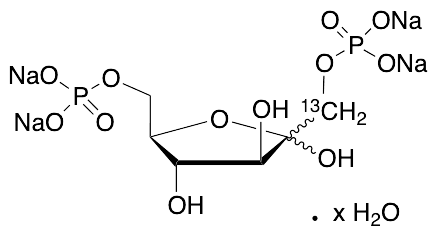
CAS :Produit contrôléApplications Isotope labelled Fructose1,6-bisphosphate is an intermediate that lies within the glycolysis metabolic pathway and is also an allosteric activator of pyruvate kinase.
References Hinder, L.M., et al.: J. Endocriol., 216, 1 (2013); Takubo, K., et al.: Cell. Stem. Cell., 12, 49 (2013); Kalam, Y., et al.: Clin. Toxciol., 50, 546 (2012);Formule :C513CH10Na4O12P2•xH2OCouleur et forme :NeatMasse moléculaire :429.03D-Fructose-13C6-1,6-diphosphate sodium salt
CAS :D-Fructose-13C6-1,6-diphosphate sodium salt is a reactive compound used as a model in studies of metabolic disorders. It has been shown to have an inhibitory effect on the enzymes that catalyze the conversion of D-fructose 1,6 diphosphate to D-fructose 6 phosphate in the cytosol. The compound is also useful for determining the binding of calcium ions to proteins and for measuring the activity of carbon source enzymes.Formule :C6H10Na4O12P2·xH2ODegré de pureté :Min. 95%Couleur et forme :PowderMasse moléculaire :434 g/mol
![{[(3S,4S,5R)-2,3,4-trihydroxy-5-[(phosphonooxy)methyl]oxolan-2-yl]methoxy}phosphonic acid](/_next/image/?url=https%3A%2Fstatic.cymitquimica.com%2Fproducts%2FIN%2Fthumb%2FDA00393R.jpg&w=3840&q=75)