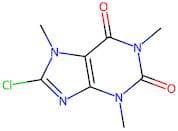
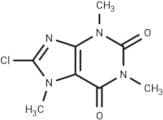
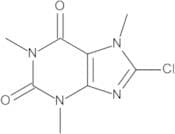
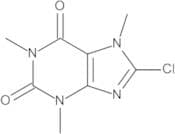
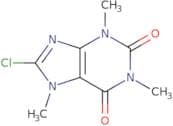
CAS 4921-49-7
:8-Chlorocaféine
Description :
8-Chlorocaféine, avec le numéro CAS 4921-49-7, est un dérivé chloré de la caféine, un stimulant bien connu que l'on trouve dans le café et le thé. Ce composé présente un atome de chlore substitué en position 8 de la molécule de caféine, ce qui modifie ses propriétés chimiques et son activité biologique. Il apparaît généralement sous forme de solide cristallin blanc à blanc cassé et est soluble dans des solvants organiques, bien que sa solubilité dans l'eau puisse être limitée. La présence de l'atome de chlore peut influencer ses effets pharmacologiques, améliorant ou modifiant potentiellement ses propriétés stimulantes par rapport à la caféine. 8-Chlorocaféine suscite un intérêt dans la recherche pour ses applications potentielles en pharmacologie et en biochimie, en particulier dans les études liées au système nerveux central. Comme pour de nombreux composés chlorés, il est essentiel de manipuler 8-Chlorocaféine avec précaution, en tenant compte de la toxicité potentielle et de l'impact environnemental. Dans l'ensemble, sa structure et ses propriétés uniques en font un sujet d'intérêt tant en chimie synthétique qu'en chimie médicinale.
Formule :C8H9ClN4O2
InChI :InChI=1/C8H9ClN4O2/c1-11-4-5(10-7(11)9)12(2)8(15)13(3)6(4)14/h1-3H3
Code InChI :InChIKey=HGKPGBJNNATDRR-UHFFFAOYSA-N
SMILES :CN1C2=C(C(=O)N(C)C1=O)N(C)C(Cl)=N2
Synonymes :- 1H-Purine-2,6-dione, 8-chloro-3,7-dihydro-1,3,7-trimethyl-
- 1H-Purine-2,6-dione, 8-chloro-3,7-dihydro-1,3,7-trimethyl- (9CI)
- 8-Chloro-1,3,7-trimethylxanthine
- 8-Chlorocaffeine
- 8-chloro-1,3,7-trimethyl-3,7-dihydro-1H-purine-2,6-dione
- Brn 0232628
- Caffeine, 8-chloro-
- Nsc 6277
- 8-Chloro-3,7-dihydro-1,3,7-trimethyl-1H-purine-2,6-dione
- 5-26-14-00135 (Beilstein Handbook Reference)
- 8-Chloro-3,7-dihydro-1,3,7-trimethyl-1H-purine-2,6-dione
- 1,3,7-Trimethyl-8-chloroxanthine
- Caffeine EP Impurity A
- Dimenhydrinate EP Impurity E (8-Chlorocaffeine)
- Dimenhydrinate Impurity 3
- 8-Chloro-1,3,7-trimethyl-3,7-dihydr
- Dimenhydrinate Impurity 5 (Dimenhydrinate EP Impurity E)
- Caffeine Impurity 2
- Dimenhydrinate Impurity E
- Dimenhydrinate Related Compound E (8-chloro-3,7-dihydro-1,3,7-trimethyl-1H-purine-2,6-dione) (1206017)
- DiMenhydrinate Related CoMpound E
- Dimenhydrinate USP Related Compound E
- Voir plus de synonymes
Trier par
Degré de pureté (%)
0
100
|
0
|
50
|
90
|
95
|
100
9 produits concernés.
Dimenhydrinate Related Compound E (8-chloro-3,7-dihydro-1,3,7-trimethyl-1H-purine-2,6-dione)
CAS :Vegetable alkaloids, natural or reproduced by synthesis, their salts and other derivatives, nesoiFormule :C8H9ClN4O2Couleur et forme :White Off-White PowderMasse moléculaire :228.04148-Chloro caffeine
CAS :8-Chloro caffeine binds to adenosine receptors with a Ki of 30 µM. It enhances UV-induced chromosomal aberrations in the Cl-I type Chinese hamster embryo lung cells. 8-Chloro caffeine is a derivative of the methylxanthine alkaloid caffeine.Formule :C8H9ClN4O2Couleur et forme :SolidMasse moléculaire :228.64Dimenhydrinate EP Impurity E (Dimenhydrinate USP Related Compound E)
CAS :Formule :C8H9ClN4O2Couleur et forme :White To Off-White SolidMasse moléculaire :228.648-Chloro-1,3,7-trimethyl-3,7-dihydro-1H-purine-2,6-dione (8-Chlorocaffeine)
CAS :Couleur et forme :Neat8-Chloro Caffeine
CAS :Applications A halogenated analog of Caffeine (C080100) as potential radiosensitizing agent.
References Bruns, R.F., et al.: Biochem. Pharmacol., 30, 325 (1981),Formule :C8H9ClN4O2Couleur et forme :White SolidMasse moléculaire :228.64Dimenhydrinate Related Compound E
CAS :Produit contrôléDimenhydrinate Related Compound E is a test compound that has shown potentiation of the inhibitory properties of hydrochloric acid against a variety of enzymes. This compound inhibits the enzyme activity of cyclooxygenase-1 (COX-1) and COX-2, which are important in the production of prostaglandins. Dimenhydrinate Related Compound E also has anticancer activity, which may be due to its ability to cause DNA damage by inhibiting the synthesis of proteins needed for cell replication. The use of this compound may have genotoxic effects and chronic exposure should be avoided.Formule :C8H9ClN4O2Degré de pureté :Min. 95%Masse moléculaire :228.64 g/mol