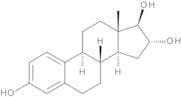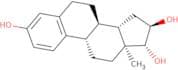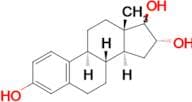
CAS 50-27-1
:Œstriol
Description :
Œstriol, avec le numéro CAS 50-27-1, est un œstrogène naturellement présent et l'un des trois principaux œstrogènes produits par le corps humain, aux côtés de l'estradiol et de l'estrone. Il est principalement synthétisé dans le placenta pendant la grossesse et joue un rôle crucial dans le maintien de la grossesse et le développement fœtal. Œstriol se caractérise par son activité œstrogénique relativement faible par rapport à l'estradiol et à l'estrone, ce qui le rend moins puissant pour stimuler les récepteurs des œstrogènes. D'un point de vue chimique, c'est une hormone stéroïdienne avec une formule moléculaire de C18H24O3, présentant une structure phénolique qui contribue à son activité biologique. Œstriol est souvent utilisé dans la thérapie de remplacement hormonal, en particulier pour les symptômes de la ménopause, et est également étudié pour ses effets protecteurs potentiels contre certains cancers liés aux hormones. Sa pharmacocinétique implique un métabolisme et une excrétion rapides, principalement par le foie. En raison de son rôle spécifique dans la santé reproductive, les niveaux de Œstriol sont surveillés pendant la grossesse et peuvent être indicatifs du bien-être fœtal.
Formule :C18H24O3
InChI :InChI=1S/C18H24O3/c1-18-7-6-13-12-5-3-11(19)8-10(12)2-4-14(13)15(18)9-16(20)17(18)21/h3,5,8,13-17,19-21H,2,4,6-7,9H2,1H3/t13-,14-,15+,16-,17+,18+/m1/s1
Code InChI :InChIKey=PROQIPRRNZUXQM-ZXXIGWHRSA-N
SMILES :C[C@@]12[C@]([C@]3([C@@](C=4C(CC3)=CC(O)=CC4)(CC1)[H])[H])(C[C@@H](O)[C@@H]2O)[H]
Synonymes :- (16Alpha,17Beta)-Estra-1,3,5(10)-Triene-3,16,17-Triol
- (16α,17β)-Estra-1,3,5(10)-triene-3,16,17-triol
- (8R,13S,17R)-13-methyl-6,7,8,9,11,12,14,15,16,17-decahydrocyclopenta[a]phenanthrene-3,16,17-triol
- 1,3,5 (10)-Estratriene-3, 16α, 17β-triol
- 1,3,5(10)-Estratriene-3,16a,17b-triol
- 13β-Methyl-1,3,5(10)-gonatriene-3,16α,17β-triol
- 16α,17β-Estriol
- 16α-Estriol
- 16α-Hydroxyestradiol
- 3,16α,17β-Estriol
- 3,16α,17β-Trihydroxyestra-1,3,5(10)-triene
- Aacifemine
- Colpogyn
- Destriol
- ESTRA-1,3,5(10)-TRIENE-3,16α,17β-TRIOL
- Estra-1,3,5(10)-triene-3,16,17-triol, (16α,17β)-
- Estra-1,3,5(10)-triene-3,16alpha,17beta-triol
- Estratriol
- Estriel
- Follicular hormone hydrate
- Gynasan
- Holin V
- Hormomed
- Incurin
- Klimax E
- Klimoral
- Nsc 12169
- OE3
- OE<sub>3</sub>
- Oekolp
- Oestriol
- Ortho-Gynest
- Ovesterin
- Ovestin
- Ovestrion
- Ovo-Vinces
- Theelol
- Tridestrin
- Trihydroxyestrin
- Triovex
- Voir plus de synonymes
Trier par
Degré de pureté (%)
0
100
|
0
|
50
|
90
|
95
|
100
Estriol
CAS :Produit contrôléApplications A metabolite of Estradiol (E888000). An estrogenic metabolite considerably less potent than the hormone Estradiol (E888000).
References Marrian, et al.: Biochem. J., 23,1090 (1929), Huffman, et al.: J. Biol. Chem., 169, 167 (1947),Formule :C18H24O3Couleur et forme :NeatMasse moléculaire :288.38Estriol
CAS :Produit contrôléEstriol is a steroidal estrogen, which is a naturally occurring hormone primarily sourced from the placenta during pregnancy. Its mode of action involves binding to estrogen receptors, thereby exerting its effects as part of the broader group of estrogens. Estriol has a relatively lower affinity for estrogen receptors compared to estradiol, contributing to its unique pharmacological profile.In scientific research and clinical settings, Estriol is employed in hormone replacement therapy, especially in postmenopausal women, due to its milder estrogenic effects and lower associated risks compared to other estrogens. It is also studied for its potential benefits in urogynecological health, such as the treatment of menopausal symptoms like vaginal atrophy. Furthermore, its application is under investigation for autoimmune conditions such as multiple sclerosis, given its immunomodulatory properties. Ongoing research aims to delineate the therapeutic potential and safety profile of Estriol in various clinical contexts.Formule :C18H24O3Degré de pureté :Min. 97 Area-%Couleur et forme :White PowderMasse moléculaire :288.38 g/mol