CAS 502-22-7
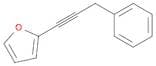
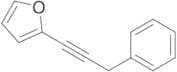
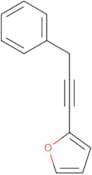
:2-(3-Phényl-1-propyn-1-yl)furane
Description :
2-(3-Phényl-1-propyn-1-yl)furane, avec le numéro CAS 502-22-7, est un composé organique caractérisé par sa structure en anneau de furanes substitué par un groupe propyne et un groupe phényle. Ce composé présente une partie de furanes, qui est un anneau aromatique à cinq membres contenant un atome d'oxygène, contribuant à sa réactivité et stabilité potentielles. La présence du groupe phényle améliore ses caractéristiques aromatiques, tandis que le substituant propyne introduit une liaison triple, qui peut participer à diverses réactions chimiques, telles que l'addition ou la substitution. Le composé est généralement un liquide ou un solide incolore à jaune pâle, selon sa pureté et ses conditions spécifiques. Il peut présenter des propriétés intéressantes telles que la fluorescence ou la réactivité photochimique en raison de son système conjugué. De plus, sa structure unique peut conférer des activités biologiques spécifiques, ce qui le rend intéressant en chimie médicinale et en science des matériaux. Comme pour de nombreux composés organiques, la manipulation doit être effectuée avec précaution, en tenant compte de la toxicité potentielle et de l'impact environnemental.
Formule :C13H10O
InChI :InChI=1S/C13H10O/c1-2-6-12(7-3-1)8-4-9-13-10-5-11-14-13/h1-3,5-7,10-11H,8H2
Code InChI :InChIKey=ICRHFCVRNWSKQH-UHFFFAOYSA-N
SMILES :C(#CCC1=CC=CC=C1)C2=CC=CO2
Synonymes :- 2-(3-Phenyl-1-propyn-1-yl)furan
- Carlina oxide
- Furan, 2-(3-phenyl-1-propyn-1-yl)-
- Furan, 2-(3-phenyl-1-propynyl)-
Trier par
Degré de pureté (%)
0
100
|
0
|
50
|
90
|
95
|
100
4 produits concernés.
2-(3-phenylprop-1-ynyl)furan
CAS :Formule :C13H10ODegré de pureté :95%+Couleur et forme :LiquidMasse moléculaire :182.2179Carlina Oxide
CAS :Produit contrôléApplications Carlina oxide is a natural polyacetylene from Carlina acaulis (Asteraceae). It showed antimicrobial, anti-inflammatory, anti-ulcer and antioxidant activities in rats.
References Herrmann, F., et al.: Planta Medica, 77, 1905 (2011); Dordevic, S., et al.: J. Ethnopharmacol., 109, 458 (2007)Formule :C13H10OCouleur et forme :NeatMasse moléculaire :182.218Carlina oxide
CAS :Carlina oxide is a natural antibacterial compound that has been shown to inhibit the growth of C. glabrata and other bacteria. It is an antioxidant compound with strong antioxidative activity, which has been demonstrated by its ability to protect cells from damage induced by hydrogen peroxide. Carlina oxide also shows potent cytotoxicity against human cancer cells and has been shown to be effective in animal models for the treatment of infections caused by E. coli and F. faecalis strains. This compound has not yet been synthesized but can be extracted from the leaves of carline thistle (Carlina vulgaris).Formule :C13H10ODegré de pureté :Min. 95%Masse moléculaire :182.22 g/molCarlina oxide
CAS :Carlina oxide is both an AChE inhibitor and an antioxidant, effective in eliminating mosquito larvae (LC50=1.39 μg/mL). Furthermore, Carlina oxide exhibits cytotoxicity in vertebrate cells, human dermis, and HCT116 and MDA-MB231 cell lines.Formule :C13H10OCouleur et forme :SolidMasse moléculaire :182.22