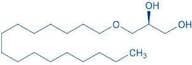
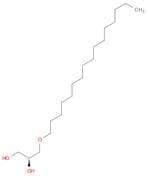
CAS 506-03-6
:Alcool chimylique
Description :
Alcool chimylique, avec le numéro CAS 506-03-6, est un alcool gras à chaîne longue qui est principalement dérivé de sources naturelles, en particulier de l'huile du fruit de la plante Chimera. Il se caractérise par sa nature hydrophobe en raison de sa longue chaîne d'hydrocarbures, qui se compose généralement de 18 atomes de carbone. Cette structure confère des propriétés telles qu'une faible solubilité dans l'eau et une tendance à agir comme tensioactif ou émulsifiant dans diverses formulations. Alcool chimylique est souvent utilisé dans les industries cosmétiques et de soins personnels pour ses propriétés hydratantes, car il peut aider à améliorer la texture et l'hydratation de la peau. De plus, il peut servir de lubrifiant et d'agent épaississant dans divers produits. La substance est généralement considérée comme sûre pour une utilisation dans les cosmétiques, bien que, comme de nombreux alcools, elle puisse provoquer des irritations chez les personnes sensibles. Sa stabilité chimique et sa compatibilité avec d'autres ingrédients en font un composant précieux dans les formulations visant à améliorer les produits de soin de la peau et des cheveux.
Formule :C19H40O3
InChI :InChI=1/C19H40O3/c1-2-3-4-5-6-7-8-9-10-11-12-13-14-15-16-22-18-19(21)17-20/h19-21H,2-18H2,1H3
Code InChI :InChIKey=OOWQBDFWEXAXPB-IBGZPJMESA-N
SMILES :C(CCCCCCCCCCCCCC)COC[C@H](CO)O
Synonymes :- (2S)-3-(Hexadecyloxy)-1,2-propanediol
- (2S)-3-Hexadecoxypropane-1,2-diol
- (S)-(+)-Chimyl alcohol
- 1,2-Propanediol, 3-(hexadecyloxy)-
- 1,2-Propanediol, 3-(hexadecyloxy)-, (2S)-
- 1,2-Propanediol, 3-(hexadecyloxy)-, (S)-
- 1-Hexadecyl-sn-glycerol
- 1-O-Hexadecyl-sn-glycerol
- 3-(Hexadecyloxy)-1,2-propanediol
- 3-(Hexadecyloxy)Propane-1,2-Diol
- Chimyl alcohol
- Nikkol Chimyl Alcohol 100
- Testriol
- α-Chimyl alcohol
- (S)-3-(Hexadecyloxy)propane-1,2-diol
- 3-(hexadecyloxy)-2-propanediol
- (S)-3-(Hexadecyloxy)-1,2-propanediol
- MONOCERYL GLYCERYL ETHER
- 1-O-hexadecyl-sn-glycerol (HG)
- 1-O-HEXADECYL-
- -glycerol (HG)
- sn
- SN
- 1-O-hexadecyl-
- 3-cetyloxypropane-1,2-diol
- 1-C16 Ether MG
- 1-hexadecylglycerol
- -GLYCEROL (HG);1-C16 ETHER MG
- 1-O-PALMITOYL-SN-GLYCEROL
- 1-o-hexadecylglycerol
- α-hexadecylglyceryl ether
- 3-hexadecoxypropane-1,2-diol
- Voir plus de synonymes
Trier par
Degré de pureté (%)
0
100
|
0
|
50
|
90
|
95
|
100
6 produits concernés.
1-O-Hexadecyl-sn-glycerol
CAS :Bachem ID: 4010402.
Formule :C19H40O3Degré de pureté :> 99%Couleur et forme :White PowderMasse moléculaire :316.531-O-Hexadecyl-SN-Glycerol
CAS :Formule :C19H40O3Degré de pureté :98%Couleur et forme :SolidMasse moléculaire :316.51911-O-Hexadecyl-sn-glycerol
CAS :1-O-Hexadecyl-sn-glycerol protects keratinocytes from UVB damage, reduces ROS and PGE2, and enhances coronary flow, cytoprotective and cardioprotective.Formule :C19H40O3Degré de pureté :99.51%Couleur et forme :SolidMasse moléculaire :316.521-O-Hexadecyl-sn-glycerol
CAS :Produit contrôléApplications 1-O-Hexadecyl-sn-glycerol restores plasmalogen levels in Chinese hamster ovary (CHO) cells and human pulmonary arterial endothelial cells (PAEC). Plasmalogen may play a role in protecting animal cells against photosensitized killing.
References Zoeller, R., et al.: J. Biol. Chem., 263, 11590 (1988); Zoeller, R., et al.: Am. J. Physiol., 283, H671 (2002)Formule :C19H40O3Couleur et forme :NeatMasse moléculaire :316.5191-O-Hexadecyl-sn-glycerol
CAS :1-O-Hexadecyl-sn-glycerol is a glycol ether that is used as a surfactant and emulsifier in cosmetic products. It has been shown to have minimal toxicity, and to not be carcinogenic or teratogenic. 1-O-Hexadecyl-sn-glycerol has been shown to increase the stability of proteins in rat liver microsomes, and it also prevents the hydrolysis of carbohydrates. The surface glycoprotein adsorbed by 1-O-Hexadecyl-sn-glycerol may play an important role in the binding of monoclonal antibodies. This compound affects cellular calcium levels, with high concentrations resulting in increased cytosolic calcium concentrations. Zirconium oxide can replace calcium ions in 1-O-Hexadecyl-sn-glycerol for this purpose, although this substitution reduces enzyme activity.Formule :C19H40O3Degré de pureté :Min. 95%Masse moléculaire :316.52 g/mol