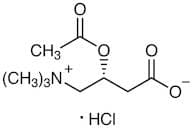
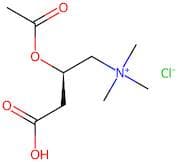
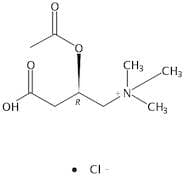
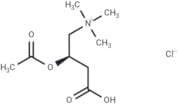
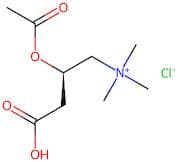
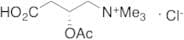
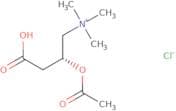
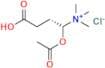
CAS 5080-50-2
:Chlorhydrate d'acétyl L-carnitine
- (2R)-2-(acetyloxy)-3-carboxy-N,N,N-trimethylpropan-1-aminium chloride
- (R)-3-Acetoxy-4-(trimethylammonio)butyrate hydrochloride
- 1-Propanaminium, 2-(acetyloxy)-3-carboxy-N,N,N-trimethyl-, chloride (1:1), (2R)-
- 1-Propanaminium, 2-(acetyloxy)-3-carboxy-N,N,N-trimethyl-, chloride, (2R)-
- 1-Propanaminium, 2-(acetyloxy)-3-carboxy-N,N,N-trimethyl-, chloride, (R)-
- <span class="text-smallcaps">L</span>-Acetylcarnitine chloride
- Acetyl <span class="text-smallcaps">L</span>-carnitine hydrochloride
- Acetyl L-carnitine HCL
- Acetyl-L-carnitine Hydrochloride
- Acetylcarnitine chloride
- Ammonium, (3-carboxy-2-hydroxypropyl)trimethyl-, chloride, acetate, (-)-
- Branigen
- Levacecarnine hydrochloride
- N-Acetyl-L-Carnitine HCL
- Normobren
- O-Acetylcarnitine hydrochloride
- R(-)-2-Acetyloxy-3-carboxy-N,N,N-trimethyl-1-propanaminium chloride
- St 200
- Zibren
- Voir plus de synonymes
Acetyl-L-carnitine Hydrochloride
CAS :Formule :C9H17NO4·HClDegré de pureté :>98.0%(T)Couleur et forme :White to Almost white powder to crystalMasse moléculaire :239.70O-Acetyl-L-carnitine HCl
CAS :Formule :C9H18ClNO4Degré de pureté :97%Couleur et forme :SolidMasse moléculaire :239.6965Acetyl-L-carnitine hydrochloride
CAS :Acetyl-L-carnitine hydrochlorideDegré de pureté :≥95%Masse moléculaire :239.7g/molAcetyl-L-carnitine hydrochloride
CAS :Formule :C9H17NO4·HClDegré de pureté :98.0 - 102.0 %Couleur et forme :White to almost white powderMasse moléculaire :239.70Acetyl-L-Carnitine HCl salt
CAS :Formule :C9H18NO4.ClDegré de pureté :>98%Couleur et forme :SolidMasse moléculaire :239.7Acetyl-L-carnitine hydrochloride
CAS :Acetyl-L-carnitine HCl: A supplement with neuroprotective, cognitive, anti-depressive properties, may ease neuropathy and modulate immunity.Formule :C9H18ClNO4Degré de pureté :96.99% - 99.34%Couleur et forme :White PowderMasse moléculaire :239.7N-Acetyl-L-carnitine hydrochloride
CAS :N-Acetyl-L-carnitine hydrochlorideFormule :C9H18NO4·ClDegré de pureté :97% by nmr (Typical Value in Batch COA)Couleur et forme : white solidMasse moléculaire :239.70g/molAcetyl L-Carnitine Hydrochloride
CAS :Applications Acetyl-L-carnitine is a mitochondrial metabolite that helps to transport fatty acids into the mitochondria for energy (1). Acetyl-L-carnitine also upregulate metabotropic glutamate receptor 2 (mGlu2) via NF-κB p65 acetylation (2,3). It exhibits antidepressant and neuroprotective properties.
References (1) Stephens, F. B., et al.: J Physiol. 581, 431 (2007) (2) Wang, S. M., et al.: J Psychiatr Res. 53, 30 (2014) (3) Cuccurazzu, B., et al.: Neuropsychopharmacology 38, 2220 (2013)Formule :C9H18NO4·ClCouleur et forme :NeatMasse moléculaire :239.7Acetyl L-carnitine chloride
CAS :Acetyl L-carnitine chloride (ALCAR) is a carnitine molecule that is used as a dietary supplement. It can be converted to acetyl coenzyme A, which provides energy for the cells and helps with the production of neurotransmitters. ALCAR has been shown to reduce neuronal death in an animal model of oxidative injury. It also increases levels of glutathione and prevents lipid peroxidation. Acetyl L-carnitine chloride is a cell permeable reagent that can be used to measure GSH-px activities in biological samples. This compound has been shown to inhibit the activity of cell nuclei and mitochondrial enzymes, such as succinate dehydrogenase, citrate synthase, and malate dehydrogenase.
Formule :C9H18ClNO4Degré de pureté :Min. 95%Couleur et forme :White PowderMasse moléculaire :239.7 g/molAcetyl-L-carnitine chloride
CAS :Formule :C9H18ClNO4Degré de pureté :98%Couleur et forme :SolidMasse moléculaire :239.7(S)-3-Acetoxy-4-(trimethylammonio)butanoate hydrochloride
CAS :Formule :C9H18ClNO4Degré de pureté :≥99%Masse moléculaire :239.7