CAS 50935-71-2
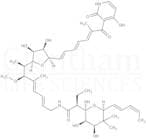
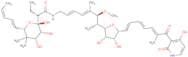
:Kirromycine
Description :
Kirromycine est un composé antibiotique qui appartient à la classe des macrolides, connu spécifiquement pour son activité contre certaines souches bactériennes. Il est produit par la bactérie *Micromonospora purpurea* et présente un mécanisme d'action unique en inhibant la synthèse des protéines dans les bactéries. Kirromycine se lie à la sous-unité ribosomique, interférant avec l'étape de translocation lors de la traduction, ce qui arrête finalement la croissance bactérienne. Ce composé se caractérise par sa structure complexe de macrolide, qui comprend un grand anneau de lactone et divers groupes fonctionnels qui contribuent à son activité biologique. Kirromycine a été étudié pour ses applications thérapeutiques potentielles, en particulier dans le traitement des infections causées par des bactéries Gram-positives. Cependant, son utilisation clinique est limitée en raison du développement de résistance et de la disponibilité d'antibiotiques plus efficaces. Comme pour de nombreux antibiotiques, la compréhension de la pharmacocinétique, de la toxicité et des mécanismes de résistance de Kirromycine continue d'évoluer, en faisant un sujet d'intérêt dans la recherche microbiologique et pharmaceutique.
Formule :C43H60N2O12
InChI :InChI=1S/C43H60N2O12/c1-9-11-13-21-31-42(6,7)38(50)39(51)43(54,57-31)28(10-2)40(52)44-23-17-16-19-26(4)36(55-8)27(5)37-35(49)34(48)30(56-37)20-15-12-14-18-25(3)33(47)32-29(46)22-24-45-41(32)53/h9,11-22,24,27-28,30-31,34-39,48-51,54H,10,23H2,1-8H3,(H,44,52)(H2,45,46,53)/b11-9-,14-12+,17-16+,20-15+,21-13+,25-18+,26-19+/t27-,28-,30-,31+,34+,35+,36-,37+,38+,39-,43-/m1/s1
Code InChI :InChIKey=HMSYAPGFKGSXAJ-PAHGNTJYSA-N
SMILES :[C@H](C(NC/C=C/C=C(/[C@H]([C@@H](C)[C@@]1(O[C@H](/C=C/C=C/C=C(/C(=O)C2=C(O)C=CNC2=O)\C)[C@H](O)[C@@H]1O)[H])OC)\C)=O)(CC)[C@@]3(O)O[C@@H](/C=C/C=C\C)C(C)(C)[C@@H](O)[C@H]3O
Synonymes :- (2R)-N-[(2E,4E,6R)-7-[(2S,5R)-3,4-dihydroxy-5-[(1E,3E,5E)-7-(2-hydroxy-4-oxo-1H-pyridin-3-yl)-6-methyl-7-oxo-hepta-1,3,5-trienyl]tetrahydrofuran-2-yl]-6-methoxy-5-methyl-octa-2,4-dienyl]-2-[2,3,4-trihydroxy-5,5-dimethyl-6-[(1E,3Z)-penta-1,3-dienyl]tetrahydropyran-2-yl]butanamide
- (2S)-N-[(6S,7R)-7-{(2S,3S,4R,5R)-3,4-dihydroxy-5-[7-(2-hydroxy-4-oxo-1,4-dihydropyridin-3-yl)-6-methyl-7-oxohepta-1,3,5-trien-1-yl]tetrahydrofuran-2-yl}-6-methoxy-5-methylocta-2,4-dien-1-yl]-2-[(2R,3R,4R,6S)-2,3,4-trihydroxy-5,5-dimethyl-6-(penta-1,3-dien-1-yl)tetrahydro-2H-pyran-2-yl]butanamide (non-preferred name)
- (αS,2R,3R,4R,6S)-N-[(2E,4E,6S,7R)-7-[(2S,3S,4R,5R)-5-[(1E,3E,5E)-7-(1,2-Dihydro-4-hydroxy-2-oxo-3-pyridinyl)-6-methyl-7-oxo-1,3,5-heptatrien-1-yl]tetrahydro-3,4-dihydroxy-2-furanyl]-6-methoxy-5-methyl-2,4-octadien-1-yl]-α-ethyltetrahydro-2,3,4-trihydroxy-5,5-dimethyl-6-(1E,3Z)-1,3-pentadien-1-yl-2H-pyran-2-acetamide
- 2H-Pyran-2-acetamide, N-[(2E,4E,6S,7R)-7-[(2S,3S,4R,5R)-5-[(1E,3E,5E)-7-(1,2-dihydro-4-hydroxy-2-oxo-3-pyridinyl)-6-methyl-7-oxo-1,3,5-heptatrien-1-yl]tetrahydro-3,4-dihydroxy-2-furanyl]-6-methoxy-5-methyl-2,4-octadien-1-yl]-α-ethyltetrahydro-2,3,4-trihydroxy-5,5-dimethyl-6-(1E,3Z)-1,3-pentadien-1-yl-, (αS,2R,3R,4R,6S)-
- 2H-Pyran-2-acetamide, N-[(2E,4E,6S,7R)-7-[(2S,3S,4R,5R)-5-[(1E,3E,5E)-7-(1,2-dihydro-4-hydroxy-2-oxo-3-pyridinyl)-6-methyl-7-oxo-1,3,5-heptatrienyl]tetrahydro-3,4-dihydroxy-2-furanyl]-6-methoxy-5-methyl-2,4-octadienyl]-α-ethyltetrahydro-2,3,4-trihydroxy-5,5-dimethyl-6-[(1E,3Z)-1,3-pentadienyl]-, (αS,2R,3R,4R,6S)-
- 2H-Pyran-2-acetamide, N-[7-[5-[7-(1,2-dihydro-4-hydroxy-2-oxo-3-pyridinyl)-6-methyl-7-oxo-1,3,5-heptatrienyl]tetrahydro-3,4-dihydroxy-2-furanyl]-6-methoxy-5-methyl-2,4-octadienyl]-α-ethyltetrahydro-2,3,4-trihydroxy-5,5-dimethyl-6-(1,3-pentadienyl)-, [2R-[2α,2[S*[2E,4E,6S*,7R*[2S*,3S*,4R*,5R*(1E,3E,5E)]]],3β,4β,6β(1E,3E)]]-
- Delvomycin
- Kirromycin
- Mocimycin
- N-[(2E,4E)-7-{3,4-dihydroxy-5-[(1E,3E,5E)-7-(2-hydroxy-4-oxo-1,4-dihydropyridin-3-yl)-6-methyl-7-oxohepta-1,3,5-trien-1-yl]tetrahydrofuran-2-yl}-6-methoxy-5-methylocta-2,4-dien-1-yl]-2-{2,3,4-trihydroxy-5,5-dimethyl-6-[(1E,3E)-penta-1,3-dien-1-yl]tetrahydro-2H-pyran-2-yl}butanamide (non-preferred name)
- NSC 316094
- Voir plus de synonymes
Trier par
Degré de pureté (%)
0
100
|
0
|
50
|
90
|
95
|
100
3 produits concernés.
Kirromycin
CAS :Formule :C43H60N2O12Degré de pureté :≥ 96.0%Couleur et forme :Yellow powderMasse moléculaire :796.94Kirromycin from Streptomyces collinus
CAS :Kirromycin is a hydroxylated tetracycline antibiotic that inhibits protein synthesis. It is used as a chemotherapeutic treatment against microbial infections, and has been shown to be effective against Streptomyces collinus. Kirromycin is also an inhibitor of bacterial ribosome activity, which can lead to the death of bacteria. This compound binds to the 30S subunit of the ribosome and prevents the attachment of amino acids to the nascent polypeptide chain during protein synthesis. The antibiotic thiostrepton from Streptomyces collinus was found to inhibit both growth and antibiotic resistance in Saccharomyces cerevisiae strains.Formule :C43H60N2O12Degré de pureté :Min. 95%Masse moléculaire :796.94 g/mol