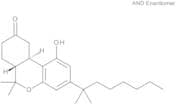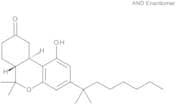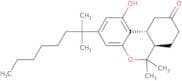
CAS 51022-71-0
:Nabilone
Description :
Nabilone est un cannabinoïde synthétique qui imite les effets du tétrahydrocannabinol (THC), le principal composant psychoactif du cannabis. Il est principalement utilisé comme antiémétique pour traiter les nausées et les vomissements associés à la chimiothérapie chez les patients atteints de cancer. Nabilone agit sur les récepteurs cannabinoïdes dans le cerveau, influençant la libération de neurotransmetteurs et apportant un soulagement des symptômes. La substance se caractérise par sa structure chimique, qui comprend une structure bicyclique et une série de groupes fonctionnels qui contribuent à son activité pharmacologique. Nabilone est généralement administré sous forme de capsules et a une demi-vie relativement longue, permettant des effets thérapeutiques soutenus. Les effets secondaires courants peuvent inclure des vertiges, une bouche sèche et des altérations de l'humeur ou de la perception. En raison de ses propriétés psychoactives, Nabilone est classé comme une substance contrôlée dans de nombreuses juridictions, nécessitant une réglementation et un suivi attentifs dans l'utilisation clinique. Son profil d'efficacité et de sécurité en a fait une option précieuse dans la gestion des nausées et vomissements induits par la chimiothérapie, en particulier pour les patients qui ne répondent pas aux traitements conventionnels.
Formule :C24H36O3
InChI :InChI=1/C24H36O3/c1-6-7-8-9-12-23(2,3)16-13-20(26)22-18-15-17(25)10-11-19(18)24(4,5)27-21(22)14-16/h13-14,18-19,26H,6-12,15H2,1-5H3/t18-,19-/s2
Code InChI :InChIKey=GECBBEABIDMGGL-PVIFGLDDNA-N
SMILES :OC1=C2[C@]3([C@](C(C)(C)OC2=CC(C(CCCCCC)(C)C)=C1)(CCC(=O)C3)[H])[H]
Synonymes :- (±)-trans-3-(1,1-Dimethylheptyl)-7,8,10,10α-tetrahydro-1-hydroxy-6,6-dimethyl-6H-dibenzo-[b,d]pyran-9(6αH)one
- 9H-Dibenzo[b,d]pyran-9-one, 3-(1,1-dimethylheptyl)-6,6a,7,8,10,10a-hexahydro-1-hydroxy-6,6-dimethyl-, trans-
- Canemes
- Cesamet
- Compd. 109514
- Lilly 109514
- Ly 109514
- Nabilone
- rel-(6aR,10aR)-3-(1,1-Dimethylheptyl)-6,6a,7,8,10,10a-hexahydro-1-hydroxy-6,6-dimethyl-9H-dibenzo[b,d]pyran-9-one
- trans-Nabilone
- 9H-dibenzo[b,d]pyran-9-one, 3-(1,1-dimethylheptyl)-6,6a,7,8,10,10a-hexahydro-1-hydroxy-6,6-dimethyl-, (6aR,10aR)-
- (6aR,10aR)-1-Hydroxy-6,6-dimethyl-3-(2-methyloctan-2-yl)-6,6a,7,8,10,10a-hexahydro-9H-benzo[c]chromen-9-one
- (6aR,10aR)-3-(1,1-Dimethylheptyl)-1-hydroxy-6,6-dimethyl-6,6a,7,8,10,10a-hexahydro-9H-benzo[c]chromen-9-on
- (6aR,10aR)-3-(1,1-dimethylheptyl)-1-hydroxy-6,6-dimethyl-6,6a,7,8,10,10a-hexahydro-9H-benzo[c]chromen-9-one
- (6aR,10aR)-3-(1,1-diméthylheptyl)-1-hydroxy-6,6-diméthyl-6,6a,7,8,10,10a-hexahydro-9H-benzo[c]chromén-9-one
- Compound 109514
- 9H-Dibenzo[b,d]pyran-9-one, 3-(1,1-dimethylheptyl)-6,6a,7,8,10,10a-hexahydro-1-hydroxy-6,6-dimethyl-, (6aR,10aR)-rel-
- 9H-Dibenzo(b,d)pyran-9-one, 3-(1,1-dimethylheptyl)-6,6a,7,8,10,10a-hexahydro-1-hydroxy-6,6-dimethyl-, (6aR,10aR)-rel-
- Voir plus de synonymes
Trier par
Degré de pureté (%)
0
100
|
0
|
50
|
90
|
95
|
100
3 produits concernés.
Nabilone
CAS :Produit contrôlé<p>Applications A synthetic cannabinoid with antiemetic, antiglaucoma, and CNS activity. Antiemetic. Controlled substance (hallucinogen). Synthetic Cannabinoids<br>References Rubin, A., et al.: Clin. Pharmacol. Ther., 22, 85 (1977), Stark, P., et al.: J. Pharmacol. Exp. Ther., 214, 124 (1980), Souter, R.W., et al.: Anal. Profiles Drug Subs., 10, 499 (1981), Ward, A., Drugs, 30, 127 (1985),<br></p>Formule :C24H36O3Couleur et forme :Off White Crystalline PowderMasse moléculaire :372.54Nabilone (1 mg/mL in Acetonitrile)
CAS :Produit contrôléFormule :C24H36O3Couleur et forme :Single SolutionMasse moléculaire :372.54Nabilone
CAS :Produit contrôlé<p>Nabilone is a dibenzopyrane-derived synthetic cannabinoid with agonist activity at the cannabinoid receptor CB1 and CB2 (Ki= 2.2 and 1.8 nM, respectively)1. In vitro studies showed that nabilone induces greater cAMP inhibition and GTPyS binding when compared to Δ9-THC in mouse brain tissue2. In vivo studies showed no genotoxicity in bacteria, rat hepatocyte cell lines, rat micronucleus test, and Chinese hamster bone marrow. Further, in vivo studies on experimental animal models showed a good safety profile in rats and monkeys, but fatal toxicity in canine models. Nabilone was shown to promote activation of CB2 receptor-mediated anti-inflammatory effects in experimental mice models3.</p>Formule :C24H36O3Degré de pureté :Min. 95%Couleur et forme :PowderMasse moléculaire :372.54 g/mol