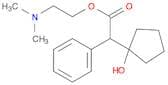
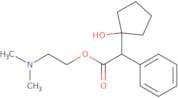
CAS 512-15-2
:Cyclopentolate
Description :
Cyclopentolate est une amine tertiaire et un dérivé de l'acide tropique, principalement utilisé comme agent mydriatique en ophtalmologie pour dilater les pupilles lors des examens oculaires. Il se caractérise par sa capacité à bloquer l'action de l'acétylcholine sur les récepteurs muscariniques dans le muscle sphincter de l'iris, entraînant une dilatation de la pupille. Cyclopentolate est généralement administré sous forme de solution en collyre et a un début d'action rapide, avec des effets durant plusieurs heures. Le composé est connu pour sa relativement faible absorption systémique, ce qui minimise les effets secondaires. En termes de propriétés physiques, Cyclopentolate est une poudre cristalline blanche à blanc cassé qui est soluble dans l'eau et présente un profil de solubilité dépendant du pH. Sa structure chimique comprend un anneau de cyclopentane, contribuant à ses propriétés pharmacologiques uniques. Comme pour tout médicament, il est essentiel de considérer les effets secondaires potentiels, y compris l'augmentation de la pression intraoculaire et la sensibilité à la lumière, en particulier chez les individus sensibles.
Formule :C17H25NO3
InChI :InChI=1S/C17H25NO3/c1-18(2)12-13-21-16(19)15(14-8-4-3-5-9-14)17(20)10-6-7-11-17/h3-5,8-9,15,20H,6-7,10-13H2,1-2H3
Code InChI :InChIKey=SKYSRIRYMSLOIN-UHFFFAOYSA-N
SMILES :C(C(OCCN(C)C)=O)(C1(O)CCCC1)C2=CC=CC=C2
Synonymes :- 1-Hydroxy-α-phenylcyclopentaneacetic acid, 2-(dimethylamino)ethyl ester
- 2-(Dimethylamino)Ethyl (1-Hydroxycyclopentyl)(Phenyl)Acetate
- 2-(Dimethylamino)ethyl 2-(1-hydroxycyclopentyl)-2-phenylacetate
- 2-Dimethylaminoethyl 1-hydroxy-α-phenylcyclopentaneacetate
- 2-Dimethylaminoethyl 2-(1-Hydroxycyclopentyl)-2-Phenylacetate
- <span class="text-smallcaps">DL</span>-Cyclopentolate
- Benzeneacetic acid, α-(1-hydroxycyclopentyl)-, 2-(dimethylamino)ethyl ester
- Ciclopentolato
- Cyclogyl
- Cyclopentaneacetic acid, 1-hydroxy-α-phenyl-, 2-(dimethylamino)ethyl ester
- Cyclopentoiate
- Cyclopentolat
- Cyclopentylate
- DL-Cyclopentolate
- Tsiklopentolat
- β-Dimethylaminoethyl (1-hydroxycyclopentyl)phenylacetate
- Mydrilate
- 2-Dimethylaminoethyl 1-hydroxy-alpha-phenylcyclopentaneacetate
- 2-dimethylaminoethyl 2-(1-hydroxycyclopentyl)-2-phenyl-ethanoate
- CYCLOPENTOLATE
- Benzeneacetic acid, a-(1-hydroxycyclopentyl)-, 2-(dimethylamino)ethylester
- 1-Hydroxy-alpha-phenylcyclopentaneacetic acid, 2-(dimethylamino)ethyl ester
- 2-(1-hydroxycyclopentyl)-2-phenyl-acetic acid 2-dimethylaminoethyl ester
- yclopentolate
- Benzeneacetic acid, alpha-(1-hydroxycyclopentyl)-, 2-(dimethylamino)ethyl ester
- α-(1-Hydroxycyclopentyl)benzeneacetic acid 2-(dimethylamino)ethyl
- beta-(Dimethylamino)ethyl (1-hydroxycyclopentyl)phenylacetate
- Cyplegin
- Voir plus de synonymes
Trier par
Degré de pureté (%)
0
100
|
0
|
50
|
90
|
95
|
100
3 produits concernés.
2-(Dimethylamino)ethyl 2-(1-hydroxycyclopentyl)-2-phenylacetate
CAS :Formule :C17H25NO3Masse moléculaire :291.38532-(Dimethylamino)ethyl 2-(1-hydroxycyclopentyl)-2-phenylacetate
CAS :Formule :C17H25NO3Degré de pureté :95.0%Masse moléculaire :291.391Cyclopentolate
CAS :Produit contrôléCyclopentolate is a muscarinic antagonist and is used as an ophthalmic drug to produce mydriasis. Cyclopentolate inhibits the metabolism of cyclopentyl-CoA via the 3-hydroxyacyl-CoA dehydrogenase, which leads to the accumulation of cyclopentyl-CoA in cells. This inhibition can cause metabolic disorders such as hyperlipidemia and diabetes mellitus, which are characterized by increased acid formation and reduced glucose uptake. Cyclopentolate also binds to DNA, inhibiting transcription, replication, and repair of DNA. The binding affinity of cyclopentolate to DNA is approximately 2500 times higher than that of other drugs in its class. Cyclopentolate has been shown to inhibit leukemia inhibitory factor (LIF) and the production of acid from fluorescein angiographyFormule :C17H25NO3Degré de pureté :Min. 95%Couleur et forme :White/Off-White SolidMasse moléculaire :291.39 g/mol