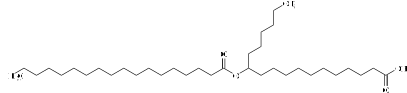
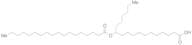
![12-[(1-Oxooctadecyl)oxy]octadecanoic acid](/_next/image/?url=https%3A%2Fstatic.cymitquimica.com%2Fcas-image%2Fthumb-webp%2F90627-12-1-oxooctadecyl-oxy-octadecanoic-acid.webp&w=3840&q=75)
CAS 51350-61-9
:Acide 12-[(1-oxooctadécyl)oxy]octadécanoïque
Description :
Acide 12-[(1-oxooctadécyl)oxy]octadécanoïque, également connu sous son numéro CAS 51350-61-9, est un dérivé d'acide gras à chaîne longue caractérisé par une queue d'hydrocarbure hydrophobe et un groupe fonctionnel acide carboxylique polaire. Ce composé présente une liaison ester formée entre un acide octadécanoïque (acide stéarique) et un groupe octadécanoïque, ce qui contribue à sa nature amphiphile. La présence du groupe oxo introduit une fonctionnalité carbonyle, améliorant sa réactivité et ses applications potentielles dans divers processus chimiques. En général, de tels composés présentent des propriétés tensioactives, ce qui les rend utiles dans l'émulsification, la solubilisation et comme intermédiaires dans la synthèse de molécules plus complexes. De plus, les longues chaînes d'hydrocarbures peuvent influencer les propriétés physiques du composé, telles que le point de fusion et la solubilité, qui sont critiques pour des applications dans les domaines pharmaceutiques, cosmétiques et des matériaux. Dans l'ensemble, Acide 12-[(1-oxooctadécyl)oxy]octadécanoïque représente un produit chimique polyvalent avec une utilité potentielle dans divers environnements industriels et de recherche.
Formule :C36H70O4
InChI :InChI=1S/C36H70O4/c1-3-5-7-9-10-11-12-13-14-15-16-17-22-25-29-33-36(39)40-34(30-26-8-6-4-2)31-27-23-20-18-19-21-24-28-32-35(37)38/h34H,3-33H2,1-2H3,(H,37,38)
Code InChI :InChIKey=HCUIHIKPUYHKSQ-UHFFFAOYSA-N
SMILES :C(OC(CCCCCCCCCCCCCCCCC)=O)(CCCCCCCCCCC(O)=O)CCCCCC
Synonymes :- Octadecanoic acid, 12-[(1-oxooctadecyl)oxy]-
- 11-Carboxy-1-hexylundecyl stearate
- 12-SAHSA
- 12-[(1-Oxooctadecyl)oxy]octadecanoic acid
Trier par
Degré de pureté (%)
0
100
|
0
|
50
|
90
|
95
|
100
4 produits concernés.
12-SAHSA
CAS :12-SAHSA is a metabolite of the amino acid methionine. It is involved in the regulation of insulin sensitivity and fatty acid metabolism. 12-SAHSA has been shown to decrease hepatic steatosis and inhibit the growth of cancer cells in vitro. 12-SAHSA is formed by oxidation of the hydroxy group in methionine, which can be analyzed using gas chromatography-mass spectrometry (GC-MS). This metabolite can be detected in human serum, tissues, and adipose tissue. The physiological function of 12-SAHSA is not yet clear, but it may play a role in fatty acid metabolism or as an intermediate in the production of other metabolites.Formule :C36H70O4Degré de pureté :Min. 95%Masse moléculaire :566.9 g/mol12-SAHSA
CAS :Branched fatty acid esters of hydroxy fatty acids (FAHFAs) are lipids recently discovered to be modulated by dietary influences such as fasting and high-fat feeding, and they play a role in enhancing insulin sensitivity. These compounds typically feature a carbon-16 or carbon-18 fatty acid (e.g., palmitoleic, palmitic, oleic, or stearic acid) esterified to a carbon-16 or carbon-18 hydroxy fatty acid. A specific example is 12-SAHSA, which consists of stearic acid linked to 12-hydroxy stearic acid. Notably, 12-SAHSA levels are found to be moderately increased in the serum of glucose tolerant AG4OX mice, a model characterized by adipose tissue-specific overexpression of the Glut4 glucose transporter.Formule :C36H70O4Couleur et forme :SolidMasse moléculaire :566.952