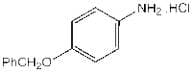
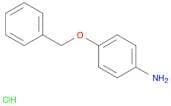
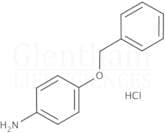
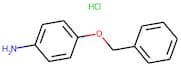
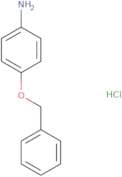
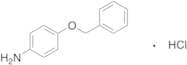
CAS 51388-20-6
:Benzenamine, 4-(phénylméthoxy)-, chlorhydrate (1:1)
Description :
Benzenamine, 4-(phénylméthoxy)-, chlorhydrate (1:1), également connu sous le nom de chlorhydrate de 4-(benzyloxy)aniline, est un composé organique caractérisé par ses groupes fonctionnels amine et éther. Il présente un cycle benzénique substitué par un groupe phénylméthoxy et un groupe amino en position para. La forme chlorhydrate indique que le composé est un sel, ce qui améliore sa solubilité dans l'eau par rapport à sa forme base libre. Ce composé apparaît généralement sous forme de solide cristallin blanc à blanc cassé. Il est souvent utilisé dans la synthèse organique et peut servir d'intermédiaire dans la production de colorants, de produits pharmaceutiques ou d'autres composés chimiques. La présence du groupe amino permet une réactivité potentielle dans diverses réactions chimiques, y compris les substitutions nucléophiles et les réactions de couplage. Les données de sécurité doivent être consultées, comme pour tout produit chimique, afin de comprendre sa manipulation, son stockage et ses dangers potentiels. Dans l'ensemble, les dérivés de la benzenamine sont significatifs en chimie médicinale et en science des matériaux en raison de leurs diverses applications.
Formule :C13H13NO·ClH
InChI :InChI=1S/C13H13NO.ClH/c14-12-6-8-13(9-7-12)15-10-11-4-2-1-3-5-11;/h1-9H,10,14H2;1H
Code InChI :InChIKey=KQBDLOVXZHOAJI-UHFFFAOYSA-N
SMILES :O(CC1=CC=CC=C1)C2=CC=C(N)C=C2.Cl
Synonymes :- 4-(Benzyloxy)aniline hydrochloride
- 4-(Phenylmethoxy)aniline hydrochloride
- 4-Aminodiphenyl ether hydrochloride
- 4-Benzyloxyaniline hydrochloric acid salt
- 4-Benzyloxyphenylamine hydrochloride
- 4-[(Phenylmethyl)oxy]aniline hydrochloride
- Benzenamine, 4-(phenylmethoxy)-, hydrochloride
- Benzenamine, 4-(phenylmethoxy)-, hydrochloride (1:1)
- p-(Benzyloxy)aniline hydrochloride
Trier par
Degré de pureté (%)
0
100
|
0
|
50
|
90
|
95
|
100
7 produits concernés.
4-Benzyloxyaniline hydrochloride, 98%
CAS :This Thermo Scientific Chemicals brand product was originally part of the Alfa Aesar product portfolio. Some documentation and label information may refer to the legacy brand. The original Alfa Aesar product / item code or SKU reference has not changed as a part of the brand transition to Thermo SciFormule :C13H14ClNODegré de pureté :98%Couleur et forme :Cream to brown or pale grey to pale pink to pink, Crystals or powder or crystalline powderMasse moléculaire :235.714-Benzyloxyaniline, HCl
CAS :Formule :C13H14ClNODegré de pureté :98%Couleur et forme :SolidMasse moléculaire :235.70944-(Benzyloxy)aniline hydrochloride
CAS :4-(Benzyloxy)aniline hydrochlorideFormule :C13H13NO·ClHDegré de pureté :≥95%Couleur et forme : faint brown solidMasse moléculaire :235.71g/mol4-Benzyloxyaniline hydrochloride
CAS :4-Benzyloxyaniline hydrochloride (4BOAH) is a pro-apoptotic agent that induces cell death by binding to the estrogen receptor. It binds to the cytoplasmic region of the estrogen receptor, which prevents the estrogen receptor from binding to its target DNA sequence. This leads to apoptosis and cell death. 4BOAH has been shown to be an effective inhibitor of breast cancer in animal models and also shows anti-estrogen activity in human liver cells. 4BOAH is a reactive compound with a molecular weight of 239.46 g/mol, an empirical formula C9H11NO2Cl, and structural formula H-C-N=C=O. 4BOAH forms hydrogen bonds with other molecules because it has a lone pair of electrons on the nitrogen atom and can form covalent bonds with amines due to its electron withdrawing properties. The structure of 4BOAH is shown below:Formule :C13H13NO·HClDegré de pureté :Min. 95%Couleur et forme :PowderMasse moléculaire :235.71 g/mol4-(Benzyloxy)aniline hydrochloride
CAS :Formule :C13H14ClNODegré de pureté :98%Couleur et forme :SolidMasse moléculaire :235.714-(Benzyloxy)aniline Hydrochloride
CAS :Produit contrôléApplications 4-(Benzyloxy)aniline Hydrochloride is used as a reagent in the synthesis of a series of amino acid derivatives as novel chromogenic enzyme substrates for the detection of aminopeptidase activity in clinically important microorganisms.
References Cellier, M., et al.: Bioorg. Med. Chem., 22, 5249 (2014)Formule :C16H20FN3O2SCouleur et forme :NeatMasse moléculaire :337.412