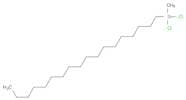
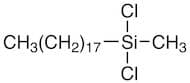
CAS 5157-75-5
:Octadécylméthyldichlorosilane
- Ai3-60187
- Dichloromethylstearylsilane
- Methyloctadecyldichlorosilane
- N-octadecylmethyldichlorosilane
- NSC 96645
- Octadecyldichloromethylsilane
- Octadecylmethyldichlorosilane
- Silane, dichloromethyloctadecyl-
- Stearylmethyldichlorosilane
- Dichloromethyloctadecylsilane
- Dichloromethyloctadecylsilane
DICHLORO-METHYL-OCTADECYLSILANE
CAS :Formule :C19H40Cl2SiDegré de pureté :%Masse moléculaire :367.5124Dichloro(Methyl)(Octadecyl)Silane
CAS :Dichloro(Methyl)(Octadecyl)SilaneDegré de pureté :99%Masse moléculaire :367.51g/molDichloro(methyl)octadecylsilane
CAS :Formule :C19H40Cl2SiDegré de pureté :>94.0%(GC)Couleur et forme :White or Colorless to Almost white or Almost colorless powder to lump to clear liquidMasse moléculaire :367.51Methyl-n-octadecyldichlorosilane
CAS :Formule :C19H40Cl2SiDegré de pureté :95%Couleur et forme :Solid, Low Melting SolidMasse moléculaire :367.51n-OCTADECYLMETHYLDICHLOROSILANE
CAS :Alkyl Silane - Conventional Surface Bonding
Aliphatic, fluorinated aliphatic or substituted aromatic hydrocarbon substituents are the hydrophobic entities which enable silanes to induce surface hydrophobicity. The organic substitution of the silane must be non-polar. The hydrophobic effect of the organic substitution can be related to the free energy of transfer of hydrocarbon molecules from an aqueous phase to a homogeneous hydrocarbon phase. A successful hydrophobic coating must eliminate or mitigate hydrogen bonding and shield polar surfaces from interaction with water by creating a non-polar interphase. Although silane and silicone derived coatings are in general the most hydrophobic, they maintain a high degree of permeability to water vapor. This allows coatings to breathe and reduce deterioration at the coating interface associated with entrapped water. Since ions are not transported through non-polar silane and silicone coatings, they offer protection to composite structures ranging from pigmented coatings to rebar reinforced concrete. A selection guide for hydrophobic silanes can be found on pages 22-31 of the Hydrophobicity, Hydrophilicity and Silane Surface Modification brochure.
n-Octadecylmethyldichlorosilane; Dichloromethyl-n-octadecylsilane; Methyldichlorosilyloctadecane; Dichloromethylsilyloctadecane
Contains 5-10% C18 isomersViscosity: 7 cStFormule :C19H40Cl2SiDegré de pureté :97% including isomersCouleur et forme :Straw LiquidMasse moléculaire :367.52Dichloro(methyl)octadecylsilane
CAS :Dichloro(methyl)octadecylsilane is a liquid that is used to coat the inside of tubes in chromatographic columns. The coating ensures that the stationary phase (the material on which the analyte travels) remains stationary and is not carried away with the mobile phase. It has been shown to be effective at removing hydrogen chloride from water and can be used as a fabricating agent for coatings. Dichloro(methyl)octadecylsilane is used in analytical chemistry, where it has been shown to have a number of uses including being able to remove hydroxy groups from molecules and electron microscopy, where it can be used as a coating for nonpolar solvents.Degré de pureté :Min. 95%n-OCTADECYLMETHYLDICHLOROSILANE, 97%
CAS :Formule :C19H40Cl2SiDegré de pureté :97% including isomersCouleur et forme :Straw LiquidMasse moléculaire :367.52