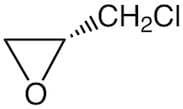
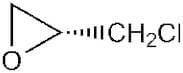
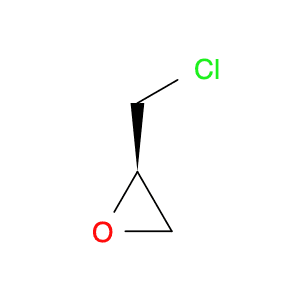
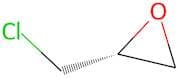
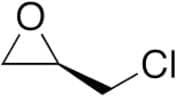
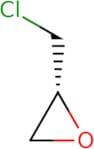
CAS 51594-55-9
:(-)-Épichlorhydrine
Description :
(-)-Épichlorhydrine, avec le numéro CAS 51594-55-9, est un liquide incolore à jaune pâle caractérisé par son odeur forte et piquante. C'est un composé époxy, spécifiquement un chlorhydrate, et il est connu pour sa réactivité en raison de la présence à la fois d'un groupe époxy et d'un atome de chlore. Ce composé est soluble dans l'eau et les solvants organiques, ce qui le rend polyvalent dans diverses applications chimiques. Il est principalement utilisé comme intermédiaire dans la synthèse des résines époxy, qui sont largement utilisées dans les revêtements, les adhésifs et les matériaux composites. (-)-Épichlorhydrine est également utilisé dans la production de glycérol et d'autres dérivés chimiques. En raison de sa nature réactive, il peut participer à diverses réactions chimiques, y compris des réactions d'ouverture de cycle et des substitutions nucléophiles. Cependant, il est important de manipuler cette substance avec précaution, car elle est classée comme matériau dangereux, avec des risques potentiels pour la santé en cas d'exposition. Des mesures de sécurité appropriées doivent être prises lors de la manipulation de (-)-Épichlorhydrine dans des environnements de laboratoire ou industriels.
Formule :C3H5ClO
InChI :InChI=1S/C3H5ClO/c4-1-3-2-5-3/h3H,1-2H2/t3-/m0/s1
Code InChI :InChIKey=BRLQWZUYTZBJKN-VKHMYHEASA-N
SMILES :C(Cl)[C@H]1CO1
Synonymes :- (-)-2-(Chloromethyl)oxirane
- (-)-Epichlorohydrin
- (2R)-2-(chloromethyl)oxirane
- (R)-(-)-2-(Chloromethyl)oxirane
- (R)-(Chloromethyl)oxirane
- (R)-1-Chloro-2,3-epoxypropane
- (R)-3-Chloro-1,2-epoxypropane
- Oxirane, (chloromethyl)-, (2R)-
- Oxirane, (chloromethyl)-, (R)-
- Oxirane, 2-(chloromethyl)-, (2R)-
- (R)-(-) Epichlorohydrin
- (R)-(-)-Epichlorohydrin
- Voir plus de synonymes
Trier par
Degré de pureté (%)
0
100
|
0
|
50
|
90
|
95
|
100
10 produits concernés.
(R)-Epichlorohydrin
CAS :Formule :C3H5ClODegré de pureté :>98.0%(GC)Couleur et forme :Colorless to Light yellow clear liquidMasse moléculaire :92.52(R)-(-)-Epichlorohydrin, 98+%
CAS :This Thermo Scientific Chemicals brand product was originally part of the Alfa Aesar product portfolio. Some documentation and label information may refer to the legacy brand. The original Alfa Aesar product / item code or SKU reference has not changed as a part of the brand transition to Thermo SciFormule :C3H5ClODegré de pureté :98+%Couleur et forme :Clear colorless, LiquidMasse moléculaire :92.52(R)-(-)-Epichlorohydrin
CAS :Formule :C3H5ClODegré de pureté :98%Couleur et forme :LiquidMasse moléculaire :92.5242(2R)-(-)-3-Chloro-1,2-propenoxide
CAS :(2R)-(-)-3-Chloro-1,2-propenoxideFormule :C3H5ClODegré de pureté :99%Couleur et forme : clear. almost colourless liquidMasse moléculaire :92.52g/molR-(-)-Epichlorohydrin
CAS :Formule :C3H5ClODegré de pureté :99.0%Couleur et forme :Liquid, ClearMasse moléculaire :92.52(R)-Epichlorohydrin
CAS :Produit contrôléApplications R-enantiomer of Epichlorohydrin, an important industrial chemical, is a bifunctional alkylating agent with the potential to form DNA cross-links. It is used as a solvent for natural and synthetic resins, gums, cellulose esters and ethers, paints, varnishes, nail enamels and lacquers, cement for Celluloid. Also, it is used as stabilizer.
Not a dangerous good if item is equal to or less than 1g/ml and there is less than 100g/ml in the package
References Romano, K.P. et al.: Chem. Res. Toxicol., 20, 832 (2007); Smyth, H.F., et al.: J. Ind. Hyg. Toxicol., 30, 63 (1948);Formule :C3H5ClOCouleur et forme :NeatMasse moléculaire :92.52(R)-Epichlorohydrin
CAS :(R)-Epichlorohydrin is an organic compound with the chemical formula (CHClO). It is a colorless liquid with a sweet odor. It has been used as an industrial solvent and in the production of other chemicals. It can also be used to inhibit microbial growth by reacting with sulfhydryl groups, which are necessary for some enzymes to function. (R)-Epichlorohydrin is synthesized from dichloroethane by chlorination followed by oxidation: The reaction mechanism proceeds through chlorination of the ethylene molecule followed by a stepwise oxidation of the resultant chlorine atoms to form epichlorohydrin: The first step involves conversion of dichloroethane into dichloroethylene, which reacts with chlorine gas to produce ethyl chloride: This intermediate then reacts with hydrogen peroxide (HOOH) to form chloroethanol, which in turn reacts with oxygen gas (O2) toFormule :C3H5ClODegré de pureté :Min. 98%Couleur et forme :Colorless Clear LiquidMasse moléculaire :92.52 g/mol