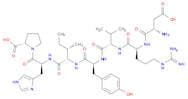
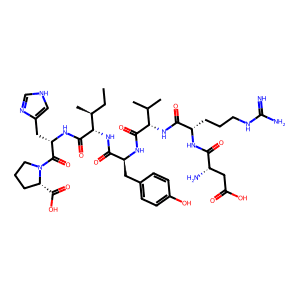
CAS 51833-78-4
:fragment d'angiotensine 1-7 acétate humain
Description :
Le fragment d'angiotensine 1-7, également connu sous le nom d'angiotensine 1-7 ou A-1-7, est un peptide qui joue un rôle crucial dans le système rénine-angiotensine, qui régule la pression artérielle et l'équilibre des fluides. Ce fragment est dérivé de la clivage de l'angiotensine II et est connu pour ses effets vasodilatateurs, favorisant la santé cardiovasculaire en contrebalançant les actions de l'angiotensine II. La forme acétate indique que le peptide est sous forme de sel, ce qui peut améliorer sa stabilité et sa solubilité. Caractéristiquement, l'angiotensine 1-7 présente une activité biologique par son interaction avec le récepteur Mas, entraînant divers effets physiologiques, y compris des actions anti-inflammatoires et antifibrotiques. Il est souvent étudié pour ses applications thérapeutiques potentielles dans des conditions telles que l'hypertension, l'insuffisance cardiaque et les maladies rénales. Le numéro CAS 51833-78-4 identifie de manière unique ce peptide spécifique, facilitant sa reconnaissance dans la littérature scientifique et les bases de données. Dans l'ensemble, le fragment d'angiotensine 1-7 est une biomolécule significative avec des implications en physiologie cardiovasculaire et des applications cliniques potentielles.
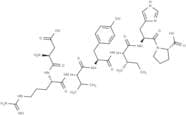
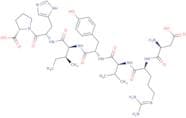
Formule :C41H62N12O11
InChI :InChI=1/C41H62N12O11/c1-5-22(4)33(38(61)50-29(17-24-19-45-20-47-24)39(62)53-15-7-9-30(53)40(63)64)52-36(59)28(16-23-10-12-25(54)13-11-23)49-37(60)32(21(2)3)51-35(58)27(8-6-14-46-41(43)44)48-34(57)26(42)18-31(55)56/h10-13,19-22,26-30,32-33,54H,5-9,14-18,42H2,1-4H3,(H,45,47)(H,48,57)(H,49,60)(H,50,61)(H,51,58)(H,52,59)(H,55,56)(H,63,64)(H4,43,44,46)/t22-,26-,27-,28-,29-,30-,32-,33-/m0/s1
SMILES :CC[C@H](C)[C@@H](C(=N[C@@H](Cc1cnc[nH]1)C(=O)N1CCC[C@H]1C(=O)O)O)N=C([C@H](Cc1ccc(cc1)O)N=C([C@H](C(C)C)N=C([C@H](CCCNC(=N)N)N=C([C@H](CC(=O)O)N)O)O)O)O
Synonymes :- Angiotensin I/II (1-7)
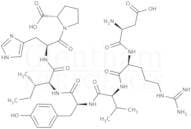
- H-Asp-Arg-Val-Tyr-Ile-His-Pro-OH
- L-alpha-aspartyl-N~5~-(diaminomethylidene)-L-ornithyl-L-valyl-L-tyrosyl-L-isoleucyl-L-histidyl-L-proline
Trier par
Degré de pureté (%)
0
100
|
0
|
50
|
90
|
95
|
100
12 produits concernés.
Angiotensin I/II (1-7)
CAS :Angiotensin (1-7), DRVYIHP, an enzymatically produced peptide of the renin-angiotensin system, shows pharmacologically distinct, tissue-specific actions that differ from those of angiotensin II. Angiotensin (1-7) shows considerable cardiovascular and antiangiogenic activity. Iusuf et al. reviewed its phamacological properties and pharmacotherapeutic perspectives. Moreover, the heptapeptide was shown to inhibit the growth of human lung cancer cells in vitro and to reduce the size of human lung cancer xenografts in vivo.Formule :C41H62N12O11Degré de pureté :99.3%Couleur et forme :White PowderMasse moléculaire :899.02ASP-ARG-VAL-TYR-ILE-HIS-PRO
CAS :Formule :C41H62N12O11Degré de pureté :98%Couleur et forme :SolidMasse moléculaire :899.0048Angiotensin (1-7)
CAS :Angiotensin (1-7) (ASP-ARG-VAL-TYR-ILE-HIS-PRO) is a synthetic heptapeptide, inhibits canine ACE activity with vasodilator and antiproliferative activities.Formule :C41H62N12O11Degré de pureté :99.90% - >99.99%Couleur et forme :White Lyophilised SolidMasse moléculaire :899Angiotensin (Human, 1-7)
CAS :Angiotensin 1-7 (Ang-(1-7)) is a component of the renin angiotensin system RAS. Ang-(1-7) is produced by angiotensin-converting enzyme 2 (ACE2), from the angiotensin II (Ang-II) peptide, as well as by prolylendopeptidase (PEP) and neutral endopeptidase (NEP) which produce Ang-(1-7) directly from angiotensin I (Ang-I).Ang-(1-7) broadly opposes Ang-II actions. Ang-(1-7) has vasodilatory and anti-oxidative effects, and exerts protective actions in hypertension, diabetes, and other cardiovascular disorders, Ang-(1-7) therefore represents a promising therapeutic target for cardiovascular and metabolic diseases. Ang-(1-7) exerts its actions via its G-protein-coupled receptor, Mas. This novel arm of the RAS has effects that counterbalance those mediated by the classical ACE/Ang-II pathway.Formule :C41H62N12O11Degré de pureté :Min. 95%Couleur et forme :PowderMasse moléculaire :899.01 g/molAngiotensin (1-7) xTFA salt
CAS :Produit contrôléApplications Angiotensin (1-7) can be used in biological study and engineering or chemical process of mechanisms of peptide oxidation by hydroxyl radicals.
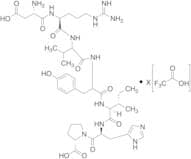
References Verlackt, C., et al.: J Phys Chem C, 121, 5787 (2017)Formule :C41H62N12O11·xTFACouleur et forme :NeatMasse moléculaire :899.00 + x(114.02)Angiotensin (Human, 1-7)
CAS :Angiotensin (human, 1-7) is a peptide that acts as an agonist for the angiotensin II receptor. It is used in research as a pharmacological tool and in cell biology to study protein interactions and signaling pathways. It is also used to study the role of angiotensin receptors in various diseases such as hypertension and heart disease. Angiotensin (human, 1-7) is supplied at high purity and without any contaminants.
Formule :C41H62N12O11Degré de pureté :Min. 95%Masse moléculaire :899 g/molAngiotensin (Human, 1-7)
CAS :Angiotensin (Human, 1-7) is a peptide hormone that is produced in the body by the renin-angiotensin system. This peptide hormone helps to regulate blood pressure and blood volume. Angiotensin (Human, 1-7) works by activating both receptors on cells, which causes vasoconstriction and stimulates the release of aldosterone from the adrenal gland. Angiotensin (Human, 1-7) can also stimulate various ion channels and cause vasoconstriction. The antibody against this peptide may be used as a research tool for studying its function in cell biology or as an inhibitor or activator in pharmacology.Formule :C41H62N12O11•CH3COOH•4H2ODegré de pureté :Min. 95%Masse moléculaire :1,031.11 g/molAngiotensin I/II (1-7) trifluoroacetate salt
CAS :Angiotensin I/II (1-7) trifluoroacetate salt is a selective inhibitor of angiotensin II. It blocks the activity of angiotensin II, and thereby prevents the activation of growth factor-β1, which leads to a decrease in pulmonary hypertension. The drug has also been shown to be effective in blocking dextran sulfate absorption, as well as preventing bowel disease by inhibiting receptor activity. Angiotensin I/II (1-7) trifluoroacetate salt has been shown to have an anti-inflammatory effect on the cardiovascular system by blocking cell signaling pathways and reducing blood pressure. This drug is used for treatment of metabolic disorders such as atherosclerotic lesion, cardiac diseases such as coronary heart diseases, and bowel disease.Formule :C41H62N12O11Degré de pureté :Min. 95%Masse moléculaire :899.01 g/molAngiotensin, Canine, Rat
CAS :Custom research peptide; min purity 95%. For different specs please use the Peptide Quote Tool
Formule :C41H62N12O11Masse moléculaire :899 g/mol