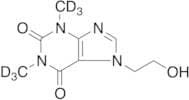
CAS 519-37-9
:Étofilline
Description :
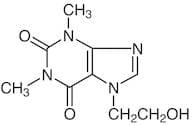
Étofilline, avec le numéro CAS 519-37-9, est un composé pharmaceutique qui appartient à la classe des dérivés de la xanthine. Il est principalement connu pour ses propriétés bronchodilatatrices, ce qui le rend utile dans le traitement des affections respiratoires telles que l'asthme et la maladie pulmonaire obstructive chronique (MPOC). La substance est une combinaison de théophylline et d'alcool éthylique, ce qui améliore sa solubilité et sa biodisponibilité. Étofilline agit en relaxant les muscles lisses des voies respiratoires, facilitant ainsi une respiration plus aisée. Il est généralement administré sous forme orale ou injectable. Le composé présente une demi-vie modérée, et sa pharmacocinétique peut être influencée par des facteurs tels que l'âge, la fonction hépatique et les médicaments concomitants. Les effets secondaires peuvent inclure des troubles gastro-intestinaux, de l'anxiété et de l'insomnie, qui sont courants avec les dérivés de la xanthine. En raison de ses effets thérapeutiques et de son profil de sécurité relativement favorable, Étofilline est utilisé dans des contextes cliniques, bien que son utilisation puisse être limitée par la disponibilité de nouveaux bronchodilatateurs.
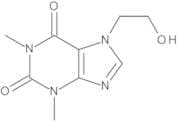
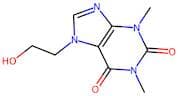
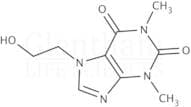
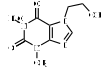
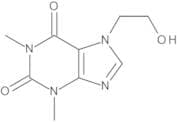
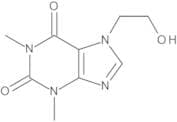
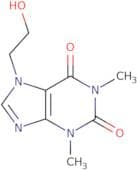
Formule :C9H12N4O3
InChI :InChI=1/C9H12N4O3/c1-11-7-6(8(15)12(2)9(11)16)13(3-4-14)5-10-7/h5,14H,3-4H2,1-2H3
Code InChI :InChIKey=NWPRCRWQMGIBOT-UHFFFAOYSA-N
SMILES :C(CO)N1C2=C(N(C)C(=O)N(C)C2=O)N=C1
Synonymes :- 1,3-Dimethyl-7-(2-hydroxyethyl)xanthine
- 1H-Purine-2,6-dione, 3,7-dihydro-7-(2-hydroxyethyl)-1,3-dimethyl-
- 3,7-Dihydro-7-(2-hydroxyethyl)-1,3-dimethyl-1H-purine-2,6-dione
- 7-(2-Hydroxyethyl)-1,3-dimethylxanthine
- 7-(2-Hydroxyethyl)theophylline
- 7-(2-hydroxyethyl)-1,3-dimethyl-3,7-dihydro-1H-purine-2,6-dione
- 7-(Hydroxyethyl)theophylline
- 7-(a-Hydroxyethyl)theophylline
- 7-(β-Hydroxyethyl)theophylline
- 7-Theophyllineethanol
- Aethophyllinum
- Ascorphylline
- Bio-phylline
- Cordalin
- Corophyllin-N
- Dilaphyllin
- Etofylline
- Etophyllin
- Etophylline
- Frekaphyllin
- Hydroxyethyltheophylline
- Kt 200G
- NSC 113373
- Oxphylline
- Oxyethophylline
- Oxyethyltheophylline
- Oxyphyllin
- Oxyphylline
- Oxytheonyl
- Phyllocormin N
- Soluphylline
- Theophylline, 7-(2-hydroxyethyl)-
- 7-(BETA-HYDROXYETHYL)THEOPHYLLINE
- BETA-HYDROXYETHYLTHEOPHYLLINE
- 7-(2-hydroxyethyl)-theophyllin
- b-hydroxyethyltheophylline
- 3,7-dihydro-7-(2-hydroxyethyl)-1,3-dimethyl-1h-purine-6-dione
- 1,3-DIMETHYL-7-(BETA-HYDROXYETHYL)XANTHINE
- BIOPHYLLINE
- Voir plus de synonymes
Trier par
Degré de pureté (%)
0
100
|
0
|
50
|
90
|
95
|
100
19 produits concernés.
Etofylline
CAS :Formule :C9H12N4O3Degré de pureté :>98.0%(HPLC)(N)Couleur et forme :White to Almost white powder to crystalMasse moléculaire :224.22Theophylline Related Compound F (7-(2-Hydroxyethyl)-1,3-dimethyl-3,7-dihydro-1H-purine-2,6-dione)
CAS :Theophylline and aminophylline (excluding fenetylline) and their derivatives, salts thereof, not elsewhere specified or includedFormule :C9H12N4O3Couleur et forme :White PowderMasse moléculaire :224.09094Etofylline
CAS :Formule :C9H12N4O3Degré de pureté :98%Couleur et forme :SolidMasse moléculaire :224.2166Etofylline
CAS :Etofylline (Oxyphylline) is used for difficulty in breathing, asthma, breathing difficulty and other conditions.Formule :C9H12N4O3Degré de pureté :99.36%Couleur et forme :SolidMasse moléculaire :224.22Theophylline EP Impurity F (Theophylline-Ethylenediamine EP Impurity F, Diprophylline EP Impurity C, Etofylline)
CAS :Formule :C9H12N4O3Couleur et forme :White To Off-White SolidMasse moléculaire :224.227-(2-Hydroxyethyl)-1,3-dimethyl-1H-purine-2,6(3H,7H)-dione
CAS :Formule :C9H12N4O3Degré de pureté :95%Couleur et forme :Solid, White to almost white powderMasse moléculaire :224.22Theophylline EP Impurity F-d6 (Theophylline-Ethylenediamine EP Impurity F-d6, Diprophylline EP Impurity C-d6, Etofylline-d6)
CAS :Formule :C9H6D6N4O3Masse moléculaire :230.26Etofylline
CAS :Applications An inhibitor of 3’,5’-Cyclic Nucleotide Phosphodiesterase. Therapeutically, this compound has diuretic, muscle relaxant, bronchial dilation and CNS stimulant activities.
References Geraets, L., et al.: Biochem. Pharmacol., 72, 902 (2006), Kumar, A., et al.: J. Clin. Diagnostic Res., 2, 938 (2008), Tanno, F., et al.: J. Pharm. Sci., 97, 2665 (2008), Ma, C., et al.: J. Pharm. Biomed. Anal., 47, 677 (2008),Formule :C9H12N4O3Couleur et forme :NeatMasse moléculaire :224.22Etofylline
CAS :Produit contrôléEtofylline is a potent antagonist of histamine receptors. It has been shown that etofylline binds to the H1 receptor and blocks the action of histamine on smooth muscle cells, leading to bronchodilation. Etofylline also has pharmacokinetic properties, including a rapid absorption in humans and high bioavailability. The drug is eliminated by hepatic metabolism with a half-life of about 7 hours. Etofylline is an analytical method for determining binding constants for hydrogen bonding interactions in biological systems such as proteins, nucleic acids, and carbohydrates. Toxicity studies show that etofylline can cause liver damage and respiratory problems in geriatric patients and pregnant women.Formule :C9H12N4O3Degré de pureté :Min. 95%Couleur et forme :PowderMasse moléculaire :224.22 g/molEtofylline-D6
CAS :Produit contrôléFormule :C9H6D6N4O3Couleur et forme :NeatMasse moléculaire :834.962