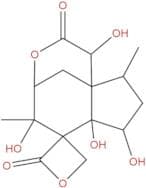
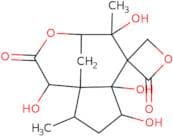
CAS 5230-87-5
:(-)-Anisatine
Description :
(-)-Anisatine, avec le numéro CAS 5230-87-5, est un composé naturellement présent classé comme une lactone sesquiterpénique. Il est principalement dérivé de l'espèce végétale Illicium anisatum, communément connue sous le nom d'anis étoilé. Ce composé se caractérise par sa structure moléculaire complexe, qui comprend un cadre bicyclique et un groupe fonctionnel lactone. (-)-Anisatine présente une gamme d'activités biologiques, y compris des propriétés antimicrobiennes et insecticides, ce qui le rend intéressant pour la recherche pharmacologique. Il a été étudié pour ses effets potentiels sur le système nerveux central, en particulier en tant que neurotoxine, influençant la libération de neurotransmetteurs. Le composé se trouve généralement sous forme cristalline et est soluble dans des solvants organiques. Sa stéréochimie est significative, car la désignation (-) indique son activité optique spécifique, qui peut influencer ses interactions biologiques. En raison de ses effets puissants, (-)-Anisatine est manipulé avec précaution dans les laboratoires, et son utilisation est réglementée dans de nombreuses juridictions. Dans l'ensemble, (-)-Anisatine représente un sujet d'étude fascinant dans la chimie des produits naturels et la pharmacologie.
Formule :C15H20O8
InChI :InChI=1S/C15H20O8/c1-6-3-7(16)15(21)13(6)4-8(23-10(18)9(13)17)12(2,20)14(15)5-22-11(14)19/h6-9,16-17,20-21H,3-5H2,1-2H3/t6-,7-,8-,9+,12+,13+,14+,15-/m1/s1
Code InChI :InChIKey=GEVWHIDSUOMVRI-QWNPAUMXSA-N
SMILES :O[C@]12[C@@]3(C[C@]([C@](C)(O)[C@]14C(=O)OC4)(OC(=O)[C@@H]3O)[H])[C@H](C)C[C@H]2O
Synonymes :- (-)-Anisatin
- (1R,3′S,4R,5R,6aR,7R,9R,9aS)-Hexahydro-1,5,6a,7-tetrahydroxy-5,9-dimethylspiro[4H-4,9a-methanocyclopent[d]oxocin-6(2H),3′-oxetane]-2,2′-dione
- (1S,2R,4R,5R,6S,7R,8R,11R)-4,5,7,11-Tetrahydroxy-2,7-dimethyl-10H-spiro[9-oxatricyclo[6.3.1.0~1,5~]dodecane-6,3'-oxetane]-2',10-dione
- Spiro[4H-4,9a-methanocyclopent[d]oxocin-6(2H),3′-oxetane]-2,2′-dione, hexahydro-1,5,6a,7-tetrahydroxy-5,9-dimethyl-, (1R,3′S,4R,5R,6aR,7R,9R,9aS)-
- Spiro[6H-4,9a-methanocyclopent[d]oxocin-6,3′-oxetane]-2,2′(1H)-dione, 4aβ,5,6a,7,8,9-hexahydro-1α,5β,6aβ,7β-tetrahydroxy-5,9α-dimethyl-
- Spiro[6H-4,9a-methanocyclopent[d]oxocin-6,3′-oxetane]-2,2′(1H)-dione, hexahydro-1,5,6a,7-tetrahydroxy-5,9-dimethyl-, (1R,3′S,4R,5R,6aR,7R,9R,9aS)-
- Spiro[6H-4,9a-methanocyclopent[d]oxocin-6,3′-oxetane]-2,2′(1H)-dione, hexahydro-1,5,6a,7-tetrahydroxy-5,9-dimethyl-, [1R-(1α,4β,5β,6β,6aβ,7β,9α,9aβ)]-
Trier par
Degré de pureté (%)
0
100
|
0
|
50
|
90
|
95
|
100
3 produits concernés.
Anisatin
CAS :LactoneFormule :C15H20O8Degré de pureté :≥ 95.0 % (HPLC)Couleur et forme :PowderMasse moléculaire :328.32Anisatin
CAS :Anisatin is a potent kinase inhibitor that has been shown to have anticancer properties. It works by inhibiting the activity of kinases, which are enzymes that play a crucial role in cell signaling and growth. Anisatin has been found in Chinese medicinal plants and has been shown to induce apoptosis (cell death) in cancer cells. This compound has also been found in human urine and may have potential as a tumor marker or therapeutic target for cancer treatment. Anisatin is an analog of another protein inhibitor, which suggests that it may have similar properties and could be used as an effective anticancer agent.Formule :C15H20O8Degré de pureté :Min. 95%Masse moléculaire :328.31 g/mol