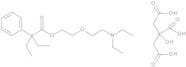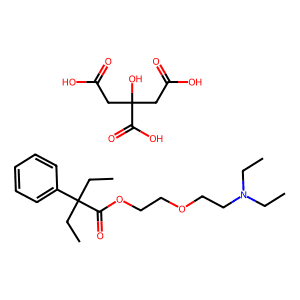
CAS 52432-72-1
:Citrate d'oxéladine
Description :
Citrate d'oxéladine est un composé chimique principalement reconnu pour son utilisation en tant que suppressor de la toux. Il est classé comme un agent antitussif, ce qui signifie qu'il aide à soulager la toux en agissant sur le centre de la toux dans le cerveau. Le composé est un sel de citrate d'oxeladine, qui améliore sa solubilité et sa biodisponibilité. Citrate d'oxéladine est généralement administré sous forme de sirop ou de comprimé et est souvent inclus dans des formulations pour traiter des conditions respiratoires. Son mécanisme d'action implique l'inhibition du réflexe de la toux sans affecter la fonction mucociliaire des voies respiratoires. La substance est généralement bien tolérée, mais comme tout médicament, elle peut avoir des effets secondaires, notamment de la somnolence ou des troubles gastro-intestinaux. Il est important d'utiliser Citrate d'oxéladine sous surveillance médicale, en particulier chez les personnes ayant des problèmes de santé préexistants ou celles prenant d'autres médicaments. Comme pour tous les médicaments, le respect des dosages et des directives recommandés est crucial pour la sécurité et l'efficacité.
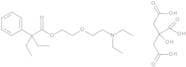
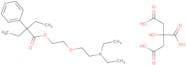
Formule :C20H33NO3·C6H8O7
InChI :InChI=1S/C20H33NO3.C6H8O7/c1-5-20(6-2,18-12-10-9-11-13-18)19(22)24-17-16-23-15-14-21(7-3)8-4;7-3(8)1-6(13,5(11)12)2-4(9)10/h9-13H,5-8,14-17H2,1-4H3;13H,1-2H2,(H,7,8)(H,9,10)(H,11,12)
Code InChI :InChIKey=KVKJFNUGVOFNGU-UHFFFAOYSA-N
SMILES :C(C(OCCOCCN(CC)CC)=O)(CC)(CC)C1=CC=CC=C1.C(CC(O)=O)(CC(O)=O)(C(O)=O)O
Synonymes :- 2-(2-(Diethylamino)ethoxy)ethyl 2-ethyl-2-phenylbutanoate 2-hydroxypropane-1,2,3-tricarboxylate
- 2-(2-Diethylaminoethoxy)-ethyl 2-ethyl-2-phenylbutyrate citrate
- 2-Methylpropane-1,2,3-Tricarboxylic Acid - 2-[2-(Diethylamino)Ethoxy]Ethyl 2-Ethyl-2-Phenylbutanoate (1:1)
- Benzeneacetic acid, α,α-diethyl-, 2-[2-(diethylamino)ethoxy]ethyl ester, 2-hydroxy-1,2,3-propanetricarboxylate (1:1)
- Butyric acid, 2-ethyl-2-phenyl-, 2-(2-diethylaminoethoxy)ethyl ester, citrate
- N,N-diethyl-2-{2-[(2-ethyl-2-phenylbutanoyl)oxy]ethoxy}ethanaminium 3,4-dicarboxy-3-hydroxybutanoate
- Oxeladin Dihydrogen Citrate
- Oxeladine citrate
- Paxeladine
- Pectamol
- Petcamon
- Silopentol
- Voir plus de synonymes
Trier par
Degré de pureté (%)
0
100
|
0
|
50
|
90
|
95
|
100
7 produits concernés.
OXELADIN HYDROGEN CITRATE CRS
CAS :OXELADIN HYDROGEN CITRATE CRSFormule :C26H41NO10Couleur et forme :Crystalline Powder. White. Powder.Masse moléculaire :527.6044Oxeladin citrate
CAS :Oxeladin citrate: potent, non-addictive cough suppressant safe for all ages and heart patients; no common antitussive side effects.Formule :C26H41NO10Degré de pureté :97.23%Couleur et forme :SolidMasse moléculaire :527.6Oxeladin Citrate
CAS :Formule :C20H33NO3·C6H8O7Couleur et forme :White To Off-White SolidMasse moléculaire :335.49 192.13Oxeladin Hydrogen Citrate
CAS :Produit contrôléFormule :C20H33NO3·C6H8O7Couleur et forme :NeatMasse moléculaire :527.60Oxeladin citrate salt
CAS :Produit contrôléOxeladin is a citrate salt that is used to treat chronic bronchitis, as well as other infections of the respiratory tract. It is prescribed in combination with sodium citrate, which acts as an osmotic laxative. Oxeladin can be administered orally or intravenously and has a low risk of side effects. This drug binds to fatty acids in the bloodstream, preventing them from being reabsorbed into the body and thus causing diarrhea. The active form of oxeladin is an analog of citric acid and it has been shown to have cancer-fighting properties in addition to its use for treating inflammatory diseases such as rheumatoid arthritis.Formule :C20H33NO3·C6H8O7Degré de pureté :Min. 95%Masse moléculaire :527.6 g/mol