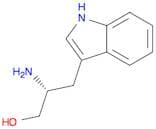
CAS 52485-52-6
:D-Tryptophanol
Description :
D-Tryptophanol, avec le numéro CAS 52485-52-6, est un dérivé d'acide aminé qui est structurellement lié au tryptophane, un acide aminé essentiel. Il se caractérise par la présence d'un anneau indole, qui est une caractéristique commune à de nombreux composés biologiquement actifs. D-Tryptophanol est connu pour son rôle potentiel dans la biosynthèse des neurotransmetteurs et son implication dans divers processus physiologiques. Il présente des propriétés qui peuvent influencer l'humeur et la régulation du sommeil, similaire à son précurseur le tryptophane. Le composé se trouve généralement sous forme cristalline et est soluble dans l'eau et les solvants organiques, ce qui le rend polyvalent pour diverses applications en recherche biochimique. De plus, D-Tryptophanol peut être étudié pour ses effets thérapeutiques potentiels, en particulier en relation avec le métabolisme de la sérotonine. Comme pour de nombreux dérivés d'acides aminés, il est important de manipuler D-Tryptophanol avec précaution dans les environnements de laboratoire, en respectant les protocoles de sécurité pour éviter toute réaction indésirable.
Formule :C11H14N2O
InChI :InChI=1/C11H14N2O/c12-9(7-14)5-8-6-13-11-4-2-1-3-10(8)11/h1-4,6,9,13-14H,5,7,12H2/t9-/m1/s1
SMILES :c1ccc2c(c1)c(C[C@H](CO)N)c[nH]2
Synonymes :- (2R)-2-Amino-3-(1H-indol-3-yl)propan-1-ol
- 1H-Indole-3-propanol, beta-amino-, (betaR)-
Trier par
Degré de pureté (%)
0
100
|
0
|
50
|
90
|
95
|
100
4 produits concernés.
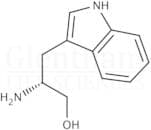
D-Tryptophanol
CAS :Formule :C11H14N2ODegré de pureté :95%Couleur et forme :SolidMasse moléculaire :190.2417d-Tryptophanol
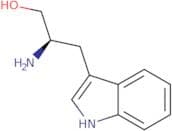
CAS :Formule :C11H14N2ODegré de pureté :98%Couleur et forme :SolidMasse moléculaire :190.246D-Tryptophanol
CAS :Produit contrôlé<p>D-Tryptophanol is a synthetic, enantiopure, hydroxymethylated tryptamine. It is a maltobionic molecule and it can be prepared by the hydrolysis of L-tryptophan with sodium hydroxide in water. D-Tryptophanol can also be synthesized from 3,4-diaminopyridine in the presence of a base and catalytic amount of copper(II) chloride. The chemical stability of D-tryptophanol has been studied using HPLC methods. Molecular modeling studies have shown that the compound forms hydrogen bonds with its neighboring molecules and has a high affinity for binding to human liver cells. D-Tryptophanol has been found to inhibit cancer cell growth at nanomolar concentrations, making it an attractive candidate for chemotherapeutic drugs. Calixarenes are used as chiral synthons to produce racemic mixtures of D-tryptophanol that could be</p>Formule :C11H14N2ODegré de pureté :Min. 95%Masse moléculaire :190.24 g/mol