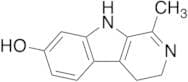
CAS 525-57-5
:Harmalol
Description :
Harmalol, avec le numéro CAS 525-57-5, est un alcaloïde dérivé des graines de la plante Peganum harmala, communément connue sous le nom de rue syrienne. Il appartient à la famille des bêta-carbolines et est structurellement lié à d'autres composés tels que l'harmine et l'harmaline. Harmalol est connu pour ses propriétés psychoactives et a été étudié pour ses effets potentiels sur le système nerveux central, y compris son rôle en tant qu'inhibiteur de la monoamine oxydase (IMAO). Cette caractéristique peut entraîner des interactions avec divers médicaments et substances alimentaires, nécessitant une prudence dans son utilisation. Le composé présente une gamme d'activités biologiques, y compris des effets antioxydants et neuroprotecteurs, qui ont suscité un intérêt dans la recherche pharmacologique. Harmalol se rencontre généralement sous forme cristalline et est soluble dans des solvants organiques. Son profil de sécurité et son potentiel thérapeutique continuent d'être explorés, en particulier dans le contexte de la médecine traditionnelle et de la pharmacologie moderne. Comme de nombreux alcaloïdes, les effets et la sécurité de Harmalol peuvent varier considérablement en fonction de la dose et de la réponse individuelle.
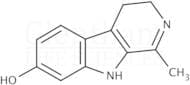
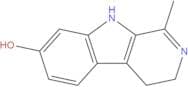
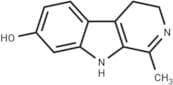
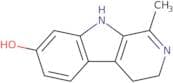
Formule :C12H12N2O
InChI :InChI=1S/C12H12N2O/c1-7-12-10(4-5-13-7)9-3-2-8(15)6-11(9)14-12/h2-3,6,14-15H,4-5H2,1H3
Code InChI :InChIKey=RHVPEFQDYMMNSY-UHFFFAOYSA-N
SMILES :CC=1C2=C(C=3C(N2)=CC(O)=CC3)CCN1
Synonymes :- 1-Methyl-3H,4H,9H-pyrido[3,4-b]indol-7-ol
- 1-Methyl-4,9-dihydro-3H-pyrido[3,4-b]indol-7-ol
- 1-methyl-2,3,4,9-tetrahydro-7H-beta-carbolin-7-one
- 1-methyl-4,9-dihydro-3H-β-carbolin-7-ol
- 11-Hydroxyharmalan
- 3H-Pyrido(3,4-b)indol-7-ol, 4,9-dihydro-1-methyl- (8CI)(9CI)
- 3H-Pyrido[3,4-b]indol-7-ol, 4,9-dihydro-1-methyl-
- 4,9-Dihydro-1-methyl-3H-pyrido(3,4-b)indol-7-ol
- Harmidol
- Harmolol
- Nsc 72293
- Voir plus de synonymes
Trier par
Degré de pureté (%)
0
100
|
0
|
50
|
90
|
95
|
100
5 produits concernés.
Harmalol
CAS :Harmalol (Harmidol) is a bioactive beta-carboline and a member of the harmala alkaloidsFormule :C12H12N2ODegré de pureté :98.94%Couleur et forme :SolidMasse moléculaire :200.24Ref: TM-T8770
1mg79,00€5mg150,00€10mg200,00€25mg360,00€50mg537,00€100mg765,00€500mg1.558,00€1mL*10mM (DMSO)130,00€Harmalol
CAS :Produit contrôléHarmalol is a reactive compound that is found in the seeds of Peganum harmala, also known as Syrian rue. Harmalol is an inhibitor of mitochondrial membrane potential and has been shown to interact with drugs that are metabolized by cytochrome P450. It also inhibits the activity of enzymes such as monoamine oxidase and phosphodiesterase. Harmalol has been shown to be cytotoxic to murine hepatoma cells and induce apoptosis via reactive oxygen species-mediated mechanisms. The molecular docking analysis reveals that harmalol binds to DNA through hydrogen bonding interactions with guanine bases on the DNA molecule. This binding may lead to DNA damage and cell death.Formule :C12H12N2ODegré de pureté :Min. 95%Couleur et forme :Clear LiquidMasse moléculaire :200.24 g/molHarmalol
CAS :Produit contrôléStability Hygroscopic
Applications Harmalol maintains a high DNA binding and apoptotic induction ability in HepG2 cells. Acetylcholinesterase inhibitor.
References Sarkar, S. et al.: Chem. Biol-Interact., 258, 142 (2016); Yang, Y. et al.: J. Ethnopharmacol., 168, 279 (2015);Formule :C12H12N2OCouleur et forme :Dark Yellow To Dark OrangeMasse moléculaire :200.24