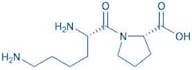
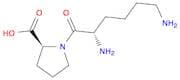
CAS 52766-27-5
:L-Lysyl-L-proline
Description :
L-Lysyl-L-proline, avec le numéro CAS 52766-27-5, est un dipeptide composé des acides aminés lysine et proline. Il se caractérise par sa séquence spécifique, où la lysine, un acide aminé essentiel, est liée à la proline, un acide aminé non essentiel. Ce composé se trouve généralement dans divers systèmes biologiques et peut jouer un rôle dans la synthèse des protéines et les fonctions cellulaires. L-Lysyl-L-proline présente des propriétés communes aux peptides, telles que la solubilité dans l'eau et la capacité à former des liaisons hydrogène en raison de ses groupes fonctionnels polaires. Sa structure comprend un groupe amino, un groupe carboxyle et une chaîne latérale caractéristique de la lysine, qui contribue à sa nature basique. La présence de proline introduit une structure cyclique unique qui peut influencer la conformation et la stabilité du peptide. L-Lysyl-L-proline peut avoir des applications potentielles en pharmacie et en biochimie, en particulier dans les études liées aux interactions protéiques et aux voies métaboliques.
Formule :C11H21N3O3
InChI :InChI=1S/C11H21N3O3/c12-6-2-1-4-8(13)10(15)14-7-3-5-9(14)11(16)17/h8-9H,1-7,12-13H2,(H,16,17)/t8-,9-/m0/s1
Code InChI :InChIKey=AIXUQKMMBQJZCU-IUCAKERBSA-N
SMILES :C([C@H](CCCCN)N)(=O)N1[C@H](C(O)=O)CCC1
Synonymes :- 205: PN: EP2161028 PAGE: 11 claimed protein
- 21: PN: WO2020097235 SEQID: 250 claimed protein
- 3-4-Substance P
- 37: PN: WO2005081628 SEQID: 1037 claimed protein
- 53: PN: WO2014102101 SEQID: 353 claimed protein
- 53: PN: WO2014102104 SEQID: 152 claimed protein
- <span class="text-smallcaps">L</smallcap>-Lysyl-<smallcap>L</span>-proline
- <span class="text-smallcaps">L</smallcap>-Proline, 1-<smallcap>L</span>-lysyl-
- <span class="text-smallcaps">L</smallcap>-Proline, <smallcap>L</span>-lysyl-
- L-Proline, 1-L-lysyl-
- L-lysyl-L-proline
- Lys-pro
- Lysylproline
- Proline, 1-<span class="text-smallcaps">L</span>-lysyl-
- Substance P<sub>3-4</sub>
- Substance P3-4
- Proline, 1-L-lysyl-
- Voir plus de synonymes
Trier par
Degré de pureté (%)
0
100
|
0
|
50
|
90
|
95
|
100
4 produits concernés.
H-Lys-Pro-OH
CAS :This dipeptide has the potential as a very promising healing agent in ulcer therapy. Daily oral applications to rats accelerated ulcer healing as well by stimulation of angiogenesis as by good mucous regeneration. In mice, a single administration stimulated granulation tissue production.Formule :C11H21N3O3Degré de pureté :> 99%Couleur et forme :WhiteMasse moléculaire :243.31Lysylproline
CAS :Lysylproline Third & fourth amino acid in substance P sequence.Formule :C11H21N3O3Couleur et forme :SolidMasse moléculaire :243.3H-Lys-Pro-OH hydrochloride salt
CAS :H-Lys-Pro-OH hydrochloride salt is a monoclonal antibody that is used to treat psychotic disorders. It blocks the binding of gamma-aminobutyric acid (GABA) to its receptor, which reduces neuronal activity and has a calming effect on the central nervous system. H-Lys-Pro-OH hydrochloride salt also inhibits the phosphatase enzyme and prevents it from breaking down phosphotungstic acid, which is used in this process. The antibody also binds to the analog of gamma aminobutyric acid, preventing it from binding with its receptor. H-Lys-Pro-OH hydrochloride salt may be advantageous in treating kidney fibrosis because it prevents cell proliferation and growth in tissue cultures by inhibiting enzymes involved in collagen synthesis. H-Lys-Pro-OH hydrochloride salt may also be useful as an antitumor agent because it inhibits tumor growth by blocking uptake and replication of DNA.Formule :C11H21N3O3Degré de pureté :Min. 95%Masse moléculaire :243.3 g/mol