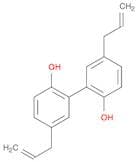
CAS 528-43-8
:Magnolol
Description :
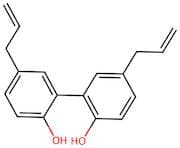
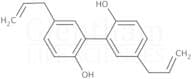
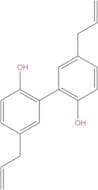
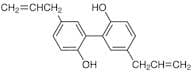
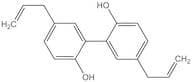
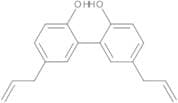
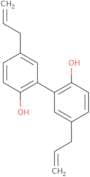
Magnolol est un composé naturel principalement dérivé de l'écorce de l'arbre Magnolia, en particulier des espèces telles que Magnolia officinalis. Il est classé comme un composé bifénolique, caractérisé par ses deux cycles aromatiques reliés par une chaîne de carbone. Magnolol présente une gamme d'activités biologiques, y compris des propriétés anti-inflammatoires, antioxydantes et antimicrobiennes, ce qui le rend intéressant pour la recherche pharmacologique. La substance est généralement un solide cristallin blanc à jaune pâle avec un point de fusion qui varie en fonction de la pureté et des conditions spécifiques. Elle est soluble dans des solvants organiques comme l'éthanol et le méthanol, mais a une solubilité limitée dans l'eau. Magnolol a été étudié pour ses effets thérapeutiques potentiels, y compris son rôle dans la réduction de l'anxiété et sa capacité à améliorer la fonction cognitive. De plus, il est exploré pour ses applications potentielles dans la conservation des aliments et les cosmétiques en raison de ses propriétés antimicrobiennes. Dans l'ensemble, Magnolol représente un composé significatif tant dans la médecine traditionnelle que dans la recherche scientifique moderne.
Formule :C18H18O2
InChI :InChI=1/C18H18O2/c1-3-5-13-7-9-17(19)15(11-13)16-12-14(6-4-2)8-10-18(16)20/h3-4,7-12,19-20H,1-2,5-6H2
Code InChI :InChIKey=VVOAZFWZEDHOOU-UHFFFAOYSA-N
SMILES :OC=1C(=CC(CC=C)=CC1)C2=CC(CC=C)=CC=C2O
Synonymes :- 2,2′-Bichavicol
- 2,2′-Biphenyldiol, 5,5′-diallyl-
- 2-(2-Hydroxy-5-prop-2-enylphenyl)-4-prop-2-enylphenol
- 5,5'-Di(Prop-2-En-1-Yl)Biphenyl-2,2'-Diol
- 5,5′-Di-2-propen-1-yl[1,1′-biphenyl]-2,2′-diol
- 5,5′-Diallyl-2,2′-biphenyldiol
- Magnolia Extract
- NSC 293099
- [1,1′-Biphenyl]-2,2′-diol, 5,5′-di-2-propen-1-yl-
- [1,1′-Biphenyl]-2,2′-diol, 5,5′-di-2-propenyl-
- Honokiol std.
- MAGNOLOL
- Magnolol std.
- 5',5-di-2-propenyl-(1,1'-Biphenyl)-2,2'-diol
- 5,5'-DIALLYL-BIPHENYL-2,2'-DIOL
- MAGNOLOL(SH)
- 1’-Biphenyl)-2,2’-diol,5’,5-di-2-propenyl-(1
- Magnolia officinalis Rehd.et Wils
- MAGNOLIABARKEXTRACT
- 5,5'-DIALLYL-2,2'-DIHYDROXYBIPHENYL
- MAGNOLOL 98.0% BY HPLC
- Voir plus de synonymes
Trier par
Degré de pureté (%)
0
100
|
0
|
50
|
90
|
95
|
100
14 produits concernés.
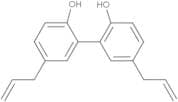
Magnolol
CAS :Magnolol analytical standard provided with w/w absolute assay, to be used for quantitative titration.Formule :C18H18O2Degré de pureté :(HPLC) ≥99%Couleur et forme :PowderMasse moléculaire :266.34Magnolol
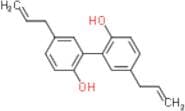
CAS :Magnolol (5,5'-Diallyl-2,2'-biphenyldiol) is a dual agonist of RXRα( EC50=10.4 μM) and PPARγ(EC50=17.7 μM). It blocks TNF-α-induced NF-KB activation.Formule :C18H18O2Degré de pureté :99.49% - 99.98%Couleur et forme :A Bioactive Compound Found In The Bark Of The Houpu MagnoliaMasse moléculaire :266.33Magnolol
CAS :Formule :C18H18O2Degré de pureté :≥ 97.0% (dried basis)Couleur et forme :White to off-white powder or crystalsMasse moléculaire :266.3Magnolol
CAS :Magnolol is a dual agonist of both RXRα and PPARγ, with EC50 values of 10.4 μM and 17.7 μM, respectively. Magnolol has antifungal, antibacterial, anti-oxidative, antidepressant-like, anti- tumor, and neuroprotective effects, it also prevents skin photoaging in UVB-irradiated hairless mice. Magnolol has a wide spectrum of targets including TNF-α, NF-KB, GSK3β.Formule :C18H18O2Degré de pureté :95%~99%Masse moléculaire :266.34Magnolol
CAS :Formule :C18H18O2Degré de pureté :>98.0%(GC)Couleur et forme :White to Almost white powder to crystalMasse moléculaire :266.34Magnolol
CAS :PolyphenolFormule :C18H18O2Degré de pureté :≥ 95.0 % (HPLC)Couleur et forme :PowderMasse moléculaire :266.34Magnolol
CAS :Produit contrôléApplications Magnolol is the bioactive phytochemicals found in Magnolia officinalis (1). Magnolol has been used to treat anxiety, cough, headache and allergies (2). It also inhibits tumor necrosis factor-α-*induced ICAM-1 expression in human lung epithelial cells.
Not a dangerous good if item is equal to or less than 1g/ml and there is less than 100g/ml in the package
References (1) Amorati, R., et al.: J Org Chem. (2015) 80:10651-9.(2) Wu, C., et. al.: Inflammation (2014) 37:1957-67Formule :C18H18O2Couleur et forme :Off-WhiteMasse moléculaire :266.33Magnolol
CAS :Magnolol is a bioactive compound, which is a type of lignan extracted from the bark of the magnolia tree, primarily Magnolia officinalis. It exhibits a diverse range of pharmacological activities, primarily attributed to its anti-inflammatory and antioxidant properties. Through the modulation of various signaling pathways, including the NF-κB pathway, magnolol effectively inhibits the activation of inflammatory mediators and scavenges free radicals.Formule :C18H18O2Degré de pureté :Min. 95%Couleur et forme :PowderMasse moléculaire :266.33 g/mol5,5′-Diallyl-[1,1′-biphenyl]-2,2′-diol
CAS :Formule :C18H18O2Degré de pureté :99%Couleur et forme :SolidMasse moléculaire :266.34












![5,5′-Diallyl-[1,1′-biphenyl]-2,2′-diol](/_next/image/?url=https%3A%2Fstatic.cymitquimica.com%2Fproducts%2F10%2Fthumb%2FF079442.jpg&w=3840&q=75)