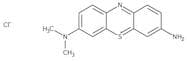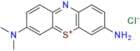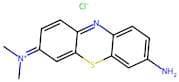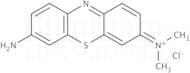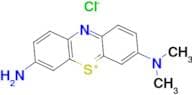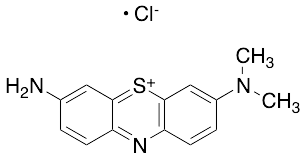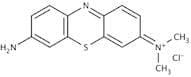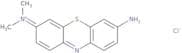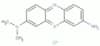
CAS 531-53-3
:Azure A
- 3-Amino-7-(dimethylamino)phenazathionium chloride
- 5-Chloro-3-dimethylamino-7-amino-5H-phenothiazine
- Azure A
- Azure A chloride
- Azure A dye
- Azure Blue Cert
- N,N-Dimethylthionine
- Phenothiazin-5-ium, 3-amino-7-(dimethylamino)-, chloride
- Phenothiazin-5-ium, 3-amino-7-(dimethylamino)-, chloride (1:1)
- C.I. 52005
Azure A chloride
CAS :Formule :C14H14ClN3SDegré de pureté :70%Couleur et forme :SolidMasse moléculaire :291.79913-Amino-7-(Dimethylamino)Phenothiazin-5-ium Chloride
CAS :3-Amino-7-(Dimethylamino)Phenothiazin-5-ium ChlorideDegré de pureté :BSMasse moléculaire :291.80g/molAzure A (C.I. 52005)
CAS :Formule :C14H14ClN3SCouleur et forme :Green to dark green-black powderMasse moléculaire :291.80Azure A (Technical Grade)
CAS :Produit contrôléApplications Azure A is an important nuclear staining component of polychrome methylene blue. Dyes and metabolites.
Formule :C14H14N3S·ClCouleur et forme :NeatMasse moléculaire :291.8Azure A Chloride
CAS :Formule :C14H14N3SClCouleur et forme :Greenish black, PowderMasse moléculaire :291.80Azure A
CAS :Azure A is a diagnostic agent that is used to detect the presence of azurea in diptera larvae. It is also used as an inhibitor molecule in polymerase chain reactions and genotoxic activity assays. Azure A has been found to have antimicrobial activity against human serum and miapaca-2 cells, as well as anti-inflammatory properties. The mechanism of action for this drug involves binding to DNA and inhibiting the synthesis of RNA. The drug also binds to transferable dyes such as tetrazolium dye and stains such as methylene blue, which leads to a staining reaction. Azure A can be detected using electrochemical impedance spectroscopy (EIS) by measuring the degree of impedance change between two electrodes in response to an alternating current that flows through them.
Formule :C14H14N3SClCouleur et forme :Green PowderMasse moléculaire :291.8 g/mol