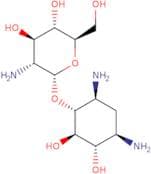
CAS 534-47-4
:Paromamine
Description :
Paromamine, avec le numéro CAS 534-47-4, est un composé chimique qui appartient à la classe des antibiotiques aminoglycosides. Il est principalement caractérisé par sa structure de sucre aminé, qui est essentielle à son activité biologique. Paromamine présente des propriétés antibactériennes, en particulier contre une gamme de bactéries Gram-négatives, ce qui le rend précieux dans le domaine de la microbiologie et de la pharmacologie. Le composé agit en inhibant la synthèse des protéines dans les bactéries, exerçant ainsi ses effets antimicrobiens. Paromamine est souvent étudié pour ses applications potentielles dans le traitement des infections, notamment dans les cas où la résistance à d'autres antibiotiques est une préoccupation. De plus, sa structure chimique comprend plusieurs groupes hydroxyles, contribuant à sa solubilité dans l'eau et à son interaction avec les systèmes biologiques. Comme de nombreux aminoglycosides, l'utilisation de Paromamine peut être associée à certains effets secondaires, notamment la néphrotoxicité et l'ototoxicité, ce qui nécessite une surveillance attentive pendant l'utilisation thérapeutique. Dans l'ensemble, Paromamine représente un composé important dans la recherche et le développement d'antibiotiques.
Formule :C12H25N3O7
InChI :InChI=1S/C12H25N3O7/c13-3-1-4(14)11(10(20)7(3)17)22-12-6(15)9(19)8(18)5(2-16)21-12/h3-12,16-20H,1-2,13-15H2/t3-,4+,5-,6-,7+,8-,9-,10-,11-,12-/m1/s1
Code InChI :InChIKey=JGSMDVGTXBPWIM-HKEUSBCWSA-N
SMILES :O([C@H]1[C@H](O)[C@@H](O)[C@H](N)C[C@@H]1N)[C@H]2O[C@H](CO)[C@@H](O)[C@H](O)[C@H]2N
Synonymes :- Neomycin D
- 4-O-α-D-Glucosaminyl-2-deoxystreptamine
- 4-O-(2-Amino-2-deoxy-α-D-glucopyranosyl)-2-deoxy-D-streptamine
- Paromamine
- D-Streptamine, 4-O-(2-amino-2-deoxy-α-D-glucopyranosyl)-2-deoxy-
Trier par
Degré de pureté (%)
0
100
|
0
|
50
|
90
|
95
|
100
2 produits concernés.
Paromamine 3HCl
CAS :Paromamine is a chemical compound that inhibits protein synthesis by enzymatic inactivation. It has been shown to have a broad spectrum of antibacterial activity against Gram-positive and Gram-negative bacteria. Paromamine also has the ability to inhibit bacterial growth at high salt concentrations, making it an attractive candidate for development as an oral antibiotic drug. Paromamine is synthesized from natural products, such as salicylaldehyde or phenylhydrazine, which are readily available and inexpensive. The reaction mechanism for the formation of paromamine starts with dehydration of the hydroxyl group on the hydrazine to form a carbonyl group. This carbonyl group reacts with sephadex g-100 to form a cyanohydrin. The cyanohydrin reacts with ammonia to form an amide bond between the two nitrogen atoms in the molecule, which forms paromamine.Formule :C12H25N3O7·3HClDegré de pureté :Min. 95%Masse moléculaire :323.34 g/mol