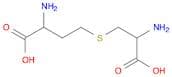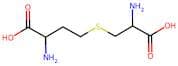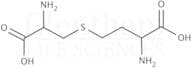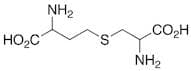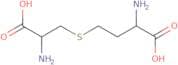
CAS 535-34-2
:cystathionine
Description :
cystathionine est un acide aminé naturellement présent et un intermédiaire clé dans la voie de transsulfuration, qui est impliquée dans le métabolisme des acides aminés contenant du soufre, en particulier la méthionine et la cystéine. C'est un dipeptide formé par la condensation d'homocystéine et de sérine, et il joue un rôle crucial dans la synthèse de la cystéine. cystathionine se caractérise par sa formule structurelle, qui comprend une liaison thioéther et un groupe acide carboxylique, contribuant à sa réactivité et à ses fonctions biologiques. Il existe sous deux formes stéréoisomériques, la forme L étant biologiquement active. En termes de solubilité, cystathionine est soluble dans l'eau, ce qui facilite ses interactions biologiques. Des niveaux élevés de cystathionine dans le corps peuvent être indicatifs de certains troubles métaboliques, y compris l'homocystinurie. De plus, cystathionine peut être impliqué dans diverses voies biochimiques, influençant les processus cellulaires et contribuant à la régulation du stress oxydatif. Son numéro CAS, 535-34-2, est utilisé pour l'identification dans les bases de données chimiques et les contextes réglementaires.
Formule :C7H14N2O4S
InChI :InChI=1/C7H14N2O4S/c8-4(6(10)11)1-2-14-3-5(9)7(12)13/h4-5H,1-3,8-9H2,(H,10,11)(H,12,13)/t4-,5?/m0/s1
Code InChI :InChIKey=ILRYLPWNYFXEMH-UHFFFAOYSA-N
SMILES :C(CCSCC(C(O)=O)N)(C(O)=O)N
Synonymes :- (3Alpha,5Alpha,17Alpha)-Androstane-3,17-Diol
- 2-Amino-4-[(2-amino-2-carboxyethyl)sulfanyl]butanoic acid
- 2-Azaniumyl-4-(2-azaniumyl-2-carboxylatoethyl)sulfanylbutanoate
- <span class="text-smallcaps">DL</span>-Allocystathionine
- <span class="text-smallcaps">DL</span>-Cystathionine
- <span class="text-smallcaps">DL</span>-Homocysteine, S-(2-amino-2-carboxyethyl)-
- Butyric acid, α-amino-γ-(2-amino-2-carboxyethylmercapto)-
- Cystathionine, <span class="text-smallcaps">DL</span>-
- Cystathionine, DL-
- DL-Allocystathionine
- DL-Cystathionine
- DL-Homocysteine, S-(2-amino-2-carboxyethyl)-
- Homocysteine, S-(2-amino-2-carboxyethyl)-
- NSC 118379
- S-(2-Amino-2-carboxyethyl)-DL-homocysteine
- S-(2-Amino-2-carboxyethyl)homocysteine
- S-(2-amino-2-carboxyethyl)-L-homocysteine
- S-[(2R)-2-amino-2-carboxyethyl]-L-homocysteine
- DL,DL-allo-Cystathionine, S-(2-Amino-2-carboxyethyl)homocysteine
- CYSTATHIONINE
- dl,dl-allo-cystathionine
- -2-Amino-4-((2-amino-2-carboxyethyl)
- 2-amino-4-[(2-amino-3-hydroxy-3-keto-propyl)thio]butyric acid
- 2-amino-4-(2-amino-3-hydroxy-3-oxopropyl)sulfanylbutanoic acid
- D,L-CYSTATHIONINE
- 2-aMino-4-((2-aMino-2-carboxyethyl)thio)butanoic acid
- 2-azanyl-4-(2-azanyl-3-hydroxy-3-oxo-propyl)sulfanyl-butanoic acid
- Allocystathionine
- Voir plus de synonymes
Trier par
Degré de pureté (%)
0
100
|
0
|
50
|
90
|
95
|
100
6 produits concernés.
(2S)-2-Amino-4-((2-amino-2-carboxyethyl)thio)butanoic acid
CAS :Formule :C7H14N2O4SDegré de pureté :97%Couleur et forme :SolidMasse moléculaire :222.2621D,L-Cystathionine
CAS :Formule :C7H14N2O4SDegré de pureté :(HPLC) ≥ 90.0%Couleur et forme :White to off-white powderMasse moléculaire :222.30D,L-Cystathionine
CAS :Produit contrôléApplications Intermediate for transsulfuration whereby a mammal transfers the sulfur of methionine via homocysteine to cysteine.
References Thompson, J.W., et al.: J. Biol. Chem., 266, 17011 (1991), Yoshida, Y., et al.: Microbiol., 148, 3961 (2002), Jiracek, J., et al.: J. Med. Chem., 49, 3982 (2006),Formule :C7H14N2O4SCouleur et forme :NeatMasse moléculaire :222.26D,L-Cystathionine
CAS :Cystathionine is a sulfur-containing amino acid that is the precursor of cysteine. Cystathionine synthase, the enzyme that catalyzes the formation of cystathionine, is inhibited by L-cysteine and glutathione. Cystathionine has been shown to be an important growth factor for fibroblasts and osteoblasts in culture as well as a regulator of gene expression. It also has been shown to be essential for iron homeostasis, as it increases iron absorption from the gut and reduces iron excretion in bile. Cystathionine is a highly reactive molecule with a high redox potential and can cause oxidative injury to cells, which may contribute to bowel disease. Cystathionine has been shown to have receptor activity in neurons, and its physiological effects are similar to those of glutamate.Formule :C7H14N2O4SDegré de pureté :Min. 95%Couleur et forme :PowderMasse moléculaire :222.26 g/mol