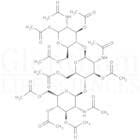
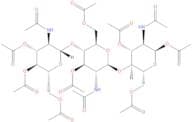
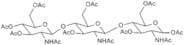
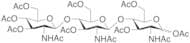
CAS 53942-45-3
:[(3S,4R,5S,6S)-5-acétamido-3-[(2S,3S,4R,5S)-3-acétamido-4,5-diacétoxy-6-(acétoxyméthyl)tétra-hydropyrane-2-yl]oxy-6-[(3S,4R,5S,6S)-5-acétamido-4,6-diacétoxy-2-(acétoxyméthyl)tétra-hydropyrane-3-yl]oxy-4-acétoxy-tétra-hydropyrane-2-yl]méthyl acétate
Description :
La substance chimique portant le nom "[(3S,4R,5S,6S)-5-acétamido-3-[(2S,3S,4R,5S)-3-acétamido-4,5-diacétoxy-6-(acétoxyméthyl)tétra-hydropyrane-2-yl]oxy-6-[(3S,4R,5S,6S)-5-acétamido-4,6-diacétoxy-2-(acétoxyméthyl)tétra-hydropyrane-3-yl]oxy-4-acétoxy-tétra-hydropyrane-2-yl]méthyl acétate" et le numéro CAS "53942-45-3" est un composé organique complexe caractérisé par ses multiples groupes fonctionnels, y compris les moieties acétamido et acétoxy. Ce composé présente un squelette de tétrahydropyrane, qui est un éther cyclique à six membres, et exhibe une spécificité stéréochimique avec plusieurs centres chiraux, indiquant qu'il existe sous des formes stéréoisomériques spécifiques. La présence de plusieurs groupes acétoxy suggère une réactivité potentielle et des applications en synthèse organique ou en chimie médicinale. Sa complexité structurelle peut contribuer à des activités biologiques uniques, ce qui le rend intéressant pour la recherche pharmaceutique. De plus, la solubilité, la stabilité et la réactivité du composé peuvent être influencées par ses groupes fonctionnels et sa stéréochimie, qui sont critiques pour comprendre son comportement dans divers environnements chimiques.
Formule :C40H57N3O24
InChI :InChI=1/C40H57N3O24/c1-15(44)41-29-36(60-23(9)52)33(27(13-56-19(5)48)63-38(29)62-25(11)54)66-40-31(43-17(3)46)37(61-24(10)53)34(28(65-40)14-57-20(6)49)67-39-30(42-16(2)45)35(59-22(8)51)32(58-21(7)50)26(64-39)12-55-18(4)47/h26-40H,12-14H2,1-11H3,(H,41,44)(H,42,45)(H,43,46)/t26?,27?,28?,29-,30-,31-,32+,33+,34+,35+,36+,37+,38+,39-,40-/m0/s1
Synonymes :- O-3,4,6-Tri-O-acetyl-2-(acetylamino)-2-deoxy-b-D-glucopyranosyl-(1-4)-O-3,6-di-O-acetyl-2-(acetylamino)-2-deoxy-b-D-glucopyranosyl-(1-4)-2-(acetylamino)-2-deoxy-1,3,6-triacetate-a-D-glucopyranose
- Tri-N-acetyl Chitotriose Octaac
- O-3,4,6-Tri-O-acetyl-2-(acetylamino)-2-deoxy--D-glucopyranosyl-(1-4)-O-3,6-di-O-acetyl-2-(acetylamino)-2-deoxy--D-glucopyranosyl-(1-4)-2-(acetylamino)-2-deoxy-1,3,6-triacetate-a-D-glucopyranose
- α-D-Glucopyranose, O-3,4,6-tri-O-acetyl-2-(acetylamino)-2-deoxy-β-D-glucopyranosyl-(1→4)-O-3,6-di-O-acetyl-2-(acetylamino)-2-deoxy-β-D-glucopyranosyl-(1→4)-2-(acetylamino)-2-deoxy-, 1,3,6-triacetate
- Tri-N-acetyl Chitotriose Octaacetate
- O-3,4,6-Tri-O-acetyl-2-(acetylaMino)-2-deoxy-β-D-glucopyranosyl-(1-4)-O-3,6-di-O-acetyl-2-(acetylaMino)-2-deoxy-β-D-glucopyranosyl-(1-4)-2-(acetylaMino)-2-deoxy-1,3,6-triacetate-α-D-glucopyranose
Trier par
Degré de pureté (%)
0
100
|
0
|
50
|
90
|
95
|
100
4 produits concernés.
Chitotriose Undecaacetate
CAS :Formule :C40H57N3O24Degré de pureté :95%~99%Masse moléculaire :963.893Chitotriose undecaacetate
CAS :Chitotriose undecaacetate is a synthetic substrate that is used in transfecting experiments. It has high sensitivity and can be used to introduce nucleic acid into cells. Chitotriose undecaacetate is used as a synthetic fluorometric assay for the determination of chitinase activity in vitro or as a substrate for cell-free synthesis of nucleic acids. It has been shown to possess moieties that are sensitive to hydrogen chloride and chloride ions, making it an effective probe for the determination of these ions. Chitotriose undecaacetate also reacts with sephadex G-200, which makes it useful for separating DNA fragments by electrophoresis.Formule :C40H57N3O24Degré de pureté :Min. 95%Couleur et forme :White PowderMasse moléculaire :963.89 g/molChitotriose Undecaacetate
CAS :Produit contrôléApplications An intermediate of 4-Methylumbelliferyl β-D-N,N',N”-Triacetylchitotrioside.
References Yang, Y., et al.: J. Biochem., 87, 1003 (1980)Formule :C40H57N3O24Couleur et forme :NeatMasse moléculaire :963.89