CAS 54-35-3
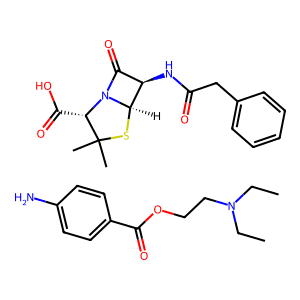
:Pénicilline G procaïne
Description :
Pénicilline G procaïne, avec le numéro CAS 54-35-3, est un antibiotique semi-synthétique qui combine la pénicilline G avec de la procaïne pour améliorer ses propriétés pharmacologiques. Ce composé se caractérise par son activité antibactérienne à large spectre, principalement efficace contre les bactéries gram-positives et certains organismes gram-négatifs. Il est généralement administré par injection intramusculaire en raison de sa faible biodisponibilité orale. Le composant procaïne sert à prolonger l'action de la pénicilline G en ralentissant sa libération dans la circulation sanguine, permettant ainsi des effets thérapeutiques prolongés. Pénicilline G procaïne est couramment utilisé dans le traitement de diverses infections bactériennes, y compris les infections des voies respiratoires, les infections cutanées et certains types de syphilis. Sa formulation est conçue pour minimiser le risque de réactions allergiques associées à la pénicilline, bien que l'hypersensibilité puisse encore survenir chez certaines personnes. Comme d'autres pénicillines, il agit en inhibant la synthèse de la paroi cellulaire bactérienne, entraînant la lyse et la mort cellulaire. Un stockage et une manipulation appropriés sont essentiels pour maintenir son efficacité, car il est sensible à la chaleur et à l'humidité.
Formule :C16H18N2O4S·C13H20N2O2
InChI :InChI=1S/C16H18N2O4S.C13H20N2O2/c1-16(2)12(15(21)22)18-13(20)11(14(18)23-16)17-10(19)8-9-6-4-3-5-7-9;1-3-15(4-2)9-10-17-13(16)11-5-7-12(14)8-6-11/h3-7,11-12,14H,8H2,1-2H3,(H,17,19)(H,21,22);5-8H,3-4,9-10,14H2,1-2H3/t11-,12+,14-;/m1./s1
Code InChI :InChIKey=WHRVRSCEWKLAHX-LQDWTQKMSA-N
SMILES :C(O)(=O)[C@@H]1N2[C@@]([C@H](NC(CC3=CC=CC=C3)=O)C2=O)(SC1(C)C)[H].C(OCCN(CC)CC)(=O)C1=CC=C(N)C=C1
Synonymes :- (2S,5R,6R)-3,3-dimethyl-7-oxo-6-[(phenylacetyl)amino]-4-thia-1-azabicyclo[3.2.0]heptane-2-carboxylic acid-2-(diethylamino)ethyl 4-aminobenzoate (1:1)
- (2S,5R,6R)-3,3-dimethyl-7-oxo-6-[(phenylacetyl)amino]-4-thia-1-azabicyclo[3.2.0]heptane-2-carboxylic acid-2-(diethylamino)ethyl 4-aminobenzoate hydrate (1:1:1)
- 3,3-Dimethyl-7-Oxo-6-[(Phenylacetyl)Amino]-4-Thia-1-Azabicyclo[3.2.0]Heptane-2-Carboxylic Acid-2-(Diethylamino)Ethyl 4-Aminobenzoate (1:1)
- 4-Thia-1-azabicyclo[3.2.0]heptane-2-carboxylic acid, 3,3-dimethyl-7-oxo-6-(2-phenylacetamido)-, compd. with 2-(diethylamino)ethyl p-aminobenzoate (1:1)
- 4-Thia-1-azabicyclo[3.2.0]heptane-2-carboxylic acid, 3,3-dimethyl-7-oxo-6-[(2-phenylacetyl)amino]- (2S,5R,6R)-, compd. with 2-(diethylamino)ethyl 4-aminobenzoate (1:1)
- 4-Thia-1-azabicyclo[3.2.0]heptane-2-carboxylic acid, 3,3-dimethyl-7-oxo-6-[(phenylacetyl)amino]- (2S,5R,6R)-, compd. with 2-(diethylamino)ethyl 4-aminobenzoate (1:1)
- 4-Thia-1-azabicyclo[3.2.0]heptane-2-carboxylic acid, 3,3-dimethyl-7-oxo-6-[(phenylacetyl)amino]-[2S-(2α,5α,6β)]-, compd. with 2-(diethylamino)ethyl 4-aminobenzoate (1:1)
- Abbocillin DC
- Afsillin
- Ampin-penicillin
- Aquacilina
- Aquacillin
- Aquasuspen
- Avloprocil
- Benzoic acid, 4-amino-, 2-(diethylamino)ethyl ester, mono[(2S,5R,6R)-3,3-dimethyl-7-oxo-6-[(phenylacetyl)amino]-4-thia-1-azabicyclo[3.2.0]heptane-2-carboxylate]
- Benzoic acid, 4-amino-, 2-(diethylamino)ethyl ester, mono[[2S-(2α,5α,6β)]-3,3-dimethyl-7-oxo-6-[(phenylacetyl)amino]-4-thia-1-azabicyclo[3.2.0]heptane-2-carboxylate]
- Benzylpenicillin
- Benzylpenicillin Procaine
- Benzylpenicillin novocaine salt
- Benzylpenicillin procaine salt
- Carepen
- Cilicaine
- Crysticillin
- Depocillin
- Despacilina
- Distaquaine
- Dorsallin AR
- Duphapen
- Duracillin
- Ethacilin
- Flo-Cillin Aqueous
- Geepenil
- Hostacillin
- Hydracillin
- Ilcocillin P
- Jenacillin O
- Kabipenin
- Ledercillin
- Lenticillin
- Mammacillin
- Masticillin
- Megapen
- Micro-Pen
- Millicillin
- Mylipen
- Neoproc
- Nopcaine
- Novocaine penicillin
- Pen 50
- Pen-Fifty
- Penaquacaine G
- Penicillin G Procaine Sterile
- Penicillin G procaine
- Penicillin procaine
- Penovet
- Pentaquacaine G
- Penzal N 300
- Premocillin
- Pro-Pen
- Procain Penicillin G
- Procaine Benzylpenicillin
- Procaine benzylpenicillin salt
- Procaine benzylpenicillinate
- Procaine penicillin (G)
- Procanodia
- Prostabillin
- Retardillin
- Sharcillin
- Vetspen
- Vitablend
- Wycillin
- Sterile Penicillin G Procaine/SodiuM3∶1 API
- Benzylpenicillinic acid, procaine
- Penicillin G procaine Benzylpenicillin procaine API
- Procaine penicillin G(fortified) USP/EP/BP
- BENZYLPENICILLIN PROCAIN SALT
- PROCAINE BENZYLPENICILLIN (PROCAINE PENICILLIN) ASSAY STANDARD BP(CRM STANDARD)
- PENICILLIN-G PROCAIN SALT
- Penicillin G Procaine/Sodium 3:1 USP/EP/BP
- PROCAINE BENZYLPENICILLIN EPP(CRM STANDARD)
- Procaine penicillin G(1% lecithin/citrate acid)
- 4-Thia-1-azabicyclo3.2.0heptane-2-carboxylic acid, 3,3-dimethyl-7-oxo-6-(phenylacetyl)amino- (2S,5R,6R)-, compd. with 2-(diethylamino)ethyl 4-aminobenzoate (1:1)
- (2S,5R,6R)-3,3-dimethyl-7-oxo-6-[(1-oxo-2-phenylethyl)amino]-4-thia-1-azabicyclo[3.2.0]heptane-2-carboxylic acid
- Penicillin G procaine +1% lecithin CP200/BP/USP/EP
- Procain-Penicillin
- PENICILLIN G PROCAINE USP/EP/BP
- Penicillin G procaine sterile CP200/BP/USP/EP
- Procaine penicillin G USP/EP/BP
- BENZYLPENICILLIN PROCAINE + POTASSIC 3:1
- Voir plus de synonymes
Trier par
Degré de pureté (%)
0
100
|
0
|
50
|
90
|
95
|
100
5 produits concernés.
Procaine benzylpenicillin
CAS :Procaine benzylpenicillinFormule :C13H20N2O2 / C13H20N2O2C16H18N2O4SH2OCouleur et forme :White PowderMasse moléculaire :236.15248(2S,5R,6R)-3,3-dimethyl-7-oxo-6-(2-phenylacetamido)-4-thia-1-azabicyclo[3.2.0]heptane-2-carboxylic acid; 2-(diethylamino)ethyl 4-aminobenzoate
CAS :Formule :C29H38N4O6SDegré de pureté :98%Masse moléculaire :570.7002Procaine penicillin G
CAS :Procaine penicillin G treats syphilis, anthrax, oral infections, pneumonia, diphtheria, cellulitis, and bites.Formule :C29H38N4O6SDegré de pureté :99.73%Couleur et forme :A White Crystalline PowderMasse moléculaire :570.7Penicillin G procaine
CAS :Produit contrôléPenicillin G procaine is a form of penicillin that is commonly used to treat bacterial infections. It is a prodrug that undergoes hydrolysis in the body to release penicillin, its active form. Penicillin G procaine has been shown to be effective against Streptococcus pyogenes, which causes streptococcal pharyngitis, and other bacteria that are sensitive to penicillin. Penicillin G procaine is less toxic than other forms of penicillin and has minimal side effects. The pharmacological effects of the drug are due primarily to the inhibition of bacterial cell wall synthesis by binding to peptidoglycan precursors and blocking their cross-linking. The concentration–time curve for penicillin G procaine shows that it has a long half-life in humans, making it suitable for continuous treatment in patients with chronic infections.Formule :C16H18N2O4S·C13H20N2O2Degré de pureté :Min. 95%Masse moléculaire :570.7 g/mol


![(2S,5R,6R)-3,3-dimethyl-7-oxo-6-(2-phenylacetamido)-4-thia-1-azabicyclo[3.2.0]heptane-2-carboxylic…](/_next/image/?url=https%3A%2Fstatic.cymitquimica.com%2Fproducts%2FIN%2Fthumb%2FDA00I9MZ.jpg&w=3840&q=75)