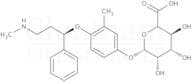
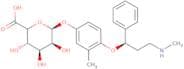
![(3S,4S,5S,6S)-3,4,5-trihydroxy-6-[3-methyl-4-[(1R)-3-(methylamino)-1-phenyl-propoxy]phenoxy]tetrah…](/_next/image/?url=https%3A%2Fstatic.cymitquimica.com%2Fcas-image%2Fthumb-webp%2F213234-3s-4s-5s-6s-345-trihydroxy-6-3-methyl-4-1r-3-methylamino-1-phenyl-propoxy-phenoxy-tetrahydropyran-2-carboxylic-acid.webp&w=3840&q=75)
CAS 540729-08-6
:acide (3S,4S,5S,6S)-3,4,5-trihydroxy-6-[3-méthyl-4-[(1R)-3-(méthylamino)-1-phényl-propoxy]phénoxy]tétrahydropyrane-2-carboxylique
Description :
La substance chimique portant le nom "acide (3S,4S,5S,6S)-3,4,5-trihydroxy-6-[3-méthyl-4-[(1R)-3-(méthylamino)-1-phényl-propoxy]phénoxy]tétrahydropyrane-2-carboxylique" et le numéro CAS 540729-08-6 est un composé organique complexe caractérisé par ses multiples groupes hydroxyles et un groupe fonctionnel acide carboxylique, qui contribuent à son hydrophilie et à son activité biologique potentielle. La présence d'un cycle de tétrahydropyrane indique une structure cyclique qui peut influencer sa stéréochimie et sa réactivité. Le composé présente également un groupe phénoxy, qui peut améliorer son interaction avec des cibles biologiques, le rendant potentiellement pertinent en chimie médicinale. Les substituants méthylamino et phényl suggèrent qu'il pourrait présenter des propriétés pharmacologiques spécifiques, agissant potentiellement comme un ligand ou un inhibiteur dans des voies biochimiques. Dans l'ensemble, la structure complexe et les groupes fonctionnels de ce composé suggèrent qu'il pourrait avoir des implications significatives dans la conception et le développement de médicaments, en particulier dans le ciblage de récepteurs ou d'enzymes spécifiques dans les systèmes biologiques.
Formule :C23H29NO8
InChI :InChI=1/C23H29NO8/c1-13-12-15(30-23-20(27)18(25)19(26)21(32-23)22(28)29)8-9-16(13)31-17(10-11-24-2)14-6-4-3-5-7-14/h3-9,12,17-21,23-27H,10-11H2,1-2H3,(H,28,29)/t17-,18+,19+,20+,21?,23-/m1/s1
Trier par
Degré de pureté (%)
0
100
|
0
|
50
|
90
|
95
|
100
6 produits concernés.
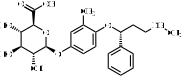
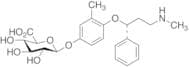
4’-Hydroxy Atomoxetine Glucuronide
CAS :Formule :C23H29NO8Couleur et forme :Off-White SolidMasse moléculaire :447.484'-Hydroxy Atomoxetine beta-D-Glucuronide
CAS :Produit contrôléApplications A metabolite of Atomoxetine (A791400).
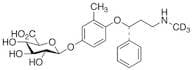
References Wong, D., et al.: J. Pharmacol. Exp. Ther., 222, 61 (1982), Steiner, E., et al.: Clin. Pharmacol. Ther., 44, 431 (1988), Gehlert, D., et al.: Neurosci. Lett., 157, 203 (1993), Kuczenski, R., et al.: J. Neurochem., 68, 2032 (1997), Sauer, J., et al.: Drug Metab. Dispos., 31, 98 (2003),Formule :C23H29NO8Couleur et forme :Light BrownMasse moléculaire :447.484’-Hydroxy Atomoxetine β-D-Glucuronide-d3
CAS :Produit contrôléFormule :C23D3H26NO8Couleur et forme :NeatMasse moléculaire :450.4974'-Hydroxy atomoxetine b-D-glucuronide
CAS :4'-Hydroxy atomoxetine b-D-glucuronide is a synthetic compound that has been modified for use in the synthesis of saccharides and oligosaccharides. The modification is a high-yielding, efficient, and economical method for the preparation of complex carbohydrates. This compound is an intermediate in the synthesis of glycosylations. It can be used for the click modification of proteins or polysaccharides.br>br> 4'-Hydroxy atomoxetine b-D-glucuronide is an intermediate in the synthesis of glycosylations. It can be used for the click modification of proteins or polysaccharides. Click chemistry is a form of chemical reaction used to modify molecules by attaching them to other molecules with similar reactive groups, such as hydroxyl groups, through a process called "click" chemistry. The term was coined by K. Barry Sharpless at Stanford University in 2000 after he demonstrated that certain metalFormule :C23H29NO8Degré de pureté :Min. 95%Masse moléculaire :447.49 g/mol