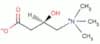
CAS 541-15-1
:(-)-Carnitine
Description :
(-)-Carnitine, avec le numéro CAS 541-15-1, est un composé d'ammonium quaternaire qui joue un rôle crucial dans le métabolisme des acides gras. C'est une substance naturellement présente, synthétisée dans le corps à partir des acides aminés lysine et méthionine. Caractéristiquement, (-)-Carnitine est une poudre blanche et cristalline qui est soluble dans l'eau et a un goût légèrement amer. Il existe sous forme de zwitterion à pH physiologique, possédant à la fois une charge positive et une charge négative, ce qui contribue à sa solubilité et à son activité biologique. Ce composé est essentiel pour le transport des acides gras à chaîne longue dans les mitochondries, où ils sont oxydés pour la production d'énergie. De plus, (-)-Carnitine a été étudié pour ses bénéfices potentiels dans l'amélioration des performances sportives, le soutien à la perte de poids et l'amélioration de la santé cardiaque. Il est souvent disponible sous forme de complément alimentaire et est reconnu pour son profil de sécurité, bien que les individus doivent consulter des professionnels de la santé avant utilisation, en particulier ceux ayant des problèmes de santé sous-jacents.
Formule :C7H15NO3
InChI :InChI=1S/C7H15NO3/c1-8(2,3)5-6(9)4-7(10)11/h6,9H,4-5H2,1-3H3/t6-/m1/s1
Code InChI :InChIKey=PHIQHXFUZVPYII-ZCFIWIBFSA-N
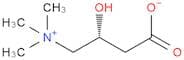
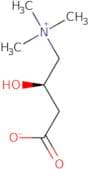
SMILES :C([N+](C)(C)C)[C@@H](CC([O-])=O)O
Synonymes :- (-)-<span class="text-smallcaps">L</span>-Carnitine
- (-)-Carnitine
- (3R)-3-Hydroxy-4-(trimethylazaniumyl)butanoate
- (D)L-Carnitine
- (R)-(3-Carboxy-2-hydroxypropyl)trimethylammoniumhydroxid
- (R)-(3-carboxy-2-hydroxypropyl)trimethylammonium hydroxide
- (R)-Carnitine
- 1-Butanaminium, 2,4-dihydroxy-N,N,N-trimethyl-4-oxo-, inner salt, (2R)-
- 1-Propanaminium, 3-carboxy-2-hydroxy-N,N,N-trimethyl-, hydroxide, inner salt, (R)-
- 1-Propanaminium, 3-carboxy-2-hydroxy-N,N,N-trimethyl-, inner salt, (2R)-
- 1-Propanaminium, 3-carboxy-2-hydroxy-N,N,N-trimethyl-, inner salt, (R)-
- 3-Hydroxy-4-(trimethylammonio)butanoate
- <span class="text-smallcaps">L</span>-Carnipure
- Aminocarnifarm
- Ammonium Hydroxide Inner Salt, 1-(3-Carboxy-2-Hydroxypropyl)Trimethyl-2R-
- Ammonium, (3-carboxy-2-hydroxypropyl)trimethyl-, hydroxide, inner salt, <span class="text-smallcaps">L</span>-
- Ammonium, (3-carboxy-2-hydroxypropyl)trimethyl-, hydroxide, inner salt, L-
- Carniking
- Carniking 50
- Carnil
- Carnilean
- Carnipass
- Carnipass 20
- Carnitene
- Carnitor
- Carnivit
- Coaxel
- L-Carnipure
- L-Carnitine Base
- Levocarnitine
- Levocarnitinep
- Natrulon RC
- St 198
- Vitamin B<sub>T</sub>
- Vitamin BT
- hidroxido de (R)-(3-carboxi-2-hidroxipropil)trimetilamonio
- Voir plus de synonymes
Trier par
Degré de pureté (%)
0
100
|
0
|
50
|
90
|
95
|
100
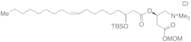
3-tert-Butyldimethylsilyloxyoleyl O-(Methoxymethoxy)carnitine Ester Chloride Salt
CAS :Produit contrôlé<p>Applications 3-tert-Butyldimethylsilyloxyoleyl O-(Methoxymethoxy)carnitine Ester Chloride Salt is an analog of Carnitine (C184110), an essential cofactor for the metabolism of fatty acids.<br></p>Formule :C33H66ClNO6SiCouleur et forme :NeatMasse moléculaire :636.42L-Carnitine extrapure, 99%
CAS :Formule :C7H15NO3Degré de pureté :min. 99%Couleur et forme :White, Crystalline compound, Clear, ColourlessMasse moléculaire :161.20L-Carnitine-15N
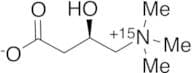
CAS :Produit contrôlé<p>Applications L-Carnitine-15N is an isotopically labelled analog of L-Carnitine (C184110), which is an essential cofactor of fatty acid metabolism; required for the transport of fatty acids through the inner mitochondrial membrane. Synthetized primarily in the liver and kidney; highest concentrations found in heart and skeletal muscle.<br>References Mitchell, M.E., et al.: Am. J. Clin. Nutr., 31, 293 (1978); Lango, R., et al.: Cardiovasc. Res., 51, 21 (2001);Vaz, F.M., et al.: Biochem. J., et al.: 361, 417 (2002);Karlic, H., et al.: Nutr. J., 20, 709 (2004)<br></p>Formule :C7H15NO3Couleur et forme :NeatMasse moléculaire :162.19L-Carnitine
CAS :<p>L-Carnitine is a naturally occurring amino acid that is involved in the metabolism of fatty acids. L-Carnitine has been shown to have antioxidant properties and can protect tissues against oxidative injury. It also plays an important role in energy metabolism, as well as the maintenance of mitochondrial functions. L-Carnitine has been used to treat atherosclerotic lesions in humans, kidney fibrosis, and blood sampling. L-Carnitine can be used to reduce the symptoms of hypoglycemia and has also been shown to inhibit the growth of infectious diseases such as Helicobacter pylori and Salmonella typhi, through scavenging of reactive oxygen radicals.</p>Formule :C7H15NO3Couleur et forme :White PowderMasse moléculaire :161.2 g/mol