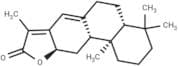
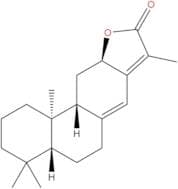
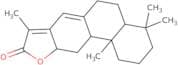
CAS 54494-34-7
:jolkinolide E
- (4aR,10aR,11aR,11bR)-4,4,8,11b-tetramethyl-2,3,4a,5,6,10a,11,11a-octahydro-1H-naphtho[2,1-f][1]benzofuran-9-one
- (4aR,10aR,11aR,11bR)-2,3,4,4a,5,6,10a,11,11a,11b-Decahydro-4,4,8,11b-tetramethyl-phenanthro[3,2-b]furan-9(1H)-one
- jolkinolide E
- Phenanthro[3,2-b]furan-9(1H)-one, 2,3,4,4a,5,6,10a,11,11a,11b-decahydro-4,4,8,11b-tetramethyl-, (4aR,10aR,11aR,11bR)-
- Helioscopinolide G
Jolkinolide E
CAS :Formule :C20H28O2Degré de pureté :98.0%Couleur et forme :SolidMasse moléculaire :300.4351Jolkinolide E
CAS :Jolkinolide E is a natural product of Stellera, Thymelaeaceae.Formule :C20H28O2Degré de pureté :98%Couleur et forme :SolidMasse moléculaire :300.44Jolkinolide E
CAS :Formule :C20H28O2Degré de pureté :95%~99%Couleur et forme :Cryst.Masse moléculaire :300.442Jolkinolide E
CAS :Produit contrôléJolkinolide E is a bioactive compound, which is a diterpenoid lactone derived from the plant Euphorbia fischeriana. This compound originates from a natural herbal source, known for its diverse biofunctional properties. Jolkinolide E's mode of action involves the modulation of inflammatory pathways, specifically by inhibiting key signaling proteins such as NF-κB, which plays a crucial role in inflammatory responses.
Jolkinolide E has garnered attention for its potential therapeutic applications. Studies have demonstrated its efficacy in reducing inflammation, making it a candidate for developing treatments for inflammatory diseases. Additionally, its anticancer potential has been explored, with research indicating its ability to induce apoptosis in certain cancer cell lines. The compound’s ability to interact with multiple cellular targets positions it as a significant focus for further pharmaceutical research and development. Overall, Jolkinolide E serves as an intriguing compound warranting further exploration in the fields of pharmacology and medicinal chemistry.Formule :C20H28O2Degré de pureté :Min. 95%Masse moléculaire :300.4 g/mol