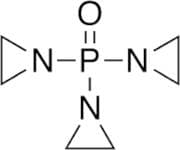
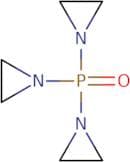
CAS 545-55-1
:Triéthylènephosphoramide
- 1,1',1''-Phosphinylidynetrisaziridine
- 1,1',1''-Phosphoryltriaziridine
- 1,1′,1′′-Phosphinylidynetris[aziridine]
- A 6366
- APO
- Ai3-24915
- Aphoxide
- Aziridine, 1,1',1"-phosphinylidynetris-
- Aziridine, 1,1′,1′′-phosphinylidynetris-
- Brn 0145971
- Cbc 906288
- Ent 24915
- Hexamethylphosphoric triamide tris(1-aziridinyl)phosphine oxide
- Hsdb 1011
- Imperon fixer T
- N,N',N -triethylenephosphoramide
- N,N',N''-Tri-1,2-ethanediylphosphoric triamide
- N,N',N''-Triethylenephosphoric triamide
- Nsc 9717
- Phosphine oxide, tris(1-aziridinyl)-
- Phosphoramide, N,N',N -triethylene-
- Phosphoric acid triethylene imide
- Phosphoric triamide, N,N',N -triethylene-
- Phosphoric triamide, N,N',N''-tri-1,2-ethanediyl-
- Sk-3818
- TEF
- TEPA (pesticide)
- Tapo
- Tepa
- Tri-1-aziridinylphosphine oxide
- Triaethylenphosphorsaeureamid
- Triaethylenphosphorsaeureamid [German]
- Triaziridinophosphine oxide
- Triaziridinylphosphine oxide
- Triethylene phophoramide
- Triethylene phosphoramide
- Triethylenephosphoramide
- Triethylenephosphoric triamide
- Triethylenephosphorotriamide
- Triethylenepyrophosphoramide
- Triethylenfosforamid
- Triethylenfosforamid [Czech]
- Tris(1-aziridine)phosphine oxide
- Tris(1-aziridinyl)phosphine oxide
- Tris(1-aziridinyl)phosphine oxide, solution
- Tris(1-aziridinyl)phosphine oxide, solution [UN2501] [Poison]
- Tris(N-ethylene)phosphorotriamidate
- Tris(aziridinyl)phosphine oxide
- Tris-(1-aziridinyl)-phosphineoxide
- Tris-(1-aziridinyl)fosfinoxid
- Tris-(1-aziridinyl)fosfinoxid [Czech]
- Un2501
- Tri(aziridin-1-yl)phosphine oxide
- Voir plus de synonymes
Triethylenephosphoramide
CAS :Stability Hygroscopic, Moisture Sensitive
Applications Used as insect chemosterilant; in dyeing. Antineoplastic.
Not a dangerous good if item is equal to or less than 1g/ml and there is less than 100g/ml in the package
References Gaines, et al.: Toxicol. Appl. Pharmacol., 14, 515 (1969), Huitema, A., et al.: Br. J. Clin. Pharmacol., 51, 61 (2001), Jinno, H., et al.: Drug Metab. Dispos., 31, 398 (2003),Formule :C6H12N3OPCouleur et forme :Yellowish Solid With A Low Melting PointMasse moléculaire :173.15Triethylenephosphoramide
CAS :Triethylenephosphoramide (TEP) is a model system for studying the reaction mechanism of the enzyme phosphotriesterase. TEP has been used in reactions with water vapor, which causes the release of hydrogen chloride. The reaction solution is analyzed by mass spectrometry to determine the reaction products. TEP has also been shown to inhibit nitrite ion-dependent enzymes such as nitrate reductase and aminopeptidase N. TEP reacts with fluorescence probes that have been modified with response elements to detect the binding of these probes to DNA and RNA. This helps researchers identify the location of TEP in proteins and nucleic acids.
Formule :C6H12N3OPDegré de pureté :Min. 95%Couleur et forme :PowderMasse moléculaire :173.15 g/mol