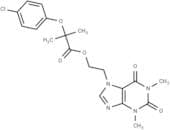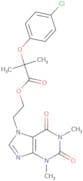
CAS 54504-70-0
:Théofibrate
- 1-(7-Theophyllinyl)-2-ethyl (2-(p-chlorophenoxy)isobutyrate)
- 1-(Theophyllin-7-yl)-aethyl-2 2-(p-chlorphenoxy)-2-methylpropionat
- 1-(Theophyllin-7-yl)-aethyl-2 2-(p-chlorphenoxy)-2-methylpropionat [German]
- 1-(Theophyllin-7-yl)-ethyl-2 2-(p-chlorophenoxy)-2-methylpropionate
- 2-(1,3-Dimethyl-2,6-dioxo-2,3,6,7-tetrahydro-1H-purin-7-yl)ethyl 2-(4-chlorophenoxy)-2-methylpropanoate
- 2-(1,3-dimethyl-2,6-dioxo-1,2,3,6-tetrahydro-7H-purin-7-yl)ethyl 2-(4-chlorophenoxy)-2-methylpropanoate
- 2-(p-Chlorophenoxy)-2-methylpropionic acid, ester with 7-(2-hydroxyethyl)theophylline
- Brn 1233286
- Clofibrate d'etofylline
- Clofibrate d'etofylline [INN-French]
- Clofibrato de etofilina
- Clofibrato de etofilina [INN-Spanish]
- Duolip
- Ethophylline clofibrate
- Etofyllinclofibrat
- Etofyllinclofibrat [German]
- Etofyllinclofibrate
- Etofyllini clofibras
- Etofyllini clofibras [INN-Latin]
- Etophylline clofibrate
- Ml 1024
- Nsc 234348
- Propanoic acid, 2-(4-chlorophenoxy)-2-methyl-, 2-(1,2,3,6-tetrahydro-1,3-dimethyl-2,6-dioxo-7H-purin-7-yl)ethyl ester
- Propionic acid, 2-(4-chlorophenoxy)-2-methyl-, 2-(1,2,3,6-tetrahydro-1,3-dimethyl-2,6-dioxo-7H-purin-7-yl) ethyl ester
- Theofibrate
- Theofibrate [USAN]
- Voir plus de synonymes
Etofylline clofibrate
CAS :Etofylline clofibrate has a hypolipidemic and antithrombotic effect and it also has an agonistic interaction with intimal PGI2.Formule :C19H21ClN4O5Couleur et forme :SolidMasse moléculaire :420.85Etofylline clofibrate
CAS :Produit contrôléEtofylline is a metabolite of clofibrate that has been used in the treatment of symptoms related to hyperlipidemia. It is an analog of etyfylline, which is a bronchodilator and anti-inflammatory drug. Etofylline inhibits the activity of hepatic lipase, an enzyme that causes the breakdown of triglycerides into free fatty acids and glycerol. This inhibition may be responsible for the reduction in serum cholesterol levels. The effects of etofylline on human serum have been tested using a double-blind cross-over study with healthy volunteers. Results showed that it inhibited the activity of dpp-iv, an enzyme that degrades proteins involved in blood clotting and coagulation. Etofylline also inhibits the activity of other enzymes such as phosphodiesterase, which increases cAMP levels, and acetylcholinesterase, which breaks down acetylcholine.
Formule :C19H21ClN4O5Degré de pureté :Min. 95%Masse moléculaire :420.85 g/mol