CAS 54522-52-0
:Méthylprotodioscine
Description :
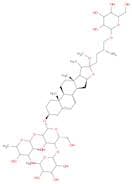
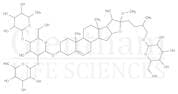
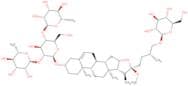
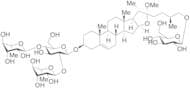
Méthylprotodioscine est une saponine stéroïdienne qui se produit naturellement, principalement trouvée dans diverses espèces de plantes, en particulier dans le genre Dioscorea. Elle se caractérise par sa structure moléculaire complexe, qui comprend un squelette stéroïdien et des moieties de sucre, contribuant à son activité biologique. Ce composé est connu pour ses propriétés pharmacologiques potentielles, y compris des effets anti-inflammatoires, immunomodulateurs et anticancéreux. Méthylprotodioscine a suscité de l'intérêt dans la médecine traditionnelle et la pharmacologie moderne en raison de sa capacité à influencer diverses voies biologiques. Sa solubilité et sa stabilité peuvent varier en fonction du solvant et des conditions environnementales, ce qui peut affecter sa biodisponibilité et son efficacité. Comme de nombreuses saponines, elle peut présenter des propriétés actives de surface, influençant les interactions de la membrane cellulaire. La recherche sur Méthylprotodioscine continue d'explorer son potentiel thérapeutique et ses mécanismes d'action, en faisant un sujet d'intérêt tant en chimie des produits naturels qu'en développement de médicaments. Cependant, d'autres études sont nécessaires pour élucider complètement sa pharmacocinétique et son profil de sécurité.
Formule :C52H86O22
InChI :InChI=1S/C52H86O22/c1-21(20-66-46-40(61)39(60)36(57)31(18-53)70-46)10-15-52(65-7)22(2)33-30(74-52)17-29-27-9-8-25-16-26(11-13-50(25,5)28(27)12-14-51(29,33)6)69-49-45(73-48-42(63)38(59)35(56)24(4)68-48)43(64)44(32(19-54)71-49)72-47-41(62)37(58)34(55)23(3)67-47/h8,21-24,26-49,53-64H,9-20H2,1-7H3/t21-,22+,23+,24+,26+,27-,28+,29+,30+,31-,32-,33+,34+,35+,36-,37-,38-,39+,40-,41-,42-,43+,44-,45-,46-,47+,48+,49-,50+,51+,52-/m1/s1
Code InChI :InChIKey=HSSJYSJXBOCKQM-GVTGEURHSA-N
SMILES :C[C@@]12[C@]([C@]3([C@](CC1)([C@]4(C)C(=CC3)C[C@@H](O[C@H]5[C@H](O[C@H]6[C@H](O)[C@H](O)[C@@H](O)[C@H](C)O6)[C@@H](O)[C@H](O[C@H]7[C@H](O)[C@H](O)[C@@H](O)[C@H](C)O7)[C@@H](CO)O5)CC4)[H])[H])(C[C@]8([C@@]2([C@H](C)[C@](CC[C@H](CO[C@@H]9O[C@H](CO)[C@@H](O)[C@H](O)[C@H]9O)C)(OC)O8)[H])[H])[H]
Synonymes :- (3beta,22R,25R)-26-(beta-D-glucopyranosyloxy)-22-methoxyfurost-5-en-3-yl 6-deoxy-alpha-L-mannopyranosyl-(1->2)-[6-deoxy-alpha-L-mannopyranosyl-(1->4)]-(2xi)-beta-D-arabino-hexopyranoside
- (3β,22α,25R)-26-(β-<span class="text-smallcaps">D</smallcap>-Glucopyranosyloxy)-22-methoxyfurost-5-en-3-yl O-6-deoxy-α-<smallcap>L</smallcap>-mannopyranosyl-(1→2)-O-[6-deoxy-α-<smallcap>L</smallcap>-mannopyranosyl-(1→4)]-β-<smallcap>D</span>-glucopyranoside
- 22-Methoxylprotodioscin
- 22-O-Methylprotodioscin
- 3b,26-Dihydroxy-22a-methoxyfurost-5-ene 3-O-beta-chacotrioside 26-O-beta-D-glucopyranoside
- 3β,26-Dihydroxy-22α-methoxyfurost-5-ene 3-O-β-chacotrioside 26-O-β-<span class="text-smallcaps">D</span>-glucopyranoside
- NSC 698790
- Smilax saponin B
- β-<span class="text-smallcaps">D</smallcap>-Glucopyranoside, (3β,22α,25R)-26-(β-<smallcap>D</smallcap>-glucopyranosyloxy)-22-methoxyfurost-5-en-3-yl O-6-deoxy-α-<smallcap>L</smallcap>-mannopyranosyl-(1→2)-O-[6-deoxy-α-<smallcap>L</span>-mannopyranosyl-(1→4)]-
- (3β,22α,25R)-26-(β-D-Glucopyranosyloxy)-22-methoxyfurost-5-en-3-yl O-6-deoxy-α-L-mannopyranosyl-(1→2)-O-[6-deoxy-α-L-mannopyranosyl-(1→4)]-β-D-glucopyranoside
- 3β,26-Dihydroxy-22α-methoxyfurost-5-ene 3-O-β-chacotrioside 26-O-β-D-glucopyranoside
- β-D-Glucopyranoside, (3β,22α,25R)-26-(β-D-glucopyranosyloxy)-22-methoxyfurost-5-en-3-yl O-6-deoxy-α-L-mannopyranosyl-(1→2)-O-[6-deoxy-α-L-mannopyranosyl-(1→4)]-
- Voir plus de synonymes
Trier par
Degré de pureté (%)
0
100
|
0
|
50
|
90
|
95
|
100
6 produits concernés.
Methyl protodioscin
CAS :Formule :C52H86O22Degré de pureté :95%Couleur et forme :SolidMasse moléculaire :1063.2260Methyl protodioscin
CAS :Methyl protodioscin boosts HDL, lowers LDL and triglycerides, has anti-cancer effects, and promotes apoptosis via mitochondrial pathways.Formule :C52H86O22Degré de pureté :99.308% - 99.73%Couleur et forme :SolidMasse moléculaire :1063.23Methyl protodioscin
CAS :Methyl protodioscin is a natural compound that has been shown to have a promising therapeutic effect on autoimmune diseases. Methyl protodioscin is derived from soybean extract and it is known to inhibit the translocation of bacteria across the gut wall, which could be due to its ability to regulate mucin gene expression. In vitro assays show that methyl protodioscin has an effect on mitochondrial membrane potential, which may be related to its anti-inflammatory properties. The effects of methyl protodioscin on mitochondrial functions were studied in C. glabrata, and it was shown that this compound can be used as a therapeutic agent for balloon injury. Methyl protodioscin also inhibits the growth of Candida albicans and other fungi in vivo, suggesting that this compound might have antifungal activity.Formule :C52H86O22Degré de pureté :Min. 95%Masse moléculaire :1,063.23 g/molMethylprotodioscin
CAS :Produit contrôléStability Hygroscopic
Applications Methylprotodioscin is a steroidal saponin compound found in a number of plant species. It is known to be the active component of the herbal aphrodisiac plant Tribulus terrestris. It has also shown to produce significant increases in the levels of the hormonal levels in animal studies.
References Gauthaman, K., et al.: Inter. J. Phytother. Phytopharm., 15, 44 (2008); Ganzera, M., et al.: J. Pharmac. Sci., 90(11), 1752 (2001);Formule :C52H86O22Couleur et forme :NeatMasse moléculaire :1063.23