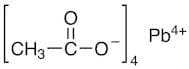
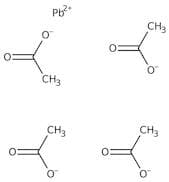
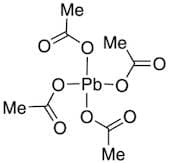
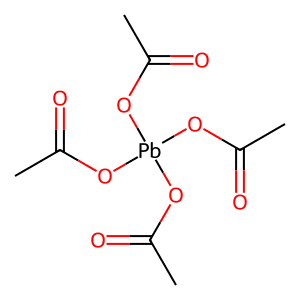
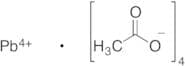
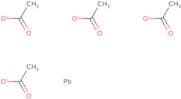
CAS 546-67-8
:Acétate de plomb (IV)
Description :
Acétate de plomb (IV), également connu sous le nom d'acétate de plomb, est un composé chimique avec la formule Pb(C2H3O2)4. Il se caractérise par son état d'oxydation du plomb(IV), qui est moins courant que les composés de plomb(II). Cette substance apparaît généralement sous la forme d'un solide cristallin blanc et est soluble dans l'eau et les solvants organiques. Acétate de plomb (IV) est connu pour son utilisation en synthèse organique, notamment en tant que réactif dans la préparation de divers composés organiques. Il présente des propriétés typiques des composés de plomb, y compris la toxicité, et pose des risques pour la santé en cas d'exposition, nécessitant une manipulation prudente et des mesures de sécurité appropriées. Le composé peut se décomposer lors du chauffage, libérant de l'acide acétique et des oxydes de plomb. En raison de ses dangers potentiels pour l'environnement et la santé, l'utilisation de Acétate de plomb (IV) est réglementée dans de nombreuses juridictions, et des alternatives sont souvent recherchées dans les applications industrielles. Comme pour toutes les substances contenant du plomb, il est crucial de gérer son utilisation de manière responsable pour minimiser l'exposition et l'impact environnemental.
Formule :C8H12O8Pb
InChI :InChI=1/4C2H4O2.Pb/c4*1-2(3)4;/h4*1H3,(H,3,4);/q;;;;+2/p-4
Code InChI :InChIKey=PNZVFASWDSMJER-UHFFFAOYSA-N
SMILES :C(C)(O)=O.[Pb]
Synonymes :- Acetate, Lead (Iv)
- Acetate, Lead(2+) Salt (4:1)
- Acetic acid, lead(4+) salt
- Acetic acid, lead(4+) salt (4:1)
- Bleitetraacetat
- LTA
- Lead (II) acetate
- Lead Tetracetate
- Lead acetate (Pb(O2C2H3)4)
- Lead acetate (Pb(O<sub>2</sub>C<sub>2</sub>H<sub>3</sub>)<sub>4</sub>)
- Lead acetate [Pb(OAc)4]
- Lead acetate [Pb(OAc)<sub>4</sub>]
- Lead tetraacetate
- Lead(4+) acetate
- Lead(IV) acetate (5-10% acetic acid)
- Lead(IV) tetraacetate
- Leadacetateaceticacidwhitetolightbrownxtl
- Plumbic acetate
- Tetraacetate de plomb
- Tetraacetato De Plomo
- Lead(IV)acetate
- leadacetate(pb(o2c2h3)4)
- LEAD ACETATE
- 4
- Tetrakis(acetyloxy)plumbane
- leadtetracetate
- Aceticacid,lead(4+)salt
- PB(ACAC)4
- plumbicacetate
- LEAD(IV) ACETATE GM
- tetra-leadacetat
- Pb(acac)
- leadacetate(pb(oac)4)
- Voir plus de synonymes
Trier par
Degré de pureté (%)
0
100
|
0
|
50
|
90
|
95
|
100
8 produits trouvés.
Lead Tetraacetate (contains Acetic Acid)
CAS :Formule :C8H12O8PbDegré de pureté :>96.0%(T)Couleur et forme :White to Almost white powder to crystalMasse moléculaire :443.38Lead(IV) acetate, 96% (dry wt.), stab. with 5-10% glacial acetic acid
CAS :Lead(IV) acetate, 96% (dry wt.), stab. with 5-10% glacial acetic acid, Alfa AesarFormule :C8H12O8PbDegré de pureté :96%Couleur et forme :Moist crystals or powder or crystalline powder, White to pale cream or pale greyMasse moléculaire :443.40Lead(IV) acetate, 95%
CAS :Lead(IV) acetate, 95%
Formule :Pb(OOCCH3)4Degré de pureté :95%Couleur et forme :white to light brown xtl.Masse moléculaire :443.37Lead(IV) tetraacetate
CAS :Lead(IV) tetraacetateFormule :C8H12O8PbDegré de pureté :96%Couleur et forme : very dark gray to black crystalline powderMasse moléculaire :443.37607g/molPlumbic acetate
CAS :Plumbic acetate releases acetate ions, acts as an oxidizer for sulfur (VI) synthesis, and reacts with thiodithiazyl dichloride.Formule :C2H4O2PbCouleur et forme :SolidMasse moléculaire :267.3Lead(IV) Acetate, Stabilized
CAS :Produit contrôléStability Hygroscopic, Moisture Sensitive
Applications Lead(IV) acetate is most commonly used in synthetic chemistry as an oxidizing agent, and is a versatile precursor for lead-containing compounds. Lead(IV) acetate is a toxic substance to humans, and is also known to induce oxidative damage and hyperlipidemia in rats.
Not a dangerous good if item is equal to or less than 1g/ml and there is less than 100g/ml in the package
References Newairy, A., et al.: Food Chem. Toxicol., 47, 813 (2009); Rahman, S. & Sultana, S.: Chem.-Biol. Int., 160, 61 (2006); Yadav, R.: Synlett, 2012, 1262 (2012)Formule :C8H12O8PbCouleur et forme :NeatMasse moléculaire :443.38Lead(IV) acetate - Stabilized with acetic acid (5-10%)
CAS :Lead acetate is an alkanoic acid that can be used as a lead salt. It has been shown to react with protocatechuic acid in the presence of hydrogen to form lead(IV) protocatechuate and acetic acid. This reaction mechanism can be applied to the analysis of other organic acids, such as fatty acids. Lead acetate also inhibits protease activity in vitro and has been shown to have therapeutic effects against autoimmune diseases and polycystic ovarian syndrome. Lead acetate has a low toxicity and is stable when mixed with trifluoroacetic acid or nitro compounds, but very reactive with strong oxidizing agents such as hydrochloric acid or hydrogen fluoride. Lead acetate is non-hygroscopic and insoluble in water, making it suitable for use in analytical chemistry.Formule :C8H12O8PbDegré de pureté :Min. 95%Couleur et forme :White PowderMasse moléculaire :443.38 g/molLead tetraacetate; 5-10% of acetic acid
CAS :Formule :C8H12O8PbDegré de pureté :98%Couleur et forme :SolidMasse moléculaire :443.3761