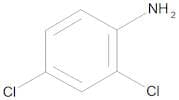
CAS 554-00-7
:2,4-Dichloroaniline
- 1-Amino-2,4-dichlorobenzene
- 2,4-Dichloranilin
- 2,4-Dichloro aniline
- 2,4-Dichlorobenzenamine
- 2,4-Dichlorophenylamine
- 2,4-Dicloroanilina
- 4-Chloro-2-chloroaniline
- Aniline, 2,4-Dichloro-
- Benzenamine, 2,4-dichloro-
- Nsc 8756
- o,p-Dichloroaniline
- Voir plus de synonymes
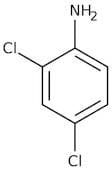
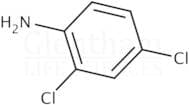
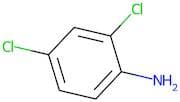
2,4-Dichloroaniline
CAS :Formule :C6H5Cl2NDegré de pureté :>99.0%(GC)Couleur et forme :White to Almost white powder to crystalMasse moléculaire :162.012,4-Dichloroaniline, 99%
CAS :This Thermo Scientific Chemicals brand product was originally part of the Alfa Aesar product portfolio. Some documentation and label information may refer to the legacy brand. The original Alfa Aesar product / item code or SKU reference has not changed as a part of the brand transition to Thermo SciFormule :C6H5Cl2NDegré de pureté :99%Couleur et forme :White to cream to grey or pale brown to brown, Powder or crystalline powder or crystals or flakes and/or chunksMasse moléculaire :162.012,4-Dichloroaniline
CAS :Formule :C6H5Cl2NDegré de pureté :(GC) ≥ 99.0%Couleur et forme :White to off-white crystalline powderMasse moléculaire :162.022,4-Dichloroaniline
CAS :2,4-DichloroanilineFormule :C6H5Cl2NDegré de pureté :99%Couleur et forme : white powder (material may darken on storage)Masse moléculaire :162.02g/mol2,4-Dichloroaniline
CAS :Formule :C6H5Cl2NDegré de pureté :98.0%Couleur et forme :SolidMasse moléculaire :162.012,4-Dichloroaniline
CAS :Produit contrôléFormule :C6H5Cl2NCouleur et forme :NeatMasse moléculaire :162.022,4-Dichloroaniline
CAS :2,4-Dichloroaniline is an organic compound that is used in analytical chemistry for the preparation of samples. 2,4-Dichloroaniline reacts with p-hydroxybenzoic acid to form a diazonium salt. This reaction takes place at room temperature and produces a deep violet color. The detection sensitivity of this reaction is 0.1 µg/mL. The glucuronide conjugate of 2,4-dichloroaniline has been detected in human urine samples and can be used as a marker for exposure to this chemical. 2,4-Dichloroaniline also inhibits protein synthesis by binding to amines or by affecting the availability of the amino acids required for protein synthesis. The hydrochloric acid present in stomachs converts 2,4-dichloroaniline into phenylglyoxylic acid, which is then excreted in the urine as its glucuronide conjugate
Formule :C6H5Cl2NDegré de pureté :Min. 95%Couleur et forme :White To Beige To Grey To Red To Brown SolidMasse moléculaire :162.02 g/mol2,4-Dichloroaniline 100 µg/mL in Methanol
CAS :Produit contrôléFormule :C6H5Cl2NCouleur et forme :Single SolutionMasse moléculaire :162.02