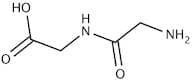
CAS 556-50-3
:Glycylglycine
Description :
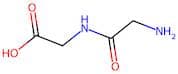
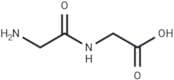
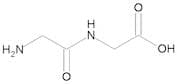
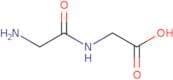
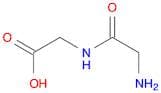
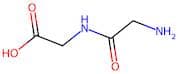
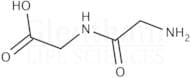
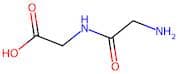
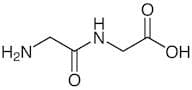
Glycylglycine, également connu sous le nom de diglycine, est un dipeptide composé de deux acides aminés glycine liés par une liaison peptidique. Sa formule chimique est C4H8N2O3 et il a un poids moléculaire d'environ 132,12 g/mol. Glycylglycine est un solide cristallin blanc soluble dans l'eau, ce qui le rend utile dans diverses applications biochimiques. Il présente des propriétés typiques des acides aminés, telles que la capacité de former des zwitterions, ce qui signifie qu'il peut porter à la fois une charge positive et une charge négative selon le pH de la solution. Glycylglycine est souvent utilisé dans la synthèse peptidique, comme agent tampon dans les tests biochimiques et dans les études liées à la structure et à la fonction des protéines. De plus, il a des applications potentielles en pharmacie et en nutrition, en particulier dans les formulations visant à améliorer l'absorption des acides aminés. Sa structure relativement simple permet une incorporation facile dans des peptides et des protéines plus grandes, ce qui en fait un composé précieux tant dans les contextes de recherche qu'industriels.
Formule :C4H8N2O3
InChI :InChI=1/C4H8N2O3/c5-1-3(7)6-2-4(8)9/h1-2,5H2,(H,6,7)(H,8,9)
Code InChI :InChIKey=YMAWOPBAYDPSLA-UHFFFAOYSA-N
SMILES :C(NCC(O)=O)(CN)=O
Synonymes :- 13: PN: WO2017167712 SEQID: 23 claimed protein
- 16: PN: WO2021041934 SEQID: 69 claimed protein
- 2-(2-Aminoacetamido)acetic acid
- 2-(Aminoacetamido)acetic acid
- 2-[(2-Aminoacetyl)amino]acetic acid
- 29: PN: US20200095309 SEQID: 56 claimed protein
- 31: PN: FR2860236 PAGE: 10 claimed protein
- 38: PN: WO2020048525 SEQID: 46 claimed protein
- 4: PN: WO2018201047 SEQID: 102 claimed protein
- 89: PN: WO2019035010 SEQID: 89 claimed protein
- Diglycine
- Diglycocoll
- G 0124
- Gly-Gly
- Gly-Gly Free Base
- Gly2
- Gly<sub>2</sub>
- Glycine dipeptide
- Glycine, Glycyl
- Glycine, N-glycyl-
- Glycine-glycine
- Glycyl-glycine,(Diglycine)
- Glycylglycine, Free Base
- H-Gly-Gly-OH
- N-Glycyl-Glycine
- N-Glycylglycin
- N-Glycylglycine
- N-glicilglicina
- Nsc 49346
- α-Glycylglycine
- Glycylglycine
- Glycyl-glycin
- GLY-GLY-OH
- (2-Amino-acetylamino)-aceticacid
- Glycinedipeptide
- 2-(Aminoacetamido)aceticacid
- Glycylglycin
- n-glycyl-glycin
- Voir plus de synonymes
Trier par
Degré de pureté (%)
0
100
|
0
|
50
|
90
|
95
|
100
Glycylglycine, ≥98.5%
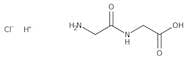
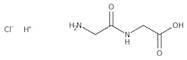
CAS :Thermo Scientific GlycylglycineFormule :C4H9ClN2O3Degré de pureté :98.5%Couleur et forme :White crystalline powderMasse moléculaire :168.58Glycylglycine, 99%
CAS :Glycylglycine is as a buffering reagent and also used in biochemical research. It is the simplest of all dipeptides and is used as a starting template for preparation of more complex peptides. It is also employed as a practical buffer with a buffering range of 7.5 - 8.9 (at 25C). Valuable agent foFormule :C4H9ClN2O3Degré de pureté :99%Couleur et forme :White, Crystals or powder or crystalline powderMasse moléculaire :168.58H-Gly-Gly-OH
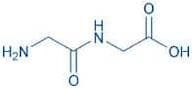
CAS :Standard acceptor in γ-glutamyltransferase assays, e.g. with H-Glu(pNA)-OH (GPNA) or H-Glu(AMC)-OH.Formule :C4H8N2O3Degré de pureté :99.82%Couleur et forme :WhiteMasse moléculaire :132.12Diglycine (glycylglycine)
CAS :Acyclic amides (including acyclic carbamates) and their derivatives and salts thereof, nesoiFormule :C4H8N2O3Couleur et forme :White PowderMasse moléculaire :132.053492-(Aminoacetamido)acetic acid
CAS :Formule :C4H8N2O3Degré de pureté :97%Couleur et forme :SolidMasse moléculaire :132.1179Ref: IN-DA0038NG
5g20,00€10g20,00€25g25,00€5kgÀ demander100g40,00€10kgÀ demander25kgÀ demander500g115,00€Gly-Gly
CAS :Formule :C4H8N2O3Degré de pureté :98.5 - 101.5 %Couleur et forme :White crystalline powderMasse moléculaire :132.12Glycylglycine
CAS :Formule :C4H8N2O3Degré de pureté :>99.0%(T)Couleur et forme :White powder to crystalMasse moléculaire :132.12Glycylglycine
CAS :GlycylglycineFormule :C4H8N2O3Couleur et forme : white powderMasse moléculaire :132.12g/molGlycylglycine
CAS :Glycylglycine (Diglycine) is a dipeptide used in biochemical research. It is the simplest and is used as a starting template for more complex peptides.Formule :C4H8N2O3Degré de pureté :≥95%Couleur et forme :SolidMasse moléculaire :132.12N-Glycylglycine
CAS :Produit contrôléApplications N-Glycylglycine is a derivative of Glycine (G615990), a non-essential amino acid that enhances N-methyl-D-aspartate (NMDA) receptor mediated synaptic potentials in the neocortex of rats. Glycine is also being used as adjuvant therapy for the treatment of schizophrenia.
References Logan, W. & Snyder, S.: Brain Res., 42, 413 (1972); Rosse, R., et al.: Clin. Neuropharmacol., 12, 416 (1989)Formule :C4H8N2O3Couleur et forme :NeatMasse moléculaire :132.12Glycyl-glycine
CAS :Glycyl-glycine is a versatile building block that can be used as a reaction component in the production of a wide range of compounds. It is also an intermediate in the manufacture of pharmaceuticals, speciality chemicals and research chemicals. Glycyl-glycine is a high quality reagent and can be used as a raw material for the synthesis of other compounds.Formule :C4H8N2O3Masse moléculaire :132.12 g/molRef: 3D-G-6001
1kgÀ demander5kgÀ demander10kgÀ demander25kgÀ demander2500gÀ demander-Unit-kgkgÀ demanderGlycylgycine
CAS :Formule :C4H8N2O3Degré de pureté :97%Couleur et forme :Solid, White powderMasse moléculaire :132.119Glycyl Glycine extrapure, 99%
CAS :Formule :C4H8N2O3Degré de pureté :min. 99%Couleur et forme :White, Crystalline powderMasse moléculaire :132.12N-Glycylglycine-13C4
CAS :Produit contrôléFormule :C4H7NO4Couleur et forme :NeatMasse moléculaire :137.073Gly-Gly
CAS :Gly-Gly is a natural compound that belongs to the group of esters. It has been shown to have an antioxidative effect in vitro and in vivo. Gly-Gly has been shown to inhibit the growth of carcinoma cells by binding with hydrogen bonding interactions, which leads to cell death. This compound also has a strong antibacterial efficacy against Gram-positive bacteria, such as methicillin-resistant Staphylococcus aureus (MRSA). In addition, gly-gly has been shown to be effective against Mycobacterium tuberculosis and Mycobacterium avium complex. This compound may be useful for treating infectious diseases caused by Gram-positive bacteria such as MRSA or methicillin resistant Staphylococcus aureus (MRSA).Formule :C4H8N2O3Degré de pureté :Min. 95%Masse moléculaire :132.12 g/mol







![2-[(2-Aminoacetyl)amino]acetic Acid (Diglycine; N-Glycylglycine)](/_next/image/?url=https%3A%2Fstatic.cymitquimica.com%2Fproducts%2F86%2Fthumb%2FMM1509.02-0100.jpg&w=3840&q=75)