CAS 55720-22-4
:Acide 5-acénaphtènecarboxylique
Description :
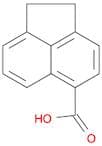
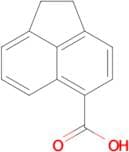
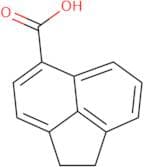
Acide 5-acénaphtènecarboxylique est un composé organique caractérisé par sa structure bicyclique, qui comprend un groupe acénaphtène. Ce composé présente un groupe fonctionnel acide carboxylique (-COOH) attaché à la position 5 du système d'anneaux acénaphtène. Il est généralement solide à température ambiante et peut présenter une solubilité modérée dans les solvants organiques, tout en étant moins soluble dans l'eau en raison de sa structure aromatique hydrophobe. La présence du groupe acide carboxylique lui confère des propriétés acides, lui permettant de participer à diverses réactions chimiques, telles que l'estérification et l'amidation. De plus, Acide 5-acénaphtènecarboxylique peut servir de bloc de construction dans la synthèse organique et peut avoir des applications en science des matériaux et en pharmacie. Sa structure unique et son groupe fonctionnel en font un sujet d'intérêt dans la recherche liée à la chimie organique et au développement de matériaux. Les données de sécurité doivent être consultées pour la manipulation et le stockage, comme pour toute substance chimique.
Formule :C13H10O2
InChI :InChI=1/C13H10O2/c14-13(15)11-7-6-9-5-4-8-2-1-3-10(11)12(8)9/h1-3,6-7H,4-5H2,(H,14,15)
SMILES :c1cc2CCc3ccc(c(c1)c23)C(=O)O
Synonymes :- 5-Acenaphthylenecarboxylic acid, 1,2-dihydro-
- Nsc 137409
- 1,2-Dihydroacenaphthylene-5-Carboxylic Acid
Trier par
Degré de pureté (%)
0
100
|
0
|
50
|
90
|
95
|
100
3 produits concernés.
1,2-Dihydroacenaphthylene-5-carboxylic acid
CAS :Formule :C13H10O2Degré de pureté :97%Couleur et forme :SolidMasse moléculaire :198.21731,2-Dihydroacenaphthylene-5-carboxylic acid
CAS :Degré de pureté :95.0%Masse moléculaire :198.22099304199225-Acenaphthenecarboxylic acid
CAS :5-Acenaphthenecarboxylic acid is a xylene derivative that has been characterized as an organometallic compound. The cyclopentane ring is the central feature of this molecule and it can be used in the synthesis of other organic compounds. 5-Acenaphthenecarboxylic acid is toxic to humans and animals and has been shown to induce liver tumors in rats. It also has been shown to inhibit the growth of some bacteria, including Mycobacterium tuberculosis, which causes tuberculosis. 5-Acenaphthenecarboxylic acid inhibits protein synthesis by binding to ribosomes and interfering with the biosynthesis of proteins. This binding prevents formation of a complex with the enzyme cell wall synthesis that is required for cell wall biosynthesis, inhibiting protein synthesis and cell division.Formule :C13H10O2Degré de pureté :Min. 95%Couleur et forme :PowderMasse moléculaire :198.22 g/mol